151 Ask Us Anything
About this episode
Bird questions can get wonderfully out of hand. For the season four finale, Sean Dooley and Jonah Lafferty answer listener questions about ravens, dinosaurs, car park birds, migration, field guides and what birds can tell us about a changing world.
Birds featured: Australian Pelican, Budgerigar, Bush Stone-curlew, Gang-gang Cockatoo, Little Raven, Noisy Pitta, Pacific Koel, Purple-crowned Lorikeet, Southern Cassowary, Zebra Finch
Episode illustration: Budgerigar
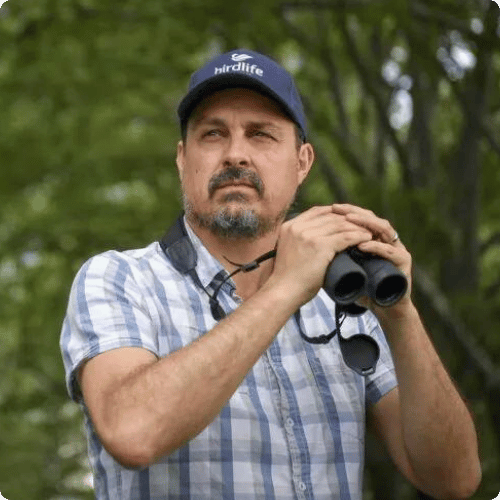
Sean Dooley is the National Public Affairs Manager for BirdLife Australia, author of The Big Twitch, and former holder of the Australian Big Year twitching record. For many years, Sean and his team have been working tirelessly to ensure that birds are protected and loved by Australians. That's why he is affectionately known as 'the Birdman' and we reckon he’s a national treasure.

Jonah Lafferty is a 27 year-old bird enthusiast and photographer living in Cairns, Queensland. Originally from Canberra, Jonah moved to Northern Australia after university for work, and has been loving the birds of the north ever since.
This episode also featured Andrew Skeoch and Tim Low.
Many thanks to Weekend Birder listeners for submitting your questions - Abby P, Brooke Y, Clare Presser, Dani K, Hugh Possingham, John T, Kelly W, Kirstie I, Lewie I, Lian W, Louis and Tom H.
-
Kirsty Costa [00:00:00]
I'm currently on Boon Wurrung Country in south-east Melbourne. How about you, Sean?Sean Dooley [00:00:05]
I am sharing the same Country with you. The fabulous Country it is too.Kirsty Costa [00:00:09]
Amazing. And how about you, Jonah?Jonah Lafferty [00:00:10]
I'm up a little bit further north than you guys on Gimuy Walubara Yidinji Country up in far north Queensland.Kirsty Costa [00:00:19]
We pay our respects to Elders past and present, and to any First Nations person from around the world listening to this podcast. Welcome to Weekend Birder. I'm Kirsty Costa, and in this podcast we notice birds together.And welcome to the final episode of season four. We started way back in episode 119, and now we've reached episode 151, and along that journey, we've chatted with an amazing group of humans - everyday bird lovers, scientists, conservationists, nature guides, artists, authors, comedians and much more.
In this special end to the season, Weekend Birder listeners have submitted their bird-related questions, and we've got two great guests who are going to answer as many as they can.
Jonah Lafferty is a bird enthusiast and photographer living in Cairns. Originally from Canberra, Jonah moved to northern Australia after university for work and has been loving the birds of the north ever since. You might know Jonah from episode 136, and maybe also from social media, as he's on a quest to see every kingfisher and owl in Australia. Hello, Jonah.
Jonah Lafferty [00:01:35]
Hi, good. Oh, it's lovely to be here. I've had the Weekend Birder theme song stuck in my head all day in anticipation of this. Oh dear.Kirsty Costa [00:01:44]
I'm so sorry about that. Also joining us is Sean Dooley. Sean is a former holder of the Australian big year twitching record. He's also an author of some fantastic books, and he's the National Public Affairs Manager for BirdLife Australia. You might know Sean from previous Weekend Birder episodes and pretty much anywhere where people are talking about birds. He's been a public voice for birdwatchers and bird conservation for many years, and we are so grateful for all the work that he does. Hello, Sean.Sean Dooley [00:02:12]
G'day, Kirsty. Thanks for having me on. It's good to be back.Kirsty Costa [00:02:18]
It is really nice to have you back on the show, my friend. Okay, we have some fantastic questions that have come in from Weekend Birder listeners. I can't wait to get into it with you.Our first question is from Lewie I.
Lewie I [00:02:30]
Hi, my name is Lewie. I've been listening to the Little Ravens in my backyard, and my question is, what's the difference between a crow and a raven in Australia?Kirsty Costa [00:02:43]
Thanks so much for your question, Lewie. Sean, I'm going to throw this one to you, because I know that you know a lot about ravens and crows. What is the answer to Lewie's question?Sean Dooley [00:02:49]
Very good question there, Lewie. And it's actually one I get asked a lot. Australians tend to call any large black bird that goes "ahh" as a crow, but we actually have five native species of corvids, crows and ravens. And they are really difficult to tell apart because they're so similar. Visually, it's very difficult to tell them apart. But the main difference between crows and ravens is physically, as if you were to catch one and blow on its feathers so that you could see the down at the base of the feathers. The ravens have a brown-coloured down, whereas the crows have a white-coloured down. But it's something you don't see very often in the wild, unless you're very close to them in the middle of a cyclone.Kirsty Costa [00:03:39]
But we wouldn't want to pick up a raven and blow on its feathers, would we, Sean?Sean Dooley [00:03:42]
Yes, and they're not particularly friendly birds.The corvids are a songbird family that has spread all around the world, and they are found on every continent. And they're one of those songbirds that we are - if people listened to your episode with Tim Low, he mentioned that Australia gave the world song. Songbirds evolved in Australia, and then island-hopped once we connected with the islands north of us about 25 million years ago, and then spread around the world to dominate the bird species list. Half the world's birds are in the passerine family.
The corvids are a family that really developed overseas and then came back to Australia. So overseas birds in the corvid family are the crows, the ravens, the jays, and also the Northern Hemisphere magpies, which are actually in no way related to our magpies, which are an endemic family of Australian or Australasian birds. They're also found in New Guinea, and some of the woodswallows in that magpie family are found to have made their way into some parts of Asia.
The Australian Magpie looks like a crow and is very intelligent, as are the corvids, even though they look like them and behave like them in certain ways. They're not. They're no more related to the corvids than, say, a robin is. Corvids are highly successful, incredibly intelligent birds. The crows and ravens, and the jays in particular, have such great memories and spatial awareness and puzzle-solving abilities that the scientists who research their cognitive abilities liken them to having the same intelligence as primates or something like, I think, a six-year-old child.
Kirsty Costa [00:05:38]
Wow, that's so interesting. And also, I didn't know that about woodswallows.Sean Dooley [00:05:40]
It was a real surprise when the DNA studies, genetic studies, showed how closely woodswallows were allied to the - well, they kind of called them the bell-magpie family for a while. So that's magpies, currawongs and butcherbirds, and you can see when you look at those three types of birds how they could be related. But it turns out these birds that kind of fly in the air and catch insects like swallows, or land in the blossoming eucalypt and drink nectar, are actually also in that family. It's nuts.Kirsty Costa [00:06:15]
Yeah, right. Well, that's such a good answer, Sean. Thank you so much. And thank you for your question, Lewie. I hope that you've learned a little bit more about the corvid family.Our next question is from Dani K.
Dani K [00:06:24]
Birds come from dinosaurs. Are you also interested in dinosaurs, and do you have a favourite?Kirsty Costa [00:07:32]
Great question, Dani. Thank you so much for sharing it. Over to you, Jonah. Do you think about dinosaurs? Are they your thing?Jonah Lafferty [00:07:40]
I love that question from Dani, because I think something that it really gets at is that as kids, all kids love dinosaurs. Obviously for some, that carries through to adulthood for a lot of people as well. But particularly, when I was a kid, I used to love those little archaeology blocks, like you get those blocks that you have to dig out a little dinosaur in. That was one of my absolute favourite things as a kid.And I think that as an adult, my love for birds is so akin to that childhood love that we all have for dinosaurs. I think that it translates so well as an adult into birdwatching, that kind of childhood love of something that's potentially a little bit, you know, something that you don't understand too well. It's so different. There are so many different species. There are so many parallels to loving birds into adulthood. And it is remarkable just how dinosaur-like some of our birds are. Like Dani said in that question, obviously emus. The other day, I had the luck of seeing a cassowary up here in far north Queensland, and it genuinely feels like you are seeing a dinosaur. It's the closest thing in Australia, I think, you can get to that feeling of what it would be like to be in Jurassic Park.
Kirsty Costa [00:09:00]
I agree, Jonah. When I see the feet of emus and cassowaries, I just feel like we are back in the Jurassic era. How about you, Sean? Do you think about dinosaurs much?Sean Dooley [00:09:09]
I guess I do. I'm the same, Jonah. Of course, I was fascinated with all wildlife and including dinosaurs when I was little. And then after I realised I wasn't ever going to see a lion or an elephant in suburban Melbourne, and after I got told off for digging up the gravel driveway looking for fossils for dinosaurs, I kind of ruled out the possibility of ever engaging with wildlife. But then a few years later, I got into birds, and then many years later, went to discover that birds are actually living embodiments of dinosaurs. It was like, wow, I was right all the way along. There were dinosaurs right in front of me, and I never knew.But the caller, the questioner, Dani, mentioned Winton has a favourite dinosaur. That's certainly my favourite dinosaur experience. The Lark Quarry out at Winton is one of the most brilliant displays I've ever seen. It has fossilised footprints of a dinosaur stampede, and the way that they've set the whole thing up is just incredible.
And what's even better is the spot where that quarry is. You walk out and there are also Rufous-crowned Emu-wrens and Opalton Grasswrens in the spinifex surrounding the area, as well as my nemesis bird, the Grey Falcon. I actually saw my first ever Grey Falcon the same day I saw my first dinosaur stampede. So yeah, that Winton species is pretty special to me too.
Jonah Lafferty [00:10:55]
You want to get birdwatchers excited? Just say Rufous-crowned Emu-wren, Opalton Grasswren and Grey Falcon in the same sentence.Kirsty Costa [00:11:01]
Yeah. Wow, Sean, that sounds like a day for the history books. All the good things happening at once.Thanks for a great question, Dani. And to answer your question about favourite dinosaurs, my new favourite dinosaur is the Archaeopteryx. This was a dinosaur that my nephews recently taught me about. It is known as the first bird and has a very famous fossil that pretty much proved that modern birds evolved from theropods.
If people haven't seen this dinosaur before, I'll put a link to the Australian Museum website so you can check it out. It's a really cool-looking dinosaur.
Okay, our next question is from Kelly, who wants to know when can you tell when you've graduated from a beginner birder to intermediate? Great question, Kelly. Jonah, what are your thoughts on this?
Jonah Lafferty [00:12:08]
Well, Sean's as advanced as they come. He must have hit his intermediate phase much, much further long ago than myself. For me, I think one thing that I found interesting that I didn't realise I was doing until maybe someone else pointed it out, was just being able to tell what a bird is by the way it flies. Or you might just get a dash of it, but just understanding what habitat you're in, the way that it moved. And so you may not even see the colours or get a good look at it, but just having that habitat, contextual understanding, you can have a pretty good guess at what it is. That's probably when I thought, oh dear, I'm starting to really fall down this bird rabbit hole.Sean Dooley [00:12:49]
To be honest, self-assessment is in the eye of the beholder. I know in the Aussie Bird Count, we ask people who are participating to mark whether they're advanced, intermediate or beginner. And then when we do the vetting, we naturally assume that people who've marked themselves as experts would be more reliable, and we wouldn't have to scrutinise as closely because they're going to know what they're seeing. That's not actually the case. A lot of the people who've marked advanced are the ones with the most fanciful sightings. So I think self-assessment has its flaws.It's funny, I often get introduced as an expert or even sometimes like, you know, Australia's leading bird expert, and it just makes me cringe because there are so many people who know so much more about birds than I do. And I still feel I'm learning all the time. Every day I learn something new. I still don't feel like I'm an expert, but I think I know quite a bit about a lot of things to do with birds, from not just identification, but to behaviours and distribution and conservation status and things. So I guess I have to say, yeah, it's not false modesty to say, yeah, I'm an expert.
But I reckon Jonah's spot on about getting to know that impression. I think you've crossed the threshold when you're birding without realising. When you're noticing without noticing. It's when suddenly you'll be working a while and someone will say, what's that bird calling? And you realise that you've already identified it as a Grey Butcherbird calling without even having it at the forefront of your mind.
I think when you learn a language, repetition makes you proficient at the language. You can do a weekly class or you can do Duolingo or something, but if you're not doing it all the time, it just drops out of your mind. But when you're immersed in that language, say if you go to the country where you've learned it, you'll find that moment where you realise that you're thinking in that language. And I think there is a point in birding where you're thinking in birding language.
Kirsty Costa [00:15:09]
Yeah, I'd agree with that. And I'd also add that when I organise Weekend Birder meetups and I ask people to tell me a little bit about their experience level, they always underrate themselves. And then when I meet them, I think, holy moly, you know heaps about birds. You're not a beginner at all. So I think that some of the birdwatchers out there are actually very modest about their expertise too.Sean Dooley [00:15:27]
Yeah. And I'd just add to that, Kirsty, that the best birders I know, the ones that I bow down to as experts, they are the people that are still curious and still questioning. They're the ones that when you're out with a bunch of gun birders, you will get the ones that just want to be the first to identify it, to prove, yeah, I got that first. And they sometimes scoff at people who know vastly more than them, because they'll actually say, oh, what's this? It could be this or it could be that. And it's because they're truth seekers. They actually really want to know. It's not about the ego of saying I'm the best.And that's always been, in my experience, the birders that I've admired the most are the ones that every time you're out there, they're totally open to being wrong and totally open to learning something new.
Kirsty Costa [00:16:18]
Yeah, I totally agree. And I want to thank all the experienced birdwatchers out there who take the time to explain and help everyone to learn. It's so appreciated.Okay. Our next question is from Hugh Possingham. Hugh is a long-time friend of the show, and he's been on multiple episodes, including one about Australia's robins and another about Oxley Common in Brisbane. Hugh has just become the president of BirdLife Australia and he has a very important question for us.
Hugh Possingham [00:16:52]
Hi, this is Hugh Possingham. My question is, how come whenever you go to somewhere to find a rare and interesting bird and get to the car park, then walk through the swamp for several hours, the bird is always in the car park when you get back?Kirsty Costa [00:17:10]
Never have truer words been spoken. Jonah. Thoughts on this?Jonah Lafferty [00:17:14]
Oh look, I don't have a silver bullet explanation, Kirsty, but I love car park birds. As a bird photographer, somebody who loves to photograph birds, car parks are 110% the best place. Because I find that the behaviour of the birds that hang out at the car park is so much more people-friendly. They're willing to tolerate me. That's the word I'm looking for. They're so much more tolerant of me and my camera, and they are so much more likely to hop in a good spot.And also, especially if you're in a rainforest or somewhere where it's quite hard to see birds, quite hard to get them landing in nice light, then a car park's the best place because they're used to people. They often land in places where there's a bit more light, perhaps due to the clearing. So that's nice for people who like taking photos.
I do just love this phenomenon. I was listening, Kirsty, to the episode that you recorded with Justine, and I think she saw Regent Honeyeaters in the Woolworths car park.
Kirsty Costa [00:18:18]
Yeah, she did. And shout out to Kylie S who saw, I think it was the Purple-crowned Lorikeet in the KFC car park in Torquay. So yeah, there's lots of good stories.Jonah Lafferty [00:18:28]
I actually saw Purple-crowned Lorikeets in a Woolworths car park the first time I saw them as well. So there you go. But yeah, it's a wonderful phenomenon. And it is nice to get to see birds that are quite rare in places - or whether they're rare.Another example is actually yesterday while I was camping, I had a cool experience at the campsite because, again, it's another one of those spots that's a bit open. The birds are perhaps a little bit more used to seeing people, and I saw a pair of Noisy Pittas jumping out in the campsite. Again, Noisy Pittas are a bird that, normally in dense, thick rainforest, are really hard to get a good look at. It was still hard to see and photograph them, of course, but to see Noisy Pittas jumping around the campsite was great.
So yeah, I think there's an extra bit of magic to seeing birds in places that we might consider more kind of quote unquote wild, but it's still just wonderful to see them where they're a bit more used to us as people as well.
Sean Dooley [00:19:27]
Yeah, undoubtedly. It's a well-known phenomenon, and I think somebody even wrote a pseudo-scientific paper about it. But my theory is that birds are morally judgy. Because why can't they be at the car park when you start the walk? But they need you to actually do the hard yards, and then they will deign to show themselves to you. But you have to actually put in the effort.Kirsty Costa [00:19:54]
Yeah, I love that as a birding philosophy that we should all hold on to. I also really like it because in my beginner birdwatcher life, I just imagined birds out there in nature, in the wild, in national parks. And obviously some of the best birding experiences I've had recently have been in my local area and have been in car parks. It's a reminder that birds are living alongside us, and you don't have to go out into the wild to see them. And more importantly, really important birds are living alongside us as well. The Purple-crowned Lorikeet in the KFC car park and the Regent Honeyeater in the Woolworths car park is a reminder that we've got to really look after our local spaces too.So I love that that's the thing. But I also laugh a lot. You can go into the bush and it could be so quiet, and you can come back to the car park and it is pumping. It's just the best. It's the best. I think lots of people will be laughing at this.
Sean Dooley [00:20:51]
Yeah. I love up your way, Jonah, and the last time I was in Cairns, in the car park at the Esplanade, Bush Stone-curlews actually occupy a space. They actually sit in a car parking space perfectly straight, like they've actually - I think they're accomplished parkers. I didn't see whether it reversed in or not, but it's pretty incredible.Jonah Lafferty [00:21:17]
That's such a good example of a built environment that's just world-class for birding. You've got car parks, parks, and then just incredible birds around there.Kirsty Costa [00:21:27]
I am loving this conversation so much. That was a great question, Hugh. Many thanks, and also many thanks for all the work that you do in bird conservation as well.Our next question is from Kirstie I, and I've actually reached out to Andrew Skeoch, who people will know from the last episode, our dawn chorus expert, to answer it.
Kirstie I [00:21:49]
Hi Kirsty, my name is also Kirstie and I'm from Geelong. I've been listening to the dawn chorus down here and I'm wondering, why do some birds sing at dawn but go quiet later in the day? We love your show here. Congrats on 150 episodes.Andrew Skeoch [00:22:04]
There's a lovely nuance to this question. Some birds, not all. Waterbirds, some ducks, moorhens, geese and so on are often quite vocal at night. And as these are older lineages of birds that evolved earlier, I speculate that birdsong originated in the dark. It's only later in evolutionary time that songbirds, primarily, plus pigeons, parrots and others, have become daytime communicators.So why do these groups sing so noticeably at dawn? Part of it seems to be that daybreak is often the coolest and least windy part of the day, and as sound travels farthest in cool conditions, it's a good time to communicate across distance.
But more significantly, birds have evolved to sing at dawn because they use communication to negotiate their essential relationships. These include attracting and bonding with a mate, acknowledging their neighbours and respective home ranges, particularly in the breeding season, affirming communities of belonging with others of their kind, and finding their place among other species within listening distance.
They achieve this with formal patterns of singing, behaviour and repertoire, all timed to utilise the optimal acoustic conditions of dawn. With sunrise, they may initially fall quite quiet, but as the day warms, they'll pick up with vocalisations which achieve other purposes, such as maintaining foraging flocks, warning of dangers, or just keeping in touch with each other as they go about their day. And if the wind rises by late morning and acoustic conditions deteriorate further, then birds will often fall progressively silent. So the answer is in how birds utilise atmospheric conditions to best achieve their essential acoustic communications.
Kirsty Costa [00:24:01]
Thanks so much, Andrew, and thanks so much for such a great question, Kirstie. We're now going to shift gears and talk about bird migration. There were lots of different questions that came through from listeners about this topic, and apologies that we weren't able to answer them all. I'll collate them and answer them in future Weekend Birder episodes for you.Okay, let's have a listen to a question from Brooke Y.
Brooke Y [00:24:24]
Hi Kirsty, my name is Brooke. I've got a question for your guests about desert birds. How do they find new sources of water after rain? Like, how do they know where to go to find that? Thanks for your podcast. We love it in our house.Kirsty Costa [00:24:36]
Great question, Brooke. I've been wondering this as well. Sean, can I hand this one to you?Sean Dooley [00:24:44]
Yeah. This is a question that many researchers and scientists have been wondering too. And we have many theories and even some proof that those theories might have substance. But the answer really is we don't know for sure, but it's probably most likely a combination of many factors, including the ones that we've thought of and investigated.So I'll briefly run through a couple of them. One theory is that birds can hear infrasound, that subsonic sound that's beyond the range of humans. And the theory is that birds, say like pelicans, can hear thunderstorms from thousands of kilometres away. And this is the other thing - we sort of look at it as an instantaneous thing, like it rained a few weeks ago and now there are birds here. How did they know in that moment? But you've got to remember that they're drawing on thousands of generations of birds that have come before them and have known how the continent works. So that's something we still can't really grapple with, that sense of big time. There is that thought that they hear that infrasound of distant storms and might respond to that after an appropriate amount of time.
But surely that can't be the only reason. There are other thoughts that they can actually smell the rain, maybe the petrichor smell. We often underestimate birds' sense of smell. Other reasons, for instance, for pelicans, how they end up in Lake Eyre, is it might be that they are constantly sending scouts. Pelicans can cruise to very high altitudes, and they're very efficient in those thermals in flying. So in terms of not much energy expenditure, they're constantly sending birds out to see what's over the horizon. So it might be a combination of all of those things.
What's more fascinating is something like the Budgerigar, which is a famous nomad, and it will have these eruptions in areas in the deserts that have had really good rains. A few weeks later, whether it's the spinifex or the other types of grasses in the desert, they'll start to flower and then produce seed. And then the budgies are right in there. There's water to drink, there's food to feast on, and they will breed like crazy.
How do they do it? They don't send up scouts thousands of feet into the air. So how do they know where to go? I think really it could be all those combinations of the senses that they're using to interpret the landscape, but I really think it has to do with that ancient wisdom that is embodied in the flock. They do have general movements, in a way. Budgies will stay put as long as there's enough food. And so if it's good conditions year on year, you'll get them staying in the one district for several years.
But there is a general movement. Obviously they've learned over tens of thousands of years or more. There's a general movement south as the climate warms up, as the summer approaches. And I suppose that makes sense because the inland is going to start drying out. Not as much water, more likely to be later seeding grasses to the south. So they follow that general pattern, but then they obviously respond to local conditions and will alter that. So they're not fixed migrants like we think of normally with bird migration. They are probably genuine nomads in that sense, although they have an ancestral pattern of movement that they will follow if it's a typical year.
Kirsty Costa [00:28:41]
Wow, that's just really interesting. Sean, thanks so much for that comprehensive answer. And it reminds me that we still don't know everything about birds. Jonah, you must see a lot of bird migration up your way as well.Jonah Lafferty [00:28:54]
Yeah, I actually have an interesting story that I spoke to someone about about a week ago. Sean, that was so fascinating because it was piecing together in my brain how this may have happened.I work up on Groote Eylandt, which is an island in north-east Arnhem Land. It's quite a large island, but then off Groote Eylandt, there are lots of small islands as well. And on one of these small islands, I was speaking to an ecologist, Paul from Groote, and he told me that there's a population of Zebra Finches on this tiny island in the Gulf of Carpentaria. They're not found on Groote, and I don't believe they're normally found anywhere else near this tiny island. In fact, the ecologist was so struck by this, I think he sent some off for genetic testing, and they're not, unfortunately, some new species. They're not the Timor one. They're related to the Australian one.
And so they must have flown out there in a period of dry in the desert. And I know up on Groote, when the desert dries out, that's when you'll start to get some interesting things, like records of Cockatiel or Budgerigar. And so even potentially crossing over to islands off the coast of Australia when this happens. And so I thought that Zebra Finch population is fascinating. The fact that birds can do that, and then, you know, give it another few thousand years and they might even evolve into their own species themselves.
Kirsty Costa [00:30:20]
That's such great food for thought, Jonah. Many thanks for your question, Brooke.Our next question is from Lois or Louis. Apologies if I've got your name wrong. They want to know, what do we know about the migration of the Pacific Koel? For those people who aren't familiar, it's also known as the Eastern Koel. Jonah, do you get any of those up in Cairns?
Jonah Lafferty [00:30:42]
I was actually wondering that. I'm not sure because I haven't heard it up here or seen it. But you would know, Sean. Do we get them up here?Sean Dooley [00:30:52]
Yeah, you do. Now, I'm trying to think. The only time I've seen it up there is actually up over the range, at Davies Creek. I think it was Davies or Emerald Creek. That was the first place I've seen them. You definitely do get them in north Queensland, but it'd be really interesting to see whether you get them before they're down south or on the way back from down south.The really fascinating thing about the koel is that its migration patterns - well, not so much the patterns, but the extent of its migration is changing. Whether that's due to urbanisation and other alterations to our habitat, or whether it's driven by climate factors, is still up for debate, but really fascinating.
The koel used to be known as one species that went from India to Australia. It's now been split into the Asian Koel and the Eastern or Pacific Koel. I can't remember what the official name is these days. The one that we get in Australia is the eastern population, the eastern species, I think it's the Pacific or whatever it is. Almost 100% of the birds leave Australia in our winter, and they spend the cooler months in places like New Guinea, the Solomon Islands and the Lesser Sundas in Indonesia.
They start coming back down to northern Australia and then down the east coast. Generally, the bulk of them start arriving late September, and the peak when they're arriving and calling - that name koel is onomatopoeic, and it's the origin of the cooee cry. When the first British settlers came, they heard the local, presumably the Eora people, use that call as a contact call inspired by the koel.
The thing was that Indigenous groups, say in Victoria or South Australia, would never use that call because the koel was unknown south of really the Sydney Illawarra region. When I was a kid, there was a koel turned up in the Melbourne suburb of Sandringham in 1986, and I went chasing after it because it was only the sixth ever record in Victoria and I dipped on it. I had to wait another 14 years before I was able to find another one in Victoria, or heard about another one, by the Yarra River in Fairfield. So that was 2000.
There'd been a few more records since then, but not that many. Put it this way, I wrote an article about cuckoos in Victoria in last spring's Australian Birdlife magazine, and I went through all the records I could find. Just in the spring of 2024, according to my estimates, there were at least 116 individual koels in Victoria for that spring, which is something like six and a half times more koel records than there were for the entire 20th century.
So these birds have expanded their range and their migration, and now they're quite a familiar sound. They've even reached Adelaide. There are at least two or three birds that get to Adelaide every year, and we're now starting to see evidence of breeding as well. So it's not just the males that are overshooting their migration. There are females coming down.
This is just such a phenomenal change, a shift in migratory patterns. And as I said, we don't really know why, but it is part of a general shift that we've seen over the last 20 to 30 years of east coast rainforest-type species heading further south and then further west once they get into Victoria. That's birds like koels, Channel-billed Cuckoos, a lot of the rainforest pigeons like Topknot Pigeon and White-headed Pigeon. But even things like insectivores such as Brown Gerygone, which has extended its range 150 kilometres west into Victoria from where it used to occur when I first became aware of birds in the 1980s.
Kirsty Costa [00:35:08]
Yeah, right. Thanks so much for that detailed answer, Sean. It gives us a lot to think about. And many thanks to the listener who asked that question.We're now going to hear from Clare from Paperback Perfumes. You might remember Clare from the episode that her and I did on a story about Elizabeth Gould. And Clare has got this question for us.
Clare Presser [00:35:26]
Hi Kirsty, it's Clare here from Paperback Perfumes. Since doing our episode together, people have been asking me about bird field guides and ways that they can get into birdwatching. I'm really keen to know from you and your guests, what would be your favourite field guides and why?Jonah Lafferty [00:35:47]
I love field guides. I like to collect field guides. I actually grabbed a few and put them next to me to help me answer this question. But I've got a big pile because, I don't know if anyone else does this, but I just love bird books. I think they're fascinating. It really captures that childlike imagination, because when you flick through a bird guide, you can just imagine all of the amazing birds that are out there to see.So whenever I travel overseas too, I make sure to get a physical bird guide. That's one of my favourite things to do. But speaking Australian bird guides, I could talk about this all day. My first one was the Simpson and Day. There's the Slater field guide, the Pizzey and Knight one as well, but the one that I use the most for day-to-day is the CSIRO one, one of the newer ones.
It's interesting too, I was just in preparation for this flicking through and noticing some of the differences in the illustrations. One of my favourite things about the Simpson and Day guide is a lot of the illustrations are beautiful habitat, like there is some amazing art in these, some of the beautiful habitats that they draw behind them. Whereas the CSIRO guide is a little bit more scientific, and the birds are drawn really well.
And then I'm sure a lot of people would know that big book, What Bird Is That?, and it's got some beautiful illustrations. And then another few of the bird books I love are some of those bird books that have early drawings of some of the early ornithologists, European ornithologists, that came out here. They're tricky because they look nothing like the bird, but just seeing their interpretation and thinking back to when people saw these birds for the first time, and they would have been working off just a few glimpses perhaps, and then reimagining and drawing the bird. So there's so much to bird guides, bird illustration and bird books that is wonderful.
One last interesting observation that I would be interested to hear from you, Kirsty and Sean, on this too, is I can never find bird guides in op shops. My theory is that they never get thrown out. When people do book clean-outs, they must never clean out their bird guides because I always go to the book section of the op shop to see if I can find any, and very rarely do I find them. So that's another interesting observation.
Sean Dooley [00:38:20]
I'm definitely with Jonah in that I really love field guides. I guess this is another hark back to the question, when do you know you're an expert? I don't look at them that often anymore, in part because I don't have need to when I'm in the field. I'd pretty much know mostly what I'm seeing, but also partly because some of them, particularly the Simpson and Day one, I've looked at them so often that they're etched on my memory. I can conjure the bird and the page and its relation to other birds.Probably my favourite guide is, again, The Australian Bird Guide, the CSIRO one. That's partly because it's the most recent and most up-to-date, and it's got amazing information. But I think it's also because it is the newest, so it's the freshest. I remember when I first got my hands on a copy, it was like seeing some of those birds again for the first time because they were so deeply etched in my mind, what they looked like in the other illustrations. It was like, wow. Particularly the honeyeaters. I remember just thinking they just popped out at me again, going, oh yeah, that's right. They do look like that. They're great, aren't they? So I don't know if that's recency bias or you can rely on it as a qualitative assessment, but probably The Australian Bird Guide is my front-runner at the moment.
Kirsty Costa [00:39:59]
Yeah, I have to say I love The Australian Bird Guide as well. And I also really love the concise version, which I call the little red book. You can whack that in your backpack and take it with you. And there's a really good double-page spread of birds of prey that I use a lot.I'm also a bit of a tech girl, and I love carrying my field guides around on my phone. I can highly recommend the Pizzey and Knight app, as well as Morcombe's Birds app as well. I use them a lot. And I'm also finding myself more and more leaning on things like Merlin Bird ID, which you can download for free in your app store.
Thank you so much for that great question, Clare, and I hope that's been useful for Weekend Birder listeners as well.
Jonah Lafferty [00:40:35]
Like Sean said at the start too, Kirsty - or maybe we weren't recording when we had this conversation - but Sean mentioned how don't just go off the little range map, because you never know. If you see something cool or out of place, back yourself in. If you think you've seen something that might be slightly outside of the little thumbnail in those books, because we were speaking about the koels and things. So much movement, things change so fast as well. But no, that's such a good question.Kirsty Costa [00:41:05]
Such good advice. And I'll put a link to all the books that we're talking about in the show notes.We have another question from John Thomas. It makes me think about this whole thing we've been talking about with migration and different birds in different areas. And he wants to know, did the nutrient-poor soils and unique climate of the Australian continent directly drive aggressive, highly territorial and highly intelligent behaviours that we see in our birds today?
Such a good question, John. And I've asked our resident bird evolution specialist, Tim Low, to answer that for you.
Tim Low [00:41:37]
In my book, Where Song Began, I drew a connection between infertile soil and bird aggression. It doesn't involve intelligence. The reasoning goes like this.Australia is the most geologically stable of all continents, and the end result has been a flat, infertile land. The plants have adapted to that infertility with specialised root systems and associations with soil fungi. But soil fertility fluctuates from place to place. It's not the same over vast areas. You've got soil eroding off rock outcrops. You've got soil moved around by water and wind, so you get variation.
Now think through time. Over the past 2 million years, you've had ice ages coming and going. Plants in the Northern Hemisphere, they often moved around to stay within the climatic zone that suited them. That was easy in glaciated landscapes, because the glaciers had crushed rocks into soil and pushed this around, creating large areas of similar soil. This fresh soil was fairly fertile, so the plants didn't need special adaptations to grow in it. They had seeds that were moved around by animals, and flowers pollinated by insects or wind.
Now, Australia was never as cold during the ice ages because the Southern Hemisphere has more ocean than land, and ocean currents have always brought warm equatorial waters southwards. That means less pressure on plants to move. Now the plants adapted to infertile soil, they don't want to move. Instead of having mobile seeds, they have mobile pollen. By investing heavily in pollination, they can evolve to survive climate change without moving around. And of course, they don't want to move because the soil varies, and they're not as well adapted if they travel 5000 kilometres.
If we think of the places with the best wildflowers, they're infertile. South-western Australia is a classic example of that. Its banksias, eucalypts, other plants, they often have very small distributions. Now these plants are very often pollinated by birds as well as insects.
Come over to eastern Australia. You can find large numbers of eucalypts with distributions that can be very large or very small. Soils mostly infertile. Now, we know from genetic studies that eucalypt species often exchange pollen in ways that help them adapt to change.
Now, if you're a bird, nectar is a very easy food to find. A blossoming banksia, a eucalypt, that's much easier to find than insects hidden among leaves and bark. One of these flowering plants can sustain a bird for weeks, but other birds roaming through the landscape, they're going to find that flowering shrub or tree. The end result will be lots of birds all wanting that nectar and fighting over access.
These are circumstances where it helps to be aggressive. You don't need any skill to find a large flowering plant, but a violent disposition will help you maintain control. So you find this all over the world, that nectar-feeding birds are aggressive. Hummingbirds are considered very aggressive by North American birdwatchers. And because Australia has got so much infertile soil, it's got more bird-pollinated plants than any other region, and it has the largest nectar birds. And they do a lot of fighting.
As we know, you can stand under a flowering eucalypt and see and hear fight after fight. Different species of honeyeater jabbing, lunging, lunging by lorikeets as well. You don't see anything like that in Europe or North America. The flowers there are just pollinated by insects or by wind.
So in my book, I also wrote about Australia having the most intelligent birds because it was the first home of songbirds and parrots. Now, songbirds and parrots are closely related, so we can suppose that intelligence evolved once in their common ancestor. But we don't know why that happened in Australia, and it might have actually happened in Antarctica or some other part of Gondwana.
Kirsty Costa [00:45:39]
Thank you so much for such a comprehensive answer, Tim, and many thanks to you, John, for asking that question. It's really fascinating to think about the way that birds continue to evolve, and how that affects the way that they go about their daily life.And that actually leads us really nicely into this question by Lian W. Lian is wondering, watching bird behaviour to predict the future has been used by many cultures. How might modern augury become part of Australian birdwatching?
Lian, I didn't know what augury was. Thank you for teaching me this new word. Clearly I don't digest enough Roman history. Augury refers to an omen, a token, or a sign that predicts what will happen in the future.
Jonah, do you think that modern augury might become more part of Australian birdwatching?
Jonah Lafferty [00:46:23]
Yeah, definitely. The first thing that came to mind on the omen question was how some of my Traditional Owner colleagues that I work with always remind me that their totem birds, when I see them, they're watching me, and they've got their eyes on me. I thought of my good friend Joshy, who I work with, whose totems are seagull, and he says, you know, whenever there's a seagull around, that's me watching you.So I love that. I love when Indigenous people and non-Indigenous people as well, when birds really become part of our psyche. We have omens about birds. I've had a lot of people tell me that they've got special birds that they see, and when they see that bird, it means they're going to have a really good day or they're going to have something really good happen. People have said that to me about Crimson Rosellas a few times, a few friends from Canberra.
So I think I love when birds fall into our mind and our hearts so much that so many people have very special connections and feel like they tell us nice things.
Sean Dooley [00:47:27]
Earlier today I was doing a talkback session, a squawk back session, on ABC Sydney, and somebody from the high country, Thredbo, was talking about that they had seen Gang-gang Cockatoos around the village in Thredbo just last week. And this was at the start of winter.It struck me then, I said to the caller, that's a very unusual sighting because at this time of year, you would expect Gang-gang Cockatoos to have headed to lower elevations. They're one of those birds that will breed up in the ranges, where there are suitable eucalypts on ridges with hollows. But in the winter, in the colder months, like the Flame Robin and a lot of other birds, they do tend to head down onto the plains. You'll see them turning up even in country towns or suburbs of places like Melbourne, and they're more common in Canberra at that time of year.
When you think about it, the fact that those Gang-gangs were there - birds express the landscape, of what's going on in the landscape. The fact that they were there so late in the season, you think, why is that? You look at the weather that we've had this year and it's been an extremely warm, late sort of autumn that's gone right to the edge of winter, and the temperatures have been well above average.
So you don't necessarily need to have the facts and figures in front of you. The birds are suggesting what's already going on in the landscape, and they've been doing that forever. Certainly birds have been telling us about the impacts of climate change long before us, very slow to understand humans have been able to pick it up.
Kirsty Costa [00:49:16]
Really important conversation to have. Thanks so much for submitting your question, Lian.All right, we're finishing the episode with two quick questions. The first one is from Tom H, who wants to know, Kirsty, what's your most memorable Weekend Birder episode?
Tom, thanks for asking that question. It's really hard for me to answer because they're all my favourites. And I'm not just saying that to be nice. Every Weekend Birder episode is an absolute joy to put together, and I learn so much, just like you do, from each of our amazing guests.
I guess one that I'll always treasure is actually the very first episode I did. I got to interview my mum about her love of birds, and I learnt so much about what birds mean to her. That was really special. I think it also set the tone for Weekend Birder, that this is not a celebrity podcast, this is a community podcast, and it's about people who really love birds and everyone is always welcome. Thanks so much for your question, Tom.
And our final question is from Abby, who asks, what is next for Weekend Birder?
Thanks for your curiosity about this, Abby. What's next is more of the same. This is the final of season four, but season five is right around the corner in the Australian spring, and I'm really looking forward to bringing you a whole lot of new topics and a whole lot of new guests. If you have a request, you can use the Weekend Birder website any time to let me know what you would like.
I'm looking forward to some really exciting new projects, which I can't wait to tell you more about, and I'm always up for collaborations if anyone would like to do something cool together. I'm also appearing at different events around Australia in the next 12 months, and the best way to keep in touch is either to follow me at Weekend Birder on social media, or sign up to the Monthly Letter, which is a little short email that I send out once a month to give updates on Weekend Birder. And we also give away a really cool bird-related gift in the monthly giveaway. You can subscribe on my website.
Sean, Jonah, this has been such a great chat. I feel like we went in all different sorts of crazy directions, and that reminded me about the richness and the rewards of loving birds like we do. Jonah, is there anything you would like to say to finish off the episode?
Jonah Lafferty [00:51:22]
Oh, Kirsty, I would like to say to listeners that I hope that they enjoyed the podcast as much as I do. You learn so many good little snippets and fun things. For me this season, the Spiny-cheeked Honeyeater, how they have different calls everywhere, and hearing those recordings that were on the podcast, you know, for me that was really going to stick with me. So there's so much to learn about birding. I hope everyone keeps listening and gets as many gold nuggets out of this podcast as they can.Kirsty Costa [00:51:52]
Yeah, that was so interesting learning about the Spiny-cheeked Honeyeaters from Andrew. Sean, what would you like to say to finish off the episode?Sean Dooley [00:51:58]
Just from what Jonah was saying a little bit earlier about how friends of his say if they find a certain bird it means they're going to have a good day. I'd actually say finding the bird means it is a good day.What's so great through this podcast and so many other things that are popping up at the moment is that for a long time, I think everybody who is into birds always thought they were the only birder in the village. But it's certainly not the case. We now have this connected community who are all out there noticing birds and sharing what they notice, which is just such a fabulous step forward for all of us.
Kirsty Costa [00:52:39]
Yeah, I totally agree. It's been such a delight to watch the birdwatching and bird-loving community grow over the last four years. I really feel like birdwatching is having a moment, and I think part of that is because watching birds and learning about birds is joyful, and it's good for our mental health, and it's a really great way to form community.Many thanks to all the Weekend Birder listeners who submitted their questions, and apologies to those who we didn't get to this time. Many thanks to you, Sean and Jonah, for all the work that you do to support our bird-loving community and also to support bird conservation. I'll put links to Sean and Jonah's details in the show notes if you want to connect with them.
Weekend Birder friends, this is the end of season four. It's been such a wonderful ride to be on with you. If you're feeling starved of birdwatching podcasts, you have 150 other Weekend Birder episodes in the library to go back and enjoy. I hope that over the season break you have lots of fantastic birdwatching adventures. I can't wait to hear all about them. Let's stay connected on social media and also via the Monthly Letter email.
Thank you again so much for your support of Weekend Birder. It means the world to me, and I'll speak to you again soon.