About this episode
In Darwin, the birds don't stay in the background. Liz Trevaskis, Brittany Hayward-Brown and Dr Amanda Lilleyman share local bird stories in our first ever live show.
Birds featured: Bush-stone Curlew, Common Greenshank, Far Eastern Curlew, Magpie Goose, Masked Lapwing, Orange-footed Scrubfowl, Torresian Imperial Pigeon
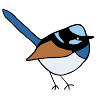
Episode illustration: Far Eastern Curlew
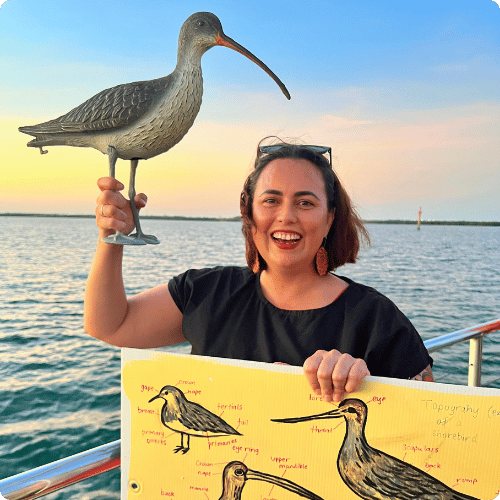
Dr Amanda Lilleyman cares about shorebirds in the NT. She has been lucky to be able to research migratory shorebirds in Darwin Harbour for many years, and has volunteered to celebrate the extraordinary lives of these birds through BirdLife Top End.
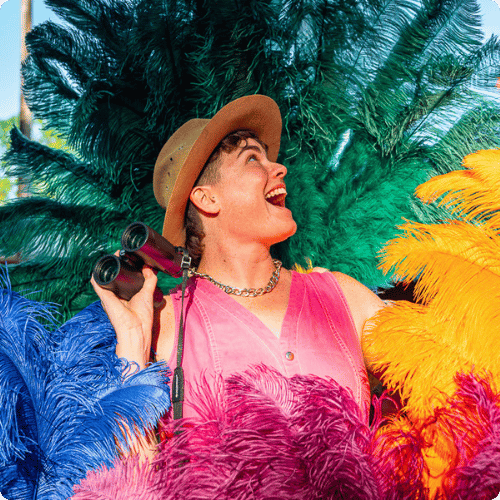
An ecologist by day and a community-builder by passion, Brittany Hayward-Brown is one of the people shaping what birding means today. The facilitator behind Hot Girl Bird Watching, a Darwin-based birdwatching group that seeks to redefine what a birdwatcher looks like, she focuses on connecting women and LGBTQIA+ folk with birds and each other. She was also the driver behind the award-winning Darwin Fringe show BIRDLESQUE.

You might know Liz Trevaskis as the host of ABC Radio NT. She is an experienced storyteller and, more recently, a fully-fledged birdwatcher. In her weekly segment Very Amateur Birdwatching, she helps listeners get excited about their local birds.
-
This episode was recorded in Darwin on the country of the Larrakia people known as the Saltwater People. The Larrakia people have a deep connection to their land and sea country, which is reflected in their songs, their stories and ceremonies. The Larrakia name for Darwin is Garramilla, meaning white stone, which refers to the pale rock and cliffs around Darwin Harbour. I pay my respects to elders, past and present, and to their families.
Welcome to a very special episode of weekend. I'm your host, Kirsty Costa. More than 300 species of birds have been recorded in the Darwin region. So imagine my excitement when I got a message from Mitch Rose from BirdLife Australia's Top End branch, inviting me to join in the fun of the annual Shorebirds Festival. Each year, the Darwin community comes together to welcome migratory shorebirds back to Darwin after their incredible journeys from the Northern hemisphere. The festival includes birdwatching trips and expert talks and community gatherings, and this year it also included Weekend Birder’s first ever live recording. A huge thank you to BirdLife Australia for hosting my visit. The team at the Museum and Art Gallery of the Northern Territory for hosting the live recording, the 120 people who joined us in the audience, and my very special guests who you'll meet in just a moment. I hope you enjoy, the Birds that Make Darwin, Darwin.
Thank you for being part of Weekend Birder’s first ever live recording. It is currently Australia's number one nature podcast. It is in its fifth season and it's all about discovering the fascinating birds of the all the birds that live around us, which is a really beautiful thing and we're very lucky to have a huge Weekend Birder community listening right now. I am absolutely thrilled to have three very special guests joining us. Please welcome to the stage, Liz Vasquez, Dr Amanda Lilleyman and Brittany Hayward-Brown. The first question we always ask to our guests on Weekend Birder is, how did you get here? How did you get involved in birds? So let me introduce to you our first guest, Liz. You might know as the host of ABC Radio Northern Territory. She's an experienced storyteller and more recently, a fully fledged birdwatcher in her weekly segment very amateur birding or bird watching. She helps listeners get excited about their local birds. Can you please welcome Liz for us? Hello, Liz. How did your love of birds come about?
Liz Trevaskis [00:02:48]
Thanks, Kirsty, for inviting me along. This is a real treat because I am what some people might describe as a bird. Notice. I don't know if I've qualified yet as a bird watcher, but as you said, the weekly segment that I have on afternoons, we have dubbed the very amateur Birdwatching Club VABW club, uh, so that everyone is welcome to talk about the birds in their backyard that they love and they don't have to know anything. And I think that's sort of exactly what Weekend Birder is all about as well. And I've been trying to figure out where it is that my love of birds has come from, and how it is that it's taken me so long to come to this place because. I think it's been within me as part of my origin story for a long time. And a story I used to tell was about my dad, who is a bird watcher or was a bird watcher, but it wasn't something that I really saw. Uh,
well, I didn't go birdwatching with him as a kid. It was a thing that he always talked about loving. But I think as a busy dad with four children, he didn't do a lot of it. But he had told a story about how in 1963, the AFL grand final, Geelong, I think it was versus Hawthorn. Who's my team? He goes for Geelong. That was the last grand final that Geelong had won until the modern era, when they started winning grand finals again. And my dad was such an avid bird watcher at the age of 14 that he chose not to go to the AFL grand final, and he went bird watching. There was a guy who was taking photos of a pork or I don't know if it was a hawk, might have been and building a hide. And the kids got paid some money to go and help out with his photographing of this bird. And so for all of these years, my dad, who was this Geelong fan, he reminisced on the fact that he that he had he'd
had the chance in 1963 when he was 14 years old, to go and watch the grand final. But he hadn't because he'd gone birdwatching instead. And it's a story that I always have told about my dad, particularly as an AFL based story. But now I'm realising that it was this thing that was in me, probably in my DNA, but hadn't quite been activated. And growing up in north east Victoria in a little country town. I was surrounded by birds. Magpies were a big part of that life. There was a little injured magpie that had had some rope around its foot, and wasn't able to walk or fly very well that we'd feed at the back door. Lots of rosellas around. They were there. They were part of the landscape. But I wasn't actively looking at them or noticing them, or watching them or twitching or any of those descriptions that we use. But then I moved to Darwin almost 20 years ago, and there's I think I'll cry as I start to describe it. There's a thing about this place that is the way that nature takes a hold of you, and you cannot escape the fact that we are part of it. We're not separate from it. We try and build houses to overtake it and live in our human construction. Or our human constructions. And the nature here says no. We are a part of it as well. The frogs will live in your toilet. Your child will bathe with a green tree frog upon its head. The geckos will be a part of the indoor lifestyle and the birds are a part of that as well. And we have these paper thin walls in the tropical elevated houses that we have. And so you can hear everything. You can hear your neighbour giving birth in a home birth, which I heard magical moment in my life. And you can hear the other neighbours fighting, and you can hear people's music and you can hear all of that, but you can also hear all of the wildlife. It's just part of the sounds of here. And so I think the way that Darwin, uh, connected me more with nature and also with a couple of birds in particular that I'll talk about a bit later on is probably it was all of nature, but birds have been a very big part of that. And so it's been it was in there. It's been activated. It's always been stories that we've told on the radio, and I've always loved to hear people's stories in the way they talk about the birds that mean something to them. So as a storyteller, I've loved to hear and share those stories. But just in the past year or so, I'm middle aged. I'm in my 40s.
Kirsty Costa [00:07:42]
It's been activated. It happens. Thank you so much for sharing that with us, Liz. I think that there are lots of people in the audience who could relate to that, and I know that there will be listeners at home as well. There's something about birds in Australia as being part of our daily lives, and they feel like they've crept up on us, but they've been with us all along. So I think there's a lot of I could see a lot of enthusiastic head nods, especially around Darwin. Thank you so much for sharing that. Yeah. Thank you. So, Brittany, it's your first time on the podcast as well. Can you please welcome Brittany for us? Brittany is an ecologist by day and a community builder by passion. She is one of the people shaping what birding means today, especially here in Darwin, as a facilitator behind the Hot Girl Birdwatching, which is a Darwin based birdwatching group whose members are in the crowd. She seeks to redefine what a bird watcher looks like. She focuses on connecting women and LGBTQi+ folks with birds and each other, and she was also the driver behind the award winning Darwin fringe show burlesque. I'm so sorry I missed that, Brittany. It sounded amazing. Brittany, thank you so much for everything that you're doing for birds and also for the incredible Darwin community. Can you tell us how did this all start for you? How did you first get into birds?
Brittany Hayward-Brown [00:09:06]
Hi, thank you so much for having me. And shout out to all the Hot Girl Birdwatchers in the room. Yes. Um, yeah. I guess like the the kind of like, surface level story is, um, bird watching is my job. So, like, I did it in uni and I do it for work now, but, um, really, uh, like, actually just listening to Liz talk about, um, feeling connected to Darwin in this place through the nature and the birds. Um, it's really what drives everything that I do. And it was so beautiful to hear your story about it. Um, and it's those stories that really, like, fuel me because I think I came to birdwatching really, through, like, an advocacy lens, because I think really like a lot of the issues that we see today, um, in terms of like, um, environmental destruction and social destruction are linked to disconnection. And I think birds are a really beautiful focal point to connect us to place and to each other. And that's really. Yeah, like the focal point of of what I do. Um, and yeah, I've kind of been like on and off with bird watching, um, over the years. But, um, I really came into it actually, like a couple of. Or maybe like 18 months ago when I was going through, um, a breakup, like a really significant breakup. And my mental health was really not great. And I was going birdwatching just as like a mindfulness exercise to kind of, like, escape the emotional wallow that I was in. Um, and yeah, I guess, like, I really was going birdwatching, like my life depended on it.
Um, and it kind of gave me, like, a really great focal point, um, and a way to like, um. Yeah, just just step outside of what I was experiencing and notice the birds and the place and, um, and through it, I also found community. Um, I kind of, like, bought, you know, a couple of, like, special interests together, I suppose. Um, but yeah, because, like, after that breakup, I also kind of I came out as queer. So, um, it ended up being that I brought my queerness to birdwatching. And that's really where Hot Girl Birdwatching started. It was just kind of like a fun, silly thing, really. I just saw like a few things on the internet of, like, younger women, like getting into birdwatching and just being a bit silly with it and kind of redefining what it looked like to be a bird watcher. Um, so the tagline of Hot Girl Birdwatching is birdwatching isn't just for the pale, stale, and male anymore. It's for the girls, the gays, and the days.
And, um, I did not expect it to take off in the way that it did. Like I had, um, I do burlesque as well. And, like, people in my burlesque community were like, oh my God, we love birds. We want to come to your bird watching walks. So, um, that's kind of how the walk, like, ended up kicking off. And, um, yeah, it really just kind of like. Really reignited my love for birdwatching, for place, and to connect me into community as well. And then, like seeing other people who don't normally see themselves represented in birdwatching as a recreation. Um, be able to, like, feel comfortable to show up as their full selves in whichever way that looks. You know, there's often like a particular image of what birdwatching looks like, you know, in your khakis. And yes, I do wear that for work. Um, um, but like, you can look any which way and you still deserve to be outside and to connect with nature and to connect with each other. Um, that's why I wear a hot pink jumpsuit when I go out. So, yeah, that's kind of what, like, brought me back to birdwatching. And yeah, it's all about connection, really.
Kirsty Costa [00:13:14]
Thanks so much for the work that you're doing in this space, Brittany. And if people would like to connect with Hot Girl Birdwatching, I will put the link in the show notes. And if there's anyone listening from around Australia in your craving community on the Weekend Birder website, I've actually tried to find every single birdwatching group in Australia and it's listed under community if people are listening. Thanks so much for your work on this, Brittany, and apologies for all the many errors I'm going to make in my speech today. I'm going to blame it on the Darwin. Hey, Amanda. Hello, friend. G'day. It's been a hundred episodes since you were last on Weekend Birder. We are at episode 157. You were on on episode 57 where you told us all about your work, your love of shorebirds and the work that's being done at Lee Point. And yesterday I was actually taken out to Lee Point to have a proper look and better understand that incredible space. I just want to say thank you to you and everyone who's working on that campaign, because we need to protect our local spaces. So thank you for that. If people didn't listen to that episode, we're just going to focus in because you've got such a amazing life story of all the ways that birds have been part of your life, but shorebirds have this very special place in your heart. And we're out here at the Darwin-Garramilla Shorebird Festival. Why shorebirds are you?
Dr Amanda Lilleyman [00:15:08]
Well, it started out in the Hunter Estuary in New South Wales, so near Newcastle and um, I was interested in birds and kind of travelled along that bird watching path and I discovered that there was a whole group of birds that I had no idea about. I couldn't identify them. There were lots of people who were very enthusiastic about these shorebirds. And in a moment of looking at these birds at the Stockton sandspit, I was just like, I want to know about these birds, and I want to be like that and and get to know them. And so then I started doing these shorebird surveys with the hunter, bird watchers, uh, observers, Hunter Bird Observers Club and, uh, and then from there, I really started getting interested in, um, the Bush and Curlew, actually as, as an issue where, um, it interacts with humans in kind of nature reserves and in local spaces. And I could see that there was an issue with this human wildlife interaction. And from there I wanted to study shorebirds and, um, become an expert in shorebirds. I just really wanted to focus. And and so I did, um, and I moved to Darwin to, to study shorebirds at Lee Point Beach to better understand them and understand how, uh, the interaction with humans through, um, through humans and their dogs, disturbing the birds would have an impact on these shorebirds. And through that, I was understanding the science and the ecology of of the shorebirds and those impacts, but also understanding that this was really a human based issue and how people are using the coast and our beaches. And, um, and then it really became a project on understanding those issues, but then engaging with people through events like the Shorebird Festival and through the monthly Shorebird Counts and all of the other engagement events that we've done over the years, so that people can learn about these birds and so that they can learn about the importance of the beaches and the need to give the bird space so that they can rest and rejuvenate and, you know, recover from their epic migration flights across hemispheres of the world and rebuild those fat stores so that they can undertake journeys of up to 10,000km one way. So I really was just on a path of like, I want to know everything about these birds. I want to understand them and I want to be able to to protect them because they're also facing some challenges. Uh, and so that was really the journey into shorebirds for me. And, um, yeah. And it continues my, my deep love for shorebirds.
Kirsty Costa [00:18:03]
And you're the co-convener of BirdLife Top End, along with Mitch Rose who's here today as well, and the incredible work that your team is doing, not only in advocating for birds and their survival, but also bringing community together. So thank you so much for everything that you're doing in this space. Was actually a shorebird that kind of created the spark for me to become a bird watcher. I was standing at my local wetlands during lockdowns when everyone else was baking sourdough in Melbourne. I was birdwatching and a Latham’s Snipe came out of the reeds in front of me with its big googly eyes, and it was plunging its bill into the mud. And I was like, what is this bird? And when I found out that it flew 7000km non-stop from Melbourne to Japan, that just blew my mind. I'm never going to complain about economy and terrible food ever again. And I realized that there were all these birds migrating from from Australia overseas all the time, and I just hadn't tuned into it. So I'm like, I think Darwin is so special that you have a festival to welcome these birds in. And I think that other places around Australia should get the same inspiration. So we're going to talk about what birds make Darwin Darwin, and this is a pretty quick list, but I've asked my amazing guests to choose a couple of iconic birds. And the first one we're going to start with is the bush chook, the Orange-footed Scrubfowl. Liz, this bird you've chosen. But before we go into why this bird makes Darwin Darwin, there's going to be a whole lot of people listening around Australia and overseas who have never seen this bird before. Can you describe what it looks like to someone who's never seen it?
Liz Trevaskis [00:19:40]
I'm feeling an incredible amount of pressure right now to have chosen this iconic bird, but there's very good reason for it. And for those who are here, you will notice that I've tried to dress in the colours of an Orange-footed Scrubfowl today to just so much channel its energy. So the Orange-footed Scrubfowl is a bird with brown feathers. Plumage, one might say, uh, and it has orange feet. And it also has a little. Not a crest like a I don't even know what they called on chickens. Not one of those, but it has what I like to think of as a bit of a pointy mohawk. It also has eyes that say, I'm going to mess your garden up and I don't care. Uh, is that is that a good description?
Kirsty Costa [00:20:31]
It's a pretty good description. What do you reckon?
Liz Trevaskis [00:20:33]
Yeah. Scrubfowl. Yeah. Uh, and we call them punks in my family because they do scratch around in your garden, and they kick up the things, and then they look at you because they know they're doing something wrong that you don't want them to do. And then they keep doing it. Their little orange foot kicking up the garden that you've lovingly created and tidied up and put effort into. And then they run off with their little head bobbing along like a total punk. Amazing. And I just love their punk energy. And yeah, so that's the visual description of the punk. Uh, dude, it's so it's so punk. It's so anti-establishment. And I love that. So am I, am I talking about why I love it? Why am I a star when I tell you why? Why is this the bird of Darwin? So the thing that I talked about before, and how nature climbs into your house and weaves its way into our living spaces. Our houses are mouldy in the wet season. Like that's just part of what life in the in Darwin is in the tropics. Like it's in your home. And I did talk back. I love to do talkback on birds on ABC Radio Darwin for the stories, and not necessarily the science, but the stories. And I might have been the presenter on the evening show at the time, and I was asking people about the animals that are a part of your family that aren't your pets. And someone called out with a story about a bush took that. So these the elevated houses that we have here, a lot of people just have like a downstairs living area where you've got couches set up and maybe you have a TV down there and a dining area. It's a beautiful outdoor living space where you're even up closer with nature. And someone had a bush chook that would just come along, sit on the seat and watch telly with this family. And I just thought that that was the coolest thing.
And this is probably ten or 11 or 12 years ago. So, um, not at the start of my time living in Darwin, but sort of early on and just thinking the chooks are watching TV with us. This is just we live with each other in our homes. Uh, but then also the fact that they, there's this constant battle in the neighbourhood between like over who has dominance of the space and they just don't they're relentless. They don't give up these mounds that they build. Someone will take the mound down. They'll spread the dirt. They'll kick them out. Kick them out. Move them on. And then they'll just come back and they'll keep going. And I just looked it up this morning because I know there's some funny advice on the. I think City of Darwin might have had some funny advice or mtg in Northern Territory government. Uh, and my, uh, ex-husband used to talk about how there was some advice that said, just don't bother because you will not win. I don't know if it says exactly that. The current advice, though, does say, look, probably just give, uh, you know, some portion of your yard to the chooks. Yeah. Uh, just let them have that space to build their mounds. And that's part of the management strategy for living with them. So love them. I just love that they don't give up. They, they're saying I this is the I'm this is where I want to build and I'm going to build here. And eventually you give up and you just say that this is your space, this is my space. This is, you know, let's dance. And that's that's that's what makes it Darwin right there.
Kirsty Costa [00:24:08]
Love it so much. And I've been learning a bit about this incredible bird. So for people who are listening around the world and in Australia, this is the Australian Brush-turkey equivalent of Darwin. So I think people in Brisbane and Sydney would know that megapode. And recently I've been learning about the Malleefowl. And so for the people who are living up in northern Victoria and southern New South Wales, and also over in South Australia, they would know the Malleefowl is kind of their equivalent. So it feels like, except for maybe in Melbourne, every capital city in Australia has this equivalent bird. And what's really amazing about Mound Builders is that they have temperature sensors inside of their bills, and they dip that into the mound so that the mound is that perfect temperature to raise the eggs and make sure that the chicks hatch. And I just think that's incredible. Imagine having a temperature sensor in your nose. I feel like I definitely have that in Darwin right now as I sweat my way through this time of year. But yeah, I think there's so many amazing things that are hidden talents around this bird as well. And I have been thinking a lot recently about wildlife and human conflict and how do we all exist together in this living world together. And I think that's a really great example of that. So thank you so much for bringing it to our attention.
Liz Trevaskis [00:25:21]
I've got another name for them is the Dinosaur Chicken, which is I love in Darwin. We have a lot of names that aren't the name of birds for birds, and that's another one of my favourites. And the sound that it makes, it just. It is not in a rainforest in my backyard, but when it makes its wobbly ancient cry, it sounds like rainforest. That's how I describe the sound of it.
Kirsty Costa [00:25:42]
It's so good. Anyone else agree with Liz that yeah, yeah. Okay, we've got some. We've got some bush talk lovers in the room. Brittany, you have chosen the earrings that Liz is wearing.
Brittany Hayward-Brown [00:25:56]
And my skirt.
Kirsty Costa [00:25:59]
The iconic Magpie Goose. I have been losing my mind watching Magpie Geese fly into Darwin, which they are at the moment. Why could you actually. Before we talk about this iconic bird, there are going to be heaps of people in Australia and overseas who have never seen it before. Can you describe it to someone who's never seen it?
Brittany Hayward-Brown [00:26:21]
She's an icon. She's a diva. Um. No matter the gender. Um, yeah. So think magpie, black and white, but then, like, add this really long neck and a little knob on top of the head, and then this, like, glorious red beak with, like, a little hook at the end. I don't know why they have that hook. Maybe, like digging out the water chestnut. Yeah, yeah. Um. Orange legs. And, um, they don't have fully webbed feet. Fun fact not like other geese and ducks. They have these, like, long clawed toes. Can relate. Um. Look, I've got to have one flaw. Okay? Everyone's, like, looking at my toes out. The worst part of Darwin. Open toed. Anyway, um, this is not about me. It's about magpies. It's always about us and birds. It's all right. I love it so much.
Kirsty Costa [00:27:22]
So why? Why the magpie goose?
Brittany Hayward-Brown [00:27:29]
Because, um. Yeah, they are just so iconic to those of us that live in Darwin. Like this time of year. I mean, to Liz's point, um, like, we're. So I feel like we're so in tune with the seasonal changes here because we're so, like, at its mercy. Um, and this time of year where the clouds are building and the humidity pops up and you start to see the new little green leaves come through on the trees that have lost all their leaves. The Magpie Geese start to arrive and you hear their like gentle honks as they're like flying in from their feast of, um, mangoes during the day out at Humpty Doo. Um um, yeah. People just get genuinely, like, really excited for the arrival of Magpie Geese back in Darwin at this time of year. And it really signifies kind of the start of the build up coming into the wet season. There's even Instagram accounts. Um, Magpie Geese of Darwin shout out I was on there this morning. There was like a reel of Magpie Geese on the footy field in celebration of the grand final. Um, there's also poly geese of Darwin because, um, Magpie Geese are polygamous, so they, um, form like lifelong breeding groups. Um, often like a male and two females. And they have group parental care. So, um, there's a big, you know, people, people in the poly community really love Magpie Geese up here too, for that very niche reason. Um, yeah. So I just find, like. Yeah, it's just like such a beautiful symbol of, like, the seasons changing and you reflect on like, oh, this time last year when they were here and you see them just, like, perched on the top of, like, palm trees and light posts and like, buildings. So they're just quite like quirky and silly birds. And they bring, um, they bring a lot of joy. Amazing. Yes.
Liz Trevaskis [00:29:28]
My question is, this is the fun fact that I always told about Magpie Geese, but I don't know if it's true. There. We call them a Magpie Goose, but they are neither magpie nor goose. Is that. Do you know if that's true? Does anyone know?
Kirsty Costa [00:29:40]
Definitely. Don't look at me, Liz. I've got no idea. Uh, magpie. Amanda might be better at this.
Dr Amanda Lilleyman [00:29:48]
Um, yes. Yes, yes. Black and white is pied. Um, I was looking. I mean, I did hear about this. Um, I knew about this because, um, a co researcher in my lab was researching Magpie Geese. They're monotypic. They're the only species in their family, and they're from a really ancient lineage of bird. Um. Before modern ducks and geese. Um, so they're not like a a goose in that sense of the word, but I guess in a really ancient sense. And that's why they have the ability. Um, like, they don't have the fully webbed feet and they have the ability to perch like that. Um, do you have anything you want to add? No.
Kirsty Costa [00:30:33]
Cut it off real nice. Brittany. Does anyone else agree that the Magpie Goose is one of the iconic Darwin birds? Yeah, I love it. The magpie goose. Give the Magpie Goose a clap. It's so good, so good.
Brittany Hayward-Brown [00:30:46]
Also a performer in burlesque. Magpie Goose. Yeah.
Kirsty Costa [00:30:51]
Shout out to the bird list. Yeah. So good. Amanda, you have chosen the Torresian Imperial-Pigeon. I love that you have chosen a pigeon. There are so many pigeons and amazing doves up in Darwin. And I know that there are some very passion pigeon, passionate pigeon and dove listeners on Weekend Bird who constantly email in and ask for topics on this. So they're going to. We've made their hearts so happy right now for someone who hasn't seen one before. How would you describe it?
Dr Amanda Lilleyman [00:31:17] - within segment
Well, it's a large white pigeon. It's very heavy looking. It's it's, um. It's quite. People might like to to eat the bird. I've heard. Um, because it's a it's a heavy kind of pigeon, but it's white all over and it's got these nice, um, black, uh, wingtips to it and black bar on the, um, on the tail and some black speckling underneath, as well as these, um, bluey grey feet and a big black eye. Um, and it's just, uh, it's quite a glorious, glorious pigeon. Um, a photo that I took just from my balcony recently, but it's it shows these pigeons, um, feeding on the Carpentaria palm berries. But the reason why it's, um, the bird that makes Darwin for me is because it is a bird that you see through throughout the different months of the year. You see it on powerlines and in trees, nesting on very flimsy sickness. And also, um, it's cool. It's kind of like this quite low, drawn out. Boom. But for me, these, um, Torresian Imperial-Pigeons, they also represent. A part of Darwin that probably Darwin Nights are quite familiar with. The coming and going of people, the transients of our population. So the Torresian Imperial-Pigeon is found across Australia. It's actually a migratory pigeon. It flies to New Guinea every year. But in in Darwin in the top end we have we have some birds that do migrate to New Guinea and some birds that stay here throughout the year. And we discovered that through counting the birds over a period of time at some of the areas around Darwin. And so to me, it just kind of signifies that the coming and going of people, whether it's with the season or over time in their careers, they, you know, people come to Darwin in some stay. People come to Darwin and some some people leave. And it's just like these birds that we see. Um, so, so for me, that's kind of, you know, it's quite an anthropomorphic, um, story about the Torresian Imperial-Pigeon, but purely for the for the bird's kind of its own value in life. I love the look of them. I love how peaceful they look, their beautiful plumage, their kind of soft calls, feeding on the berries, gorging themselves on these berries. Yeah,
Kirsty Costa [00:34:00]
I really appreciate that. Darwin has so many melodic birds compared to where I'm from in Victoria. There's a lot of like up and down melodies going on, and then in the background it's like the Torresian Imperial-Pigeon is the base. You know, it just kind of keeps the rhythm with the bass and almost completes the orchestra for me. So thank you so much. Are there people who also agree that this pigeon is iconic and Darwin amazing?
Audience [00:34:25]
Yes.
Kirsty Costa [00:34:29]
We are going to briefly hear from our audience. We've got time for three people to put their hands up and tell us an iconic Darwin bird. Um, we might get the amazing MAGNT team to grab the mic. And we're going to start here with someone who wants to tell us about his favourite. His favourite bird. And just a reminder to the audience this will be on the podcast, so your voice will be there just in case that's not comfortable for you. What's your name? Leroy. Hi, Leroy. Leroy, can you tell us about which bird makes Darwin Darwin for you?
Audience - Leroy [00:35:01]
Well, this time bird says actually, tell us about it. It drops all the berries that they eat, right? Nut. The nut bit right into our paw on the ground. Yeah, the imperial pigeon. Sometimes with the nuts.
Kirsty Costa [00:35:24]
Amazing. So you agree with Amanda that the Terezin imperial pigeon is the iconic bird of Darwin? Yes. Amazing. Thanks so much, Leroy. Amazing. We've got someone at the front here. What's your name?
Audience - Summer [00:35:37]
Hi. My name is Summer.
Kirsty Costa [00:35:37] - within segment
Hello, summer. Summer is actually a friend of mine, so I'm pretending that I don't know her, but I do. Always iconic. Hello, Summer. And we got matching hair. That's how you know, um, summer, what is an iconic Darwin bird for you?
Audience - Summer [00:35:49]
You know, Amanda, you've called this out as well. And same Leroy. There is an iconic one on the corner of Knuckey Street and Cavenagh Street. And when we had the cyclone last year, um, it was one of the first things that everyone was checking in on. Is the pigeon still there? Is the pigeon okay, gal pals of Darwin. Where, like, I'll go out as soon as I possibly can. And, uh, I checked on the nest yesterday, and, um. Yeah, it looks like they're back, which is fabulous. Amazing. I love that so much.
Kirsty Costa [00:36:22]
So much love for a pigeon. I'm so here for it. Has someone got a different bird for us that we haven't mentioned yet? We'll go this person at the front and then we've got someone at the back. So, uh, my favourite bird in Darwin is the Rainbow Pitta. And I think you've just seen one yourself. Lost my mind. Lost my mind I cried, I did cry. Amazing. What was your name? Sorry.
Audience - David [00:36:44]
David Percival.
Kirsty Costa [00:36:46]
David. Why is the Rainbow Pitta the Darwin bird for you?
Audience - David [00:36:49]
Because they're shy, colourful. Interesting. Cool. Love rainforest. rainforest is one of the most difficult birding habitats. And there's some really nice ones all over Southeast Asia and Africa.
Kirsty Costa [00:37:02]
Amazing. Thank you so much. Does other people agree about this bird as well? Great suggestion David. And then we've got one person just up the back for a final suggestion from our audience. What's your name?
Audience - Finn [00:37:17]
My name is Finn. And what is the iconic Darwin bird for you? The iconic Darwin bird for me is the Red-collared Lorikeet.
Kirsty Costa [00:38:00]
Oh. Great choice. I can hear there's a lot of support for the lorikeet in the crowd. Why is that your favourite? Because it's loud and chaotic. Amazing. Thank you so much for that suggestion. The Red-collared Lorikeet was actually the first bird that I saw when I arrived off the plane in Darwin. I was at Chemist Warehouse in the car park and a flock through passed and I thought, that's my first lifer shout out to the lorikeet as well. There are, um, birds in Darwin that aren't as loved, and I asked Liz to think about which Darwin Bird deserves more love than it gets. And. Liz. Oh, sorry. So it was Brittany, wasn't it? It was Brittany. Brittany I apologies, Brittany. Um, you you can add to this if you like. You're welcome to Brittany. You chose the Masked Lapwing as the bird that deserves more love. And not only is this an iconic Darwin bird, it is an iconic Australian bird. Why do you think it deserves more love?
Brittany Hayward-Brown [00:38:24]
Um, yeah. This. People often call it plover. I grew up calling it a plover. I grew up here. Um. And have you no fond memories of trauma bonding with my classmates? You know, when you've accidentally kicked the footy too close to the plover nest and you have to go get it? Um, a friend of mine also calls, um, them the melted cheese faces. Poor things. They really cough it. Um, but, uh, one thing that I, um. Yeah, what I really love about them, actually, is they like such, you know. Yes, they are really aggressive and they give us a hard time, but it's because they're really good parents. They're really protective. Yeah. Yes. And also what I love is like, you know, go down to, um. Local. My local pool, Nightcliff Pool. Shout out to the MVP of Darwin Pools and the staff there like to like protect the Masked Lapwings and they put the little like witches hats around the nest to like make sure that nobody disturbs it and doesn't mow the lawn there while the mother and the parents are sitting on the eggs and the chicks are fledging. Um, and then everyone gets like, really excited, like watching the little babies kind of grow up. And yeah, I just think that's I think it's really sweet. And people can get like quite, you know, annoyed by them. But I think we just need to respect the game like they're there to protect their babies. And yeah I agree. Yeah.
Kirsty Costa [00:39:55]
And just like magpies lapwings remember uh your face. So I have some that live in the park next to me and all through the year I say good morning to them. And then when they do have their babies, if I get a bit close, they will sort of show me a warning sign. But they're definitely not swooping because they know me. And so I do that with magpies as well. I am that person that says, good morning to all the birds. Oh, I think my neighbours are a bit worried about me, but. It's I think it's also about building relationships with birds. And once you have that, they'll know. They'll know you're not a threat. And as long as you're not wearing sunglasses and a bike helmet and then they can't see who you are, you're pretty much good to go. So thank you so much for bringing this iconic bird back to our attention. And how amazing is their call? As soon as you hear it, you know where you are in space and
Brittany Hayward-Brown [00:40:41]
time. It's like, don't make eye contact, just walk straight. Don't run.
Kirsty Costa [00:40:46]
Speaking of iconic calls, when I got you to think about another iconic Bird Lives, you were thinking back to actually something that Amanda in the BirdLife team were helping to be responsible for, which was in 2020. Darwin selected its top bird. Is that what it was called? Amanda, the top bird of Darwin and Darwin chose the stone-curlew, which is so amazing. This was an initiative run by BirdLife and ABC. Tell us about this bird and why you think it was so popular, or why everyone voted for it as the Darwin bird?
Liz Trevaskis [00:41:20]
I think the well, my first memory of the stone-curlew was actually being out in Malaysia for work and on the way into Arnhem Land, and pretty new to the territory and. Sleeping at night in a strange landscape that I hadn't been in before. I had never really spent time in any, uh, Northern Territory indigenous communities. So it was all very new and eye opening for me. And you always feel a bit unsettled in those circumstances, and your ears are open more widely than they are normally. And then hearing the wail of the curlew in the night and having no idea what that sound was, and thinking that someone was being murdered. And that's what was going on. And I think this is the thing about that, is that I think that is everyone's entree to the Bush Stone-curlew. And now that we live here and we hear it, we all know that. Yet somehow we come here without anyone having warned us that, uh, that is what that sound is that you will hear at night time. It is a beautiful bird, those big,
beautiful eyes that it has. That one on the screen is scowling at us, obviously, but it's inspired so much it's inspired. People will be familiar with the creepy curlew art design, and I've got posters of that on the wall of my house. And there another one that kind of sneaks up on you. They do blend into the landscape so well. They're so well camouflaged that you don't notice that they're there. And then you start looking for them and you see them. But also there's there's some kind of magic in that as well, where I think, like when you leave here today, we will be seeing them when you there's something there is a, there's a, there's this strange magic about the curlews where I think we conjure them. Um, and we did a whole show on ABC Darwin, on the afternoon's show with my beautiful colleague Miranda, who actually, uh, introduced me to the concept of bird noticing, which is kind of how I began on this journey. And that's where the very amateur bird watching segment came from, which you can tune into Monday afternoons on ABC Radio Darwin.
Um, but we did a whole festival of Curlews one afternoon, and everyone had a story about the curlew that lives in their neighbourhood and the relationship that they have with them, and the I know there's something around how they form partnerships. I just can't remember what it is. But someone had a story about the curlew that maybe had a mate, uh, near his printing shop and then the mate. Had disappeared or had died. I can't quite remember. And the curlew was coming to the window regularly to, like, look at its reflection or look for its mate. And so they printed off, because he was at a printing shop, a friend for the curlew, um, to replace the friend that the curlew had lost. And again, it's just another one of those birds that captures our heart and captures our imagination, but has just. I don't know what it is. For me at least that there's just a magic. And every time we talk about them, they suddenly appear. And I have no way of describing that. But I think there is a magic that surrounds them.
Kirsty Costa [00:44:24] - within segment
Yeah, and I want to acknowledge that they've got incredibly important cultural significance to Larrakia people. And I've been learning about that from some Larrakia mob while I've been up here. So thank you for that cultural education too.
Liz Trevaskis [00:44:39]
Yeah. I also want to point out that their babies are adorable. Oh, yeah.
Kirsty Costa [00:44:42]
For people listening at home, I've just put up a picture and they almost look like baby Muppets. They look like puff balls on legs. Yeah. So adorable. And I love the way that they get scooped underneath and protected by the by their parents. So amazing.
Liz Trevaskis [00:44:55]
I think the curlews are good communicators as well, with the way that they spread their wings out wide to tell you to back off. And I think the same of the melted cheese face that when they're nesting, they're fine. Like they're not going to bother you if they have chicks to protect that are so like melted cheese paste babies, little fluff balls. They are so cute. You can't you can't always see them straight away. That's when they screech at you. And that's when they tell you back off.
Kirsty Costa [00:45:21] - within segment
There are babies around here and otherwise they're not a risk. So I loved that point about them being good parents. Yeah, I love that so much. The final iconic Darwin bird that we're going to talk about is actually the ambassador or the the bird that has been chosen to represent this year's Darwin-Garramilla Shorebird Festival. And that is the common Greenshank. What an incredible shorebird. Amanda, can you quickly tell us about this bird?
Dr Amanda Lilleyman [00:45:46]
Sure. Yeah. So I had to choose a shorebird. Of course. And this is one of our migrant shorebirds. So it breeds in the northern hemisphere. It undertakes a journey of thousands of kilometres through the East Asian Australasian Flyway. And then it arrives here in Australia for our build up and wet season in northern Australia and elsewhere in the summertime. So this is a bird that can be found on our coastal areas, uh, and also in freshwater wetlands. So it can it's pretty versatile in that way. It's got, it's it's long legs for wading. It's called a Greenshank. So they are slightly green legs. And of course it's got this long thin bill to catch its food. So it will feed on things like fish and and other intertidal invertebrates. And this is, this is a bird that unfortunately is classified as an endangered species. And that's because its population has declined over several years, if not decades. And scientists have discovered that population trend because of lots of incredible people all around Australia and elsewhere in the world who go out and count these shorebirds so that we can understand how the population trends are going. So citizen scientists have contributed to the understanding of how the Greenshank is going in Australia. And it's it is a bit of a sad path for the Common Greenshank. So, um, one of our beloved um, shorebird volunteers suggested that we choose this bird, the Common Greenshank, as our bird of this year's Darwin Shorebird Festival. And, um, in previous years, we've we've selected birds that are also facing declines. So species that are on the threatened species list and and the Common Greenshank is one of those birds. And so we hope to bring more, um, more knowledge and awareness about this species, this bird and um, and its challenges and how it lives, its life.
Kirsty Costa [00:47:54]
And part of the work that the BirdLife team has been doing are two major campaigns. So Lee Point, which you can learn about in episode 57. And since I've arrived, I've been learning a lot about Middle Arm. And this incredible, um, this incredible space and currently home to a lot of shorebirds as well as other iconic Darwin birds and a bit under threat. I on Weekend Birder. We touch conservation lightly because we know that 2026 and whatever year someone might be listening to this podcast is complicated. And so we think about how we can care for local spaces and care for people. And I've noticed that sometimes we have to do the dance between that a bit. And this is an example of how we think about caring for both. Can you quickly tell us about Middle Arm, why it special and why we need to protect it.
Dr Amanda Lilleyman [00:48:41]
Yeah. So Middle Arm is in Darwin Harbour. So Darwin Harbour has three major arms of it East Arm, Middle Arm and West Arm. And on the Middle Arm peninsula there's it's there's mangroves, there's intertidal sand and mudflat. And then behind the mangroves there's these salt pans which have salt marsh habitat. They uh They get wet during the the biggest tides that we have every spring tide. And because of that it's a really nice habitat. It's a really nice environment for some of our shorebirds, and one of the birds that we've found there in quite important numbers over several years, from aerial surveys of Darwin Harbour, is the Far Eastern Curlew. So the Far Eastern Curlew is one of our biggest migratory shorebirds in the world. And it's found here in Darwin Harbour, in Middle Arm, on the Middle Arm, salt pans or salt marsh in nationally significant numbers. So that means that the habitat there is crucial to the survival of this species. So critically endangered is pretty much the worst scenario you can be in if you're a threatened species. So as as an organisation at BirdLife Top End, what we're doing is we're trying to raise the awareness of this species and the habitat that it uses in Darwin Harbour, and the importance of keeping every bit of its environment intact so that we can keep these shorebirds coming back every year. And middle arm is so crucial to migratory shorebirds in Darwin Harbour, and so we want to keep it that way so that we can celebrate these birds year after year.
Kirsty Costa [00:50:23]
So this part of Darwin is currently under threat. So we'll put in the show notes some information for everyone who's listening. To learn a bit more about what the proposal is, how you can get involved, and how we honour both the needs of humans and the needs of birds. So I will put a link to the show notes about that, and I just want to say thanks to everyone in the room who's listening at home or in their car, and especially to the BirdLife Top End team for all the work that they're doing to look after Top End's birds. So thank you, Amanda, for that. Really appreciate it. Darwin, you had me at hello with the Red-collared Lorikeets outside Chemist Warehouse, and I have been so grateful so far to see 35 species of birds that I've never seen before. After doing that yesterday, I had to go home and have a nap because I was so overwhelmed by how delightful it is, and I just am so grateful for everyone who's rocked up today for Weekend Birder for Darwin's Birds. Join me in thanking our hosts Museum and Art Gallery of Northern Territory BirdLife, Top End volunteers and also everyone involved in the Darwin-Garramilla Shorebird Festival. And can you please thank our incredible guests Liz, Amanda and Brittany. This has been Weekend Bird live. We'll speak to you again soon.