143 Filming What We Miss
About this episode
Sometimes the moment you miss is the one you remember most. Wildlife filmmaker Jeremy (jeremyfilmsthings) shares how filming birds has changed the way he sees and listens to the living world.
Birds mentioned in this episode: Satin Bowerbird, Superb Lyrebird
Resources
Meet the guest
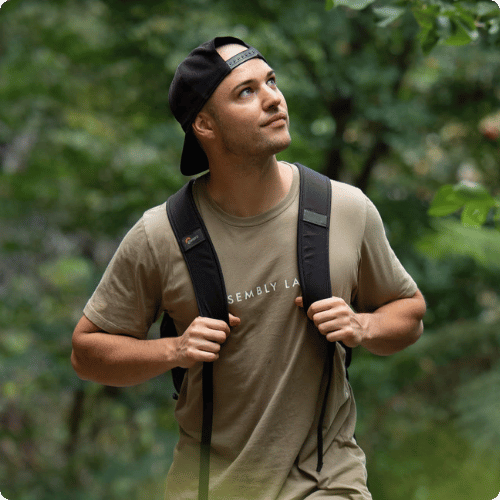
Jeremy is an Australian wildlife filmmaker and the creator behind jeremyfilmsthings. Through quiet, observational videos, he captures animals as they go about their lives, encouraging people to slow down, notice more, and connect with the natural world.
-
Kirsty Costa [00:00:00]
This episode was recorded on Bunurong/Boon Wurrung Country. I pay my respects to Elders past and present, and to the deep knowledge held here for tens of thousands of years. Knowledge about birds, land, seasons and story.Welcome to Weekend Birder. I'm Kirsty Costa, and here together we notice birds.
You might already know today's guest, Jeremy. He is the person behind Jeremy Films Things. And if you've spent any time on Instagram or Facebook, there's a good chance you've come across his amazing videos of lyrebirds and other wildlife.
Like many of us, Jeremy's story starts with a growing curiosity about the animals around him.
Jeremy Drakeford [00:00:56]
Well, I've always been into animals, but I think during 2020, obviously we were forced to stay local. And that's when I started noticing more birds and getting really into them. And from there, I started taking my camera out. And yeah, it sort of snowballed into what I do now.I grew up in the suburbs, so there wasn't a whole lot of animals around. I think when I was really young I had an obsession with penguins. I remember being five years old and going and borrowing the same penguin book from the library on repeat and just obsessing over them. But then I got into astronomy and space and that sort of took over for a while. But then I came back to the animals later in life.
Kirsty Costa [00:01:36]
I love how often that comes up in this podcast. There isn't always a big defining moment. It's often just a slow build, spending time outside, noticing more, getting curious, and then realising at some point that birds have quietly become part of your life.Jeremy also didn't set out to become a wildlife filmmaker. He says that he already had the camera skills and an interest in animals, and then at some point these two things just came together.
Jeremy Drakeford [00:02:03]
I was already working sort of in the videography space. I started in music, and then I was doing music videos, and then I sort of got into the corporate stuff, which wasn't very much fun, but I get paid pretty well.And then I just had a camera. So I would take it out and film birds with it and then buy birding lenses and pretend it was for work and part of the tax. So yeah, I just was using all my work equipment that I already owned to film birds. And now that's what I do for work somehow.
Kirsty Costa [00:02:33]
If you've ever watched Jeremy's videos, I think you'd agree that they don't feel like traditional wildlife films. They feel quieter than that. There's a kind of patience to them, and a real sense that you're being allowed to watch something unfold, rather than being told what to see.Jeremy Drakeford [00:02:51]
I think that there's two types of people that capture nature, whether it's photography or videography. There's the documenting sort of style, where it's as is, and then there's the highly stylised art side of capturing nature.And I think that I fall somewhere in the middle, where it's as it is, but I'm trying to find beauty within nature. So it's all done sort of in camera. I don't do a lot of editing, but I'm trying to find nice framings in the forest and nice pictures. So I try and make art out of it, but it's nature that's giving me the art, if that makes sense.
Kirsty Costa [00:03:26]
Jeremy says there's a lot that goes into what we end up seeing on our screens.Jeremy Drakeford [00:03:31]
When I'm filming, I just hit record on pretty much every animal that I see. And then when I get home later, I sort of look at it and I try and work out where the story is, what establishing shot I want, and what moments are interesting.Because a bird will sit on the perch for 5 or 10 minutes sometimes, but I'll be like, oh, in this moment it did a little call here. It was eating a worm. And I'll just use the highlights and try and make it flow in a way that's like a story.
And sometimes I'll use stuff that's not even from the same day and edit it in a way that looks like it's a story, but that's how all nature documentaries are made. I've watched some and I'm like, that's not even the same individual, you can tell. Sometimes you have to get creative.
Kirsty Costa [00:04:13]
What's standing out for me as I listen to Jeremy is that his work depends on not being noticed. He's trying not to insert himself into the moment. He's actually trying to disappear from it.Jeremy Drakeford [00:04:26]
It's always different. And that is something I'm very conscious of. I'm finding myself using the biggest lenses possible and trying to distance myself as much as I can, because I've noticed that when you go anywhere near an animal, they start acting different. They're on edge. They'll probably just fly away half the time.So my goal is to intrude as little as possible and almost act like I'm not there. I find the best results when I just leave a remote camera.
I was filming Satin Bowerbirds last year, and when I was close, the male would tolerate me, but all the others wouldn't come in. But as soon as I left my camera rolling and I walked away, within five minutes I had seven bowerbirds around the bower in one of the examples. And as soon as I came back to grab the camera, they would all sort of scatter.
So that was sort of proof that my presence definitely was having an impact. So I removed myself as much as I possibly can.
Kirsty Costa [00:05:25]
This means that what you're seeing in Jeremy's videos is real bird behaviour. It's not an animal reacting to a human being there. It's just the animal going about its life.Jeremy Drakeford [00:05:36]
Because obviously I work with lyrebirds the most, and I think I've learned more about them through observation than I have through reading books and talking to the scientists in that field. Just because I've spent hundreds, if not thousands of hours with lyrebirds.So I get to know what every call means, or I have my own sort of inkling of what it is, and what the body language is, what they're going to do next. So yeah, just through observation and being there so much, I've sort of learned things on my own. And then I can take it to the scientists that I know and they tend to confirm it, or sometimes they don't even know what I'm talking about. And it's something new for them. And I find that really exciting.
Kirsty Costa [00:06:13]
With so many hours in the field, Jeremy says that he has many memories that he'll treasure.Jeremy Drakeford [00:06:19]
Some of the most memorable moments are ones that I actually missed with the camera. I had the wrong settings, or I had too big of a lens on.The one that really sticks with me, that I hate myself for missing, was a three-way mature male lyrebird fight. All three of them were doing a face-off, with their tails over their head. They were doing the territorial stuff, so they sort of dance at each other. It's the same calls that they'll do during courtship, but the males will do it in a territorial dispute.
But yeah, I've never seen three of them do it at once. So I'm scrambling to grab the camera, but I had a really long lens on and they were doing it probably within three metres of me. And someone was walking past with their phone and they got it on their phone, because obviously that's a much better set-up for that. And they walked off and they got the shot and I missed it.
So there's been a few times like that. It's quite disappointing. But it was still an experience in person that I got to have.
Kirsty Costa [00:07:15]
It's funny, isn't it? Sometimes the moments we miss are the ones that stay with us the longest.Jeremy says that he loves all wildlife, and there are a few animals he especially enjoys spending time with.
Jeremy Drakeford [00:07:27]
I really enjoy echidnas because they tend to find an ant nest and stick in the one spot. And I find that their temperaments are - some of them are really chill having you there, and others, as soon as you get within ten metres, they've burrowed themselves and they won't come out until you leave.But when you get a really friendly one, they'll sort of go around your feet eating ants and stuff like that. So I really enjoy filming echidnas, when you get one that's a bit more relaxed.
In the way of birds, I just love parrots. They are such characters. And again, if you can get them - we've got prickly currant up where I film, and once they get into that, as long as you don't approach, if you film from as far back as you can with the big lens, they'll stay in there until they get spooked by something else. And they'll be jumping around and fighting each other and all sorts of stuff. It's great.
Over summer and until about now, you get all sorts of parrots in there. Red Wattlebirds, Pied Currawongs. I'm trying to think who else gets in there. That's about it where I film.
But yeah, they don't always get along, and that makes for good filming. Actually, I love conflict. I love a good bird fight. Not that I want them to hurt each other, but as soon as I hear something going on, I'm like, oh, I'm going over there to find out.
The other day, actually, I could hear something really going on. I could hear magpies and currawongs both making a fuss. I went over and there was a Brown Goshawk sort of having a go at all of them. So yeah, moments like that are pretty exciting for me.
Kirsty Costa [00:08:58]
If you've ever watched Jeremy's videos, you'll know that it's not just about what you see. The sound is such a big part of it as well.Jeremy Drakeford [00:09:06]
Yeah, so audio has always been probably my primary focus when it comes to video. I think it's the most important thing, especially with birds, because their calls are such a big part of who they are.So I always try and focus on getting the cleanest sound possible, which can be challenging. Making that Birds of Australia video was very hard because every time I tried to get a magpie call, there would be road noise in the background or a dog barking or just someone with a leaf blower.
So it's actually really hard to get just a common bird calling. For me, it's taken me years to get a really good magpie call, and I still haven't got a kookaburra. Everyone in the comments had a go at me because I hadn't got it. And I was like, I genuinely can't get it. I've been trying. They call from the very top of the mountain ash trees where I normally am. I've tried locally, there's too much road noise. I can't win.
But yeah, that video, I snuck in a little bit during the kookaburra and that really upset people. They were like, oh, someone's got the wrong bird here. AI has stuffed up. They thought I'd used the program to make the edit, but yeah.
Kirsty Costa [00:10:12]
After listening to Jeremy talk about his experiences, I'm curious to know what is on his bird bucket list.Jeremy Drakeford [00:10:20]
I mean, my bucket list is huge. The real bucket list bird was last year. I wanted to get the Albert's Lyrebird, and I did. Not only did I find one, I got the courtship display out of one of the males, so that was probably the highlight of my life. So that was sort of the bucket list one.But there's others. I haven't seen a cassowary yet. I haven't even gone up that far north. So I think, yeah, cassowary is one of them.
I would love to get a shot of a catbird calling, because I heard them when I was filming the Albert's Lyrebird, but I could not see them. So I'd love to get them.
Oh, what else is there? There's just so many. All the ones I haven't got, which is probably about 700 birds, if I'm honest.
Jeremy Drakeford [00:10:58]
Anyone that does courtship would be an amazing thing to film, even like the grebes. I would love to see that. I've seen the grebes, but I've not seen them do the courtship displays.I've really only filmed lyrebirds and Satin Bowerbirds doing courtship displays. I mean, I get the Spotted Doves bowing to each other and stuff like that on the neighbour's roof, but I don't know if that counts.
Kirsty Costa [00:11:21]
With so much time on social media, I bet that Jeremy has been watching the comments and learning a lot about people's relationships with birds.Jeremy Drakeford [00:11:30]
It's a very broad spectrum. Even on that Sounds of Australia thing, some people got angry hearing a raven calling because they'll be triggered by it or something, and other people obviously seek so much comfort in it. They're like, oh, I played this ten times in a row, or, you know, I live in London now, and I've just been playing this on repeat to remind myself of home.So I think a lot of people really take comfort in nature. And it's almost like part of their identity as an Australian to identify with the bird calls.
But yeah, just in general, my comment sections, I never know what to expect because you'll get some people that really genuinely love wildlife, and then you get some people that talk about hunting the bird that I'm showing. So it's just both ends of the spectrum.
Kirsty Costa [00:12:13]
Jeremy briefly mentioned before some of the challenges that he's facing with people accusing him of using AI on Instagram and TikTok. There are other challenges that technology is throwing up as well.Jeremy Drakeford [00:12:25]
I think it's a really hard time to be starting to do what I do. I think if I just now started posting these lyrebird videos, a lot more people would think that it's AI. I think I have the advantage of a few years of lyrebird videos before AI really boomed, but I still get those comments.And yeah, since the start, people have been stealing my content, reposting it either as like a mirror image of my account pretending to be me, or just pretending it's their own. You see these accounts and they've stolen from all sorts of people. I go through, and I can see my friends' posts on their page. A lot of them are on Facebook, so they're monetised and they're profiting off other people's work.
And it's really disheartening because it takes a lot of time, and it takes me a lot of money to film these videos. I've got to pay for fuel and equipment and insurance and all these things, and then someone can take it and repost it in a minute.
It's really frustrating, but thankfully Facebook has brought in this thing where it automatically detects videos. Now, it doesn't take them down automatically, but I can see all of the things that have been stolen and I can go through manually and block them. But I get over a hundred a day. So maybe once a week I sit there and I block as many as I can, but I never get through the list. It just doesn't stop. It's relentless.
Kirsty Costa [00:13:43]
I'm so grateful that Jeremy is persisting despite these challenges because his videos are truly beautiful and extraordinary. I reckon someone sends me a link to his videos at least once every few days.Those quiet recordings take a lot of time and effort, and he has some advice if you're thinking about doing some of your own.
Jeremy Drakeford [00:14:01]
Well, it depends if they're using a phone or an actual camera. You can get a pretty cheap camera set-up that can virtually do what I do. You just need any old camera body. They're all good. You can all make them work. And then just the biggest lens you can get.Anyone can make that work. It's just learning how to use it and learning how to use manual focus. That was like the game changer for me, because autofocus is not reliable. Even on these brand new cameras, it'll focus on a bit of grass or something.
So yeah, just taking the time to learn that stuff. Do it in your own backyard, and then once you've got your skills up, you can take it out into the wilderness, I guess.
Kirsty Costa [00:14:39]
And if you do decide to start creating some of your own recordings, Jeremy says, have a little think about ethics before you do.Jeremy Drakeford [00:14:47]
I think that we should all agree on the ethics, because I think that callback in almost every situation is wrong, and I think that we should stay away from nests. I can't think of any reason why you should do those things. That's pretty much my stance on it. I don't do either of them.I have filmed a lyrebird nest for my documentary that I made a few years ago, and even just being near the nest, even with my big lens, I could see that the female was upset. So I left and I never did it again.
It's like, nothing is worth the shot that you get if you've upset the animal. If you truly love the animals that you're filming, why would you? I don't know. That's just how I see it anyway.
Kirsty Costa [00:15:27]
I really like how simply Jeremy put that. Nothing is worth stressing out an animal. And I 100% agree with his ethics as well.Before he heads off on his next adventure, I've got one final question for Jeremy. Filming wildlife takes a lot of time, a lot of patience, and potentially a lot of waiting around getting bitten by insects. So what keeps him coming back for more?
Jeremy Drakeford [00:15:51]
When you mention all of those bad things, it does sound pretty terrible because there are mosquitoes and leeches and sometimes it's too hot. But I just tend to avoid those things.Leeches are fine. I was so scared of them when I first started filming, but now they're like my little buddies. I just roll them up in a ball and just put them off to the side. They're part of the whole ecosystem, and I understand that they have a purpose like everything else does.
So if you want the good things in nature, you've got to deal with the bad as well. You can't have one without the other.
I find that on the days that I don't go out and I'm sitting at home scrolling my phone or something, I'm just so much more anxious. Whereas if I go out and I sit and just wait for birds, even just being out there is just so calming. Just hearing the dawn chorus and that just really resets you, I think.
I don't know, I just think that humans are so disconnected from nature now that we should all be trying to get more of it back in our lives, because it really makes a difference.
I like to think that my content's like the antidote to the rest of the algorithm, because you scroll and you never feel better for it. But I just want to have that video that is in contrast to that, that maybe does make people feel better.
Kirsty Costa [00:17:03]
I can confirm that that is definitely true for me.And I think what Jeremy is describing is something that many of us feel, even if we don't always have the words for it. Spending time with birds, or any part of the living world, doesn't remove the hard things. But it does give you somewhere to stand. Somewhere a little quieter. Somewhere where you can pay attention again.
Many thanks to Jeremy for sharing his time and his work with us. If you'd like to see what he creates, you can connect with him on Instagram and TikTok at @jeremyfilmsthings, all one word. In the show notes, you'll find the links to his accounts.
And I'm also super excited to hear that he is planning his first feature-length film. You can show your support by donating to his GoFundMe. I've put a link in the show notes for that as well.
If this episode stayed with you, make sure you subscribe to Weekend Birder in your podcast app, and a five-star rating and review is always appreciated and really helps other people find the show.
Thanks so much for your support, and speak to you again soon.