Encore: Little Penguins
About this episode
Little Penguins come ashore each night - but there’s a lot we don’t see. This encore episode with researcher Paula Wasiak explores penguin behaviour, conservation and life on Phillip Island.
Resources
Little Penguin recording by David Boyle licenced from xeno-canto.org
Short-tailed Shearwater recording by Peter Boesman licenced from xeno-canto.org
Meet the guest
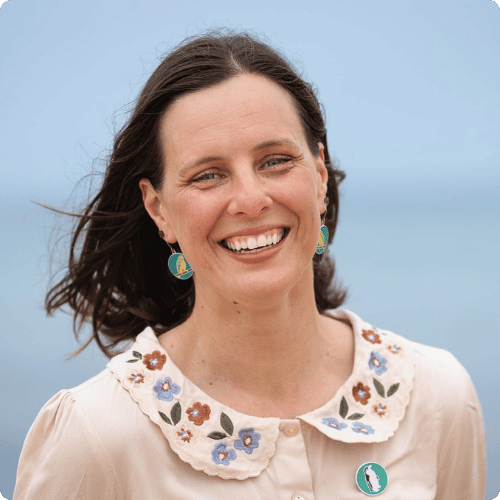
Paula Wasiak began her wildlife research journey in 2007 and spent over 15 years covered in penguin poop and elbow deep in burrows, while she coordinated and conducted field data collection for the Phillip Island Nature Parks. She is currently undertaking a PhD through the Australian National University, reintroducing the locally extinct Bush Stone-curlew back onto Millowl, Phillip Island. Named a Superstar of STEM in 2023/24, Paula loves sharing her knowledge with different audiences, from community groups to students, and occasionally on the radio and telly.
-
Kirsty Costa [00:00:00]
Hi, it’s Kirsty here. I was down at Phillip Island in southern Victoria recently watching the Little Penguins come in at dusk. Hearing those quiet gasps of wonder ripple through the crowd around me, watching those little flippers come up onto the shore - it’s truly magic. And it brought me back to this episode with Paula Wasiak. Paula has spent over 15 years working alongside these birds, learning how they move, how they breed, and what it takes to protect them. There are so many small details in this episode that will change the way you understand Little Penguins - how they stay waterproof and can remain in the water for hours, the way they gather out at sea before coming ashore, and the rhythm of their lives, mostly hidden from our view. Since we recorded this episode, Paula has started her PhD, now focusing on reintroducing Bush Stone-curlews to south-eastern Australia. You can hear more about that in Episode 98. I hope you enjoy listening back to this one. Here’s the encore of Little Penguins with Paula. This episode was recorded on Bunurong Boon Wurrung Country, the traditional custodians of the land, waterways and sky from the Werribee River to Wilsons Promontory in Victoria. I would like to pay my respects to Elders past and present. Long before the Great Pyramids of Egypt had even been built, the Bunurong Boon Wurrung people were here, living on this Country for tens of thousands of years.Kirsty Costa [00:01:37]
Welcome to Weekend Birder. I’m your host, Kirsty Costa. This episode is about an Aussie penguin. Forget icebergs and blizzards - the smallest of the world’s penguins is more at home in sand dunes and beach waves. Many thanks to Anita, Jo, Rachel, Sarah and Todd for requesting this pint-sized bird as today’s topic. Meet our Little Penguin expert and fellow bird nerd, Paula Wasiak.Paula Wasiak [00:02:05]
I first got interested in birds through my interest in wildlife. I asked my mum recently to find the earliest photos she could of me with wildlife, and she found this great photo of me when I was three years old patting a wild deer. I’ve had this connection to animals my entire life. My mum was also a wildlife carer, so I grew up surrounded by animals. My first job was in a pet shop that specialised in birds, and I think that’s when I really started to fall in love with them - seeing their behaviours and how different they are.Kirsty Costa [00:02:45]
Paula was named a Superstar of STEM, a program that increases the visibility of women and non-binary people in science. She studied zoology and marine biology, and during her honours year she was introduced to the weird and wonderful world of Little Penguins.Paula Wasiak [00:03:11]
I did a science degree majoring in zoology and freshwater and marine biology. During my honours year I researched reproductive physiology in penguins. I also volunteered with the St Kilda Penguin colony, which is an incredible colony right in the city of Melbourne. They started colonising the St Kilda breakwater after it was built for the Olympics, and now there are thousands of penguins there. It’s an amazing opportunity to work with penguins in an urban setting. For about 16 years now, I’ve been working closely with penguins in one way or another.Kirsty Costa [00:04:08]
Little Penguins live along the southern edge of mainland Australia, as well as Tasmania, New Zealand and the Chatham Islands. Phillip Island, known by traditional owners as Millowl, is famous for its Little Penguins and is just 90 minutes from Melbourne. Paula has worked there since 2009 with Phillip Island Nature Parks.Paula Wasiak [00:05:18]
Little Penguins are found across southern Australia and New Zealand, wherever they can find a place to nest - either burrows or crevices. They’re often found on offshore islands because of predator pressure on the mainland, especially foxes. A single fox can kill up to 30 penguins in one night. On islands, though, you can have colonies in the thousands.Kirsty Costa [00:05:33]
When people imagine penguins, they often picture black and white birds in Antarctica. But Little Penguins are quite different.Paula Wasiak [00:05:51]
Little Penguins are blue and white, not black and white. They’re only about 30 centimetres tall. The blue on their backs and white on their bellies helps camouflage them in the water from predators above and below.Kirsty Costa [00:06:58]
Little Penguins spend about 80% of their lives in the water and have incredible adaptations to survive there.Paula Wasiak [00:07:09]
They never feel water on their skin because of their dense, waterproof feathers. Underneath, their down is completely dry. They also have a layer of air for insulation and buoyancy. They can swim up to 12km/h and dive as deep as 72 metres. They can stay underwater for almost two minutes and spend weeks at sea, resting on the surface between foraging.Kirsty Costa [00:09:55]
Little Penguins are nocturnal on land and diurnal in the water.Paula Wasiak [00:10:08]
They forage during the day and come ashore at night to avoid predators. Before coming in, they gather in groups offshore - what we call rafting - and then come in together at sunset. They return to the same colony, and often the same burrow, year after year. They recognise each other by sound, not sight.Paula Wasiak [00:10:08]
They also go through a catastrophic moult once a year, losing all their feathers over about three weeks. During this time, they stay on land and don’t eat, so they need to build up fat reserves beforehand.Kirsty Costa [00:13:11]
Little Penguins also have fascinating breeding behaviour.Paula Wasiak [00:13:24]
They are socially monogamous but sexually promiscuous. They may breed with the same partner for years, but can have multiple partners as well. If breeding fails, they are more likely to change partners.Kirsty Costa [00:14:31]
Little Penguins are also very vocal, using sound to communicate with each other.Paula Wasiak [00:15:15]
Working with penguins at night is incredible. It’s just you, the penguins and other seabirds like Short-tailed Shearwaters. It’s such a special experience being out there.Kirsty Costa [00:18:02]
Paula is passionate about ethical wildlife research.Paula Wasiak [00:18:02]
We use technology like automated monitoring systems to reduce handling. When we do handle penguins, they are strong and will defend themselves. Conditions are changing rapidly, and it’s important we continue learning from them.Kirsty Costa [00:19:30]
Despite global declines in penguins, the Little Penguin colony at Phillip Island is thriving.Paula Wasiak [00:19:38]
The colony has grown from around 12,000 individuals to over 40,000 breeding adults. That’s due to conservation efforts - removing foxes, restoring habitat and even removing housing to create penguin habitat. It’s a powerful example of what’s possible when people come together to protect a species.Paula Wasiak [00:24:00]
For me, birdwatching is about slowing down and noticing what’s around you. It’s about relaxing, observing behaviour and finding joy in everyday bird moments.Kirsty Costa [00:24:55]
Thanks so much to Paula for sharing her knowledge and passion. I’ll speak to you again soon.