About this episode
You can learn a lot about a place by noticing which birds are still there. Kai Hill-Crofts shares stories of birds, ecology and growing up on Country.
Birds featured: Eastern Osprey, Superb Fairywren, White-bellied Sea-eagle
Episode illustration: White-bellied Sea-eagle
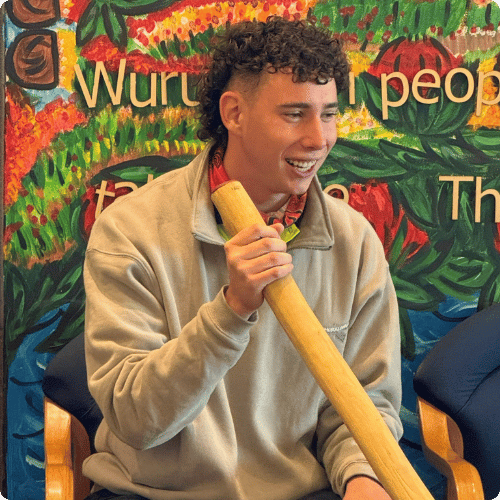
Kai Hill-Crofts is a proud Yorta-Yorta and Barapa-Barapa man with connections to Dja Dja Wurrung and Wurundjeri, passionate about sharing his culture and knowledge. He works as a trainee ecologist and Traditional Owner representative at Ecology & Restoration Australia, co-leads the Habitat Warriors initiative, and serves as Vice President of Eco Warriors Australia, focusing on Indigenous-led conservation and education.
-
Kai Hill-Crofts [00:00:01]
Right now I'm currently at Maldon driving through, so I'm on the drive around Country. I'm a proud Yorta Yorta and Barapa Barapa man with connections to Dja Dja Wurrung and Wurundjeri. I'd like to acknowledge the Country I'm standing on and pay my respects to Elders past, present and emerging.Kirsty Costa [00:00:17]
And I would like to acknowledge that I'm on the Country of the people of south-east Melbourne. It's such a privilege to live, work and play on this incredible Country with its bushlands, wetlands, waterways, ocean and sky. I pay my respects to Elders past and present and to their families.Welcome to Weekend Birder. I'm Kirsty Costa, and here together we notice birds. And joining us today is Kai Hill-Crofts. I've been a big fan of Kai's for a while now, so I'm thrilled to introduce him to you.
Hi, Kai. For people who don't know you, would you like to introduce yourself?
Kai Hill-Crofts [00:01:10]
I'm Kai. I'm a proud Yorta Yorta and Barapa Barapa man, and I'm a trainee ecologist for Ecology & Restoration Australia. So I do a lot of field work all across Victoria and across Australia.I also co-lead our school programs, and it's called Habitat Warriors. My role in that is creating a living classroom for schoolchildren. We run a lot of revegetation programs where we go from plant propagation to seed collection to our planting days, and then we also do our monitoring classes where we turn them into environmental scientists.
I also run the cultural heritage classes with that. It's all about learning from 65,000 years ago. I get the students to close their eyes, and then they've got to learn how Indigenous kids learnt back in the day through dance, through songlines and through Dreamtime stories and through artwork. So there's no pen or paper. It's all from outdoor classes.
And that's a bit about me.
Kirsty Costa [00:02:11]
Thanks, Kai. One of my favourite questions to ask Weekend Birder guests is how did birds first come into your life? And I'm wondering how this journey of being an ecologist and educator started for you.Kai Hill-Crofts [00:02:23]
I've been working in the environmental industry for about four and a half years, and it started with a company called Wetland Revival Trust. Our main goal was working up in northern Victoria around the Kerang area, and we restore farm dams, and we also revive wetlands because it's all on Country where I've grown up.Where I've grown up is a place called Kerang, and the Indigenous word for Kerang is surrounded by water. And now that I've got older, and now I'm a trainee ecologist, there are over 30 Ramsar sites where I've grown up as a kid. So we're surrounded by water.
And now I get the privilege to come back and do a lot of surveys. If that's fish, if that's frogs, if that's birds, all around these wetlands, and yeah, get to see the healthy ecosystems thrive.
Kirsty Costa [00:03:13]
That's really awesome that you're continuing to care for the Country where you grew up. And I'm curious to know whether you would consider yourself a birdwatcher.Kai Hill-Crofts [00:03:22]
The last 12 months I've really started to become a birder, but my younger brother Taj is one of the best. Like, the best birder I've ever met. And I've worked with some very, very smart ecologists, but yeah, my younger brother takes the cake.We were sort of rescue carers. If there were any animals around the district, they would always bring the animals to us, and we sort of thought it was Taj's job to look after them. At one stage we had a couple of Tawny Frogmouths, and I remember growing up with them. And every night we'd just look out on that big aviary and you would have all these Tawny Frogmouths, and you'd have all the nightjars around.
I've always been surrounded by birds, but it's not until I've become a bit older where I've actually started looking for them. They were just around.
Kirsty Costa [00:04:07]
Do you still get to go birdwatching with Taj now?Kai Hill-Crofts [00:04:10]
Yeah. He's like an Indigenous ranger, and we do a lot of the bird surveys, and it's almost sort of like a competition with us now these days. It's a friendly brotherhood competition. Who sees the next bird?Unfortunately, he is winning by a mile, which I would never let him know. But it's always good to go out, and it's always a bit of a competition. Who can find the rare bird?
I still remember the first ever time I got to do bird surveys. It was definitely a dream come true, but I never thought my dream was going to be getting paid to look at birds. And it's amazing because I get to talk to my brother, and now my younger sister, who is in high school, she's starting to become interested and starting to join us and starting to learn.
Kirsty Costa [00:04:55]
I love it. You're not the first Weekend Birder guest to say that they've got an ongoing competition with a sibling when it comes to birdwatching, and you definitely won't be the last.You're working on some really interesting bird conservation projects that combine your ecology training with traditional knowledge, and one of these projects is the edible habitat pods. Can you tell us about it?
Kai Hill-Crofts [00:05:15]
The edible habitat pods are traditionally woven out of lignum, or tangled lignum, and cumbungi or bulrush. I made the idea and it was for small-bodied native fish. That was the first idea of this. It's called the zombie fish, or the Southern Purple-spotted Gudgeon. It was put in waterways to help small-bodied native fish, for more structure, and put a potted plant in.And then I was doing a presentation and the wonderful Kylie Sones came up to me and said, have you ever tried this with Superb Fairywrens?
And it took me by surprise, and I said, oh, I can look into it.
And I remember there's this Dreamtime story where they talk about the Superb Fairywren, or “wild people”, and it means little one of the lignum bush. And we make our pods out of lignum. And I thought it was a no-brainer to try to use these pods, as I'm trying to trial them as a nest, as like a nest box with a bit of habitat.
With the pods, the lignum is really soft and the fibres are really soft, so it's easy to weave. But once it dries out, it goes rock hard. I tell this story to the kids. I had a pod in the back of a trailer drying, and the pod bounced out in front of an oncoming truck. I had to quickly slam the brakes on, go grab the pod, and it was in perfect condition.
So I tell the kids, a truck can hit a pod and the pod doesn't break. They're invincible.
So we're trialling these pods at Westgate Park and Royal Park in the coming months. We've already had Superb Fairywrens check them out, but I would love to see if they could come in and nest. They'd love to nest in that tangled sort of mess of an area, and trialling this could be a safe method in urban park areas where there's known foxes and cats, if they can nest in there.
Kirsty Costa [00:07:08]
It's such a cool project. I love the focus on giving urban birds a new place to nest, and I'm really impressed by the way that you picked up a project about fish and were able to put it down for birds. So good. Shout out to Dr Kylie Sones as well, who's a good friend of the Weekend Birder community.Kai, can you describe the pods in a bit more detail? I'd love us all to imagine what they look like.
Kai Hill-Crofts [00:07:31]
It is like the size of a washing basket. So imagine a washing basket, and how you've got the cross weaves. Them cross weaves is like the cumbungi or the bulrush in the inside, and you push that and mould it in, and then the lignum on the outside is like your hut.So it's got exactly the same replica as a washing basket, and you flip your washing basket over, and you've got that sort of hut look. That's the best way to describe it.
You have to build a habitat pod using as much traditional knowledge as possible. As we're sitting there, I'm working with Landcare groups, weaving the pods. So you're sitting all in a circle talking, and as you're talking, you're getting their local knowledge.
So I'm trying to weave all the three sciences together. You've got the traditional knowledge of the pods. You've got the local knowledge of the Landcare groups that tell you where they've been seeing the Superb Fairywrens. And then you've got your Western science, which is the further surveys on the pods.
So trying to weave the three sciences together in my pods.
Kirsty Costa [00:08:36]
I'll put a link to the Habitat Warriors website in the show notes if people want to check it out.I really like the way that you're getting people involved in bird conservation through hands-on projects and important conversations, and you're also doing this in your school education programs. Can you tell us more about that?
Kai Hill-Crofts [00:08:52]
With birds and Indigenous astronomy, they link very well. The Barapa, which is over near Swan Hill, near where I grew up, about a 40-minute drive, they pride themselves as the best astronomers in Australia, and a lot of their constellations refer to birds.There would be over 10 different constellations of different birds, like the Red-rumped Parrot, or the Emu, or the crow, or Bunjil, the Wedge-tailed Eagle. So many different birds.
And it's because birds are stubborn compared to a lot of other animals. When we think of a lot of marsupials and that, they can nest sort of all year round, where our birds like to nest at the same times each year. So it's very easy to find them in the night sky at each time, which the Barapa clan done.
So it was like a database for them. When they would look up at the night sky and they would see these certain animals in the night sky, they knew it was their breeding time. So they knew you weren't allowed to eat them, you weren't allowed to touch them. It's their breeding time.
And I like to teach the students that because it's a step into Indigenous sustainability and how we do that.
And I've got this beautiful big poster of birds and when they nest, and I've got all these cutouts. We go on a basketball court and they've got to pick a bird up, and we've got this big circle, and you've got January all the way around to December, and they've got to grab a bird and they've got to go put it on the month they nest in.
And then the next thing is they go get an Australian plant or flower, and when that nests - or flowers - they put that on the next part of the circle. And then you can go up and it starts to show your seasonal calendar. It starts to show you've got your astronomy, you've got your birds nesting, and you've got your plants flowering.
And it's that stepping stone onto how everything's connected from the night sky, to our birds nesting, to our plants flowering, and how you can look at one plant flowering. And it gets our kids, hopefully when they grow up with this knowledge, and when they see the kangaroo grass dropping, they know that the Superb Fairywren is about to nest.
It's about how everything's connected.
Kirsty Costa [00:11:05]
I think that there's also lots of adults listening who would love to learn more about this, Kai. Thank you for helping young people better understand the world around them through different knowledge systems.It wasn't something that was part of my school education, and as an adult I've spent a lot of time unlearning and relearning what I know about the living world. And one of the big learnings for me has been about the seven seasons of the Country that I live on.
In school, I was taught about four seasons, but thanks to my friends in the Eastern Kulin Nation community, who are the Traditional Owners of Melbourne and surrounding central Victoria, I now see the year pan out in a whole different way.
Can you share with us what you know about these seasons?
Kai Hill-Crofts [00:11:42]
I could talk about this all day, and if everyone that's listening, check out Seven Seasons documentary. That's talking about the seven seasons. It's a beautiful documentary and that will explain it in a bit more detail.But with me, I'm looking at more animals and plants, and when we can see them in our own backyards and schools and what seasons they mean. I do a lot about seasonal indicators, a lot about the kingfisher and the Rainbow Bee-eater, and how when they come, we know we've got to start approaching warmer weather. And once we see them take off, we know it's cooler weather.
And then I'll link that to ecology. So once we see them go, we know we've got to start planting. And then once we start seeing them coming, we know we've got to cut planting. And that starts getting in with our harvesting.
There are so many different seasonal indicators, and I love to talk to students about that. Especially about when you start to see more reptiles, we know the warmer weather is approaching.
And it's all about just ways that you can tell the seasons, and the proper seasons. Like when we talk about autumn, when all our leaves fall off, there's not many Australian plants that lose their leaves in autumn.
So it's really good to see all the different seasonal calendars that are coming out in Australia and linking them to what we can see in our own backyard.
Kirsty Costa [00:13:04]
I hope that everyone starts to see the living world around them a little bit differently after listening to Kai.I'll put a link to the Seven Seasons film in the show notes. And Kai, I know this has been a project that you've been part of, so congratulations to you and the team.
You've grown up around Gunbower on Yorta Yorta Country at the top of Victoria in southern Australia. I've heard about this special place, but I've never visited. I'm curious to know, what is it like?
Kai Hill-Crofts [00:13:27]
Gunbower Island in the gulf is the biggest inland island in Australia, and they call it the Kakadu of the south. And I couldn't put any words into how beautiful it is, especially right now. It is absolutely flourishing.When we do the bird surveys, before we even get to put the kayak in the water, we're already up to 20 birds every single time. The calls are all around you.
And then I recommend anyone bring your kayak down and go for a paddle. The birdlife is just amazing, and especially on the Murray River, all the wetland birds you get to see. You can count hundreds to 200 birds in just one billabong. It's just amazing, and it just takes you by surprise, the amount of birds nesting as well.
I think that's definitely because birds nesting is a healthy indicator of healthy Country. So whenever I see a bird's nest, it always puts a smile on my face straight away because I know I'm walking on healthy Country.
And when you're paddling along and all you can see is all your wetland birds, like your egrets and your darters and all your ducks, and then you've got your baby swans coming around.
You look up and there's a White-bellied Sea-Eagle's nest that's in Gunbower, and that's my favourite bird of all time. And just seeing the White-bellied Sea-Eagle's nest there each year, it just puts a smile on my face.
Kirsty Costa [00:14:59]
Wow. I never knew that about Gunbower Island, and now it is officially on my bucket list.And thanks for reminding us that bird nests mean healthy Country. That's something I'll need to remember when I'm walking on Country.
As someone who's lived on the same Country for such a long time, and now who looks at it through the eyes of an ecologist and a Traditional Knowledge holder, what changes have you seen? Have things changed a lot?
Kai Hill-Crofts [00:15:22]
When I think of the Murray now and what I hear from our Elders, we can already see the change from the fish to the clean water. But also the birds are a huge change.When I think of the Murray, I think of the kingfishers as I'm going down in my kayak. I also think of all the reed-warblers and all the waterhens running around.
But there's stories about the Osprey that used to live all along the Murray, and there's even a Barapa and Wamba word for the Osprey. That's because they can only hunt in clear water. So once the water got murky from the European carp, the Osprey unfortunately died out.
But now when I think of birds like Brolgas and the Magpie Geese, who are very, very rare to see on the Murray these days, it makes me start to think, will things like the kingfisher start to disappear? And will it just be a word that we think about in the future?
And a lot of these other birds that are becoming less rare on the Murray, yeah, it's just definitely something that unfortunately, when I'm looking at the Murray, starts to burden me and I start to think about.
Kirsty Costa [00:16:38]
That's so interesting, and also a bit sad to think that the Osprey once lived in that area and is no longer there. I had no idea.I've recently been thinking about the concept of natural history. For those who are new to this space, natural history is recorded through observing plants and animals in their natural ecosystems. Famous natural historians include Charles Darwin or Gerald Durrell or David Attenborough.
And what we don't talk about as much is the natural history that's been observed by our First Peoples over tens of thousands of years. Language and songlines and other ways of communicating about traditional knowledge can tell us even more about the history of Australia's birds and animals and plants, can't they?
Kai Hill-Crofts [00:17:21]
When I heard about the Osprey being there, I only found out because of the language.But there was also another rare bird that not many people pick, which is the lyrebird. It has a Barapa and Wamba name, which is pretty crazy because, remember, that's brought up near Swan Hill and Kerang. And that's a pretty far way to travel.
Was it the lyrebird who travelled up to the Murray? Or was it Barapa and Wamba who travelled down to the forest?
And I think that's learning back this language. That was something that I will never know the answer to, but it's just pretty interesting that so far up on the Murray, people had a name for the lyrebird.
Kirsty Costa [00:18:01]
Wow, that's so interesting. I wonder who did the travelling.Kai Hill-Crofts [00:18:04]
That's true. It's very crazy.And you think, for so many, like tens and tens of thousands of years, the Murray landscape that we see now wouldn't have been the Murray landscape that it is now. So were there forests that the lyrebirds ran through? Who knows?
Kirsty Costa [00:18:21]
We talk about breakthroughs in Western science, and something that Weekend Birder listeners may not realise is that traditional knowledges of Aboriginal and Torres Strait Islander peoples is also growing and thriving today.Traditional knowledges can be rooted in the past, but are evolving over time, just like our individual learning does.
Kai Hill-Crofts [00:18:41]
Definitely. You're always learning so much every single time you go out to a forest. If it's a different bird you might see or a different nest you might see, you're always finding new things.Kirsty Costa [00:18:56]
As I listen to you talk, Kai, I'm reminded that birdwatching isn't always about seeing something new. Sometimes it's about returning to the same place and noticing what's still there.Thanks so much for sharing your experiences with us.
Before you head off, I've got one final question for you. For someone who's listening, who's just starting out, or who feels like they don't quite know what they're doing yet, what would you want them to know about birdwatching?
Kai Hill-Crofts [00:19:22]
There's so many different, like Co-Exist would definitely be a big one to jump on there. Young people, they get a heap of young people and they go out and they do plantings, and they go out and get out and do bush hikes. They're running some camps at the moment.I feel like just getting amongst other people that are like-minded is definitely the way to go. Like with, for instance, my younger brother Taj, we've been able to see a bird and call each other. Oh, look, this is what I've seen.
You need that, and that keeps your passion and enthusiasm going, getting around like-minded people.
And yeah, that definitely would be my tip for anyone. Get a mate and go out and look at a lake and start finding some birds, and then you never stop. You won't ever stop.
Kirsty Costa [00:20:19]
And that's how I found myself hosting a birdwatching podcast.Kai Hill-Crofts [00:20:22]
Haha.Kirsty Costa [00:20:24]
Kai, thank you. I really love this conversation and I hope Weekend Birder listeners have as well. Thanks for sharing your big heart and your big smarts with us. There's still so much to learn about the world and it's been a joy learning alongside you.You're part of so many great programs, and I'll put a long list of links in the show notes, I think, including your Instagram account if people want to chat further with you.
And listeners, you can find me at Weekend Birder. Thanks so much to everyone who's been supporting the podcast so far. You've been so good to me and I'm super grateful for this ever-growing community.
Speak to you again soon.