145 Woodland Birds
About this episode
Woodlands can feel empty until you learn where to look. Ecologist Emi Arnold shares how to identify the birds living in Australia’s woodland habitats.
Birds featured: Brown Treecreeper, Diamond Firetail, Glossy Black-Cockatoo
Episode illustration: Diamond Firetail
Resources
Woodland bird recordings are by Marc Anderson - licenced from wildambience.com
Meet the guest
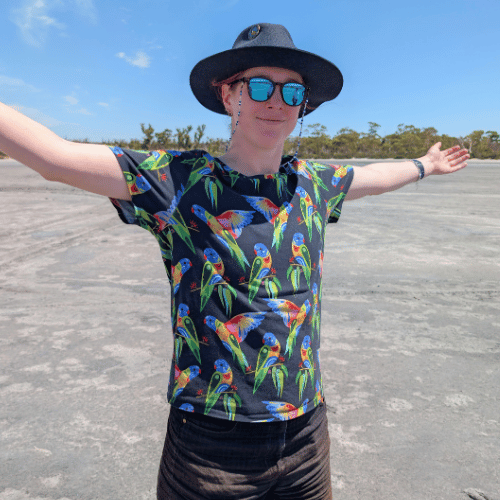
Emi Arnold is a consulting ecologist based in Melbourne. Conducting fauna surveys throughout south-eastern Australia also means she has plenty of time to keep an eye out for birds - perks of the job! Her specialty is woodland bird survey and driving positive conservation outcomes for threatened species on projects. When not birding for work, Emi is often out birding while camping, talking at her friends about birds, or planning her next birdwatching adventure.
-
Kirsty Costa [00:00:00]
This episode was recorded on Wurundjeri Woi-wurrung Country here in Naarm, Melbourne. My connection to Wurundjeri Country is really strong. I was born on this Country and I regularly return to see my family and friends. I pay my respects to Elders past and present, and to their families.Kirsty Costa [00:00:34]
This is Weekend Birder. I'm Kirsty Costa, and if you are a bird lover, you are in the right place, my friend. One of the best things about this podcast is its community. Each week, thousands of people from around the world tune in together, and each week, some of those people use the form at Weekend Birder to request a topic. In this episode, we're focusing on woodland birds, and I'm sending my thanks to Adam K, Bianca K, ML, John T, Shauna L, and Tony M. Some people fall in love with birds later in life, and some people grow up noticing them from a young age. For our guest, Emi Arnold, it started in the backyard.Emi Arnold [00:01:16]
I first got into birds probably through my grandmother particularly, and then my parents. So I remember my grandma taking me around the backyard and pointing out different birds in the backyard when I was super young. And then when we moved to Melbourne, when I was about five years old, my parents got into birdwatching because there were all these new and exciting birds in their backyard. And so I kind of went along for the ride with that as well. And they bought me the field guide to the birds of Australia, and I could not put it down. I just never really stopped looking at it.Kirsty Costa [00:01:50]
These days, Emi spends a lot of time with birds, but in a slightly different way.Emi Arnold [00:01:55]
I'm a consulting ecologist, predominantly a zoologist, working for an engineering firm in Melbourne. So a lot of my day-to-day role involves fauna-targeted survey. So a lot of bird surveys, traditionally the two-hectare 20-minute bird count, the BirdLife Australia method, but a lot of spotlighting as well for nocturnal species and kind of more specialist stuff for, say, Orange-bellied Parrots or Plains-wanderers. So survey is predominantly something that we do to see the species assemblage or species richness, so how many birds are there, or for occupancy. So if we've got a particular target species and we want to see if it's present in particular habitats. So we'll go out and we'll either just make a big old list of everything that's there, everything that we can see, everything we can hear, or we'll go out with a particular species in mind and we'll do call playback, or spotlighting, or look for nests, or look for other signs like scats, or for birds of prey we'll look for big nests with bones or fish or anything underneath them and look for occupancy that way.Kirsty Costa [00:02:57]
And this is where Emi's work becomes really interesting.Emi Arnold [00:03:01]
It depends on our client's project. So some of them are to get baseline conditions before a project is being built. So if there's going to be an impact on the habitat and we want to know what was there beforehand. Because we often do before, after and control survey. So we'll do the before baseline surveys, we'll do the during-construction surveys to see if the birds are persisting in that area, and then we'll do post-construction monitoring to see if birds are recolonising or if they're using the habitat that's created for them, or if they've disappeared entirely, which is obviously something that we try to avoid as much as possible. It just depends on the project.Kirsty Costa [00:03:43]
Some Weekend Birder listeners may assume the worst when they hear about a housing or commercial development. As a scientist who helps to survey and evaluate projects, Emi sees it a little differently.Emi Arnold [00:03:54]
For a lot of our clients, it's not just fulfilling an obligation as well. They are required under Commonwealth and state legislation often to do these kinds of things, but some clients do want to go a little bit further and say, okay, we've done the bare minimum, but can we do a little bit extra just to see if we can make the habitat better for a couple of extra species at the end of the survey? Or if we can avoid impacting a species entirely by just changing an alignment of something by 50 to 100 metres to avoid bigger trees or something like that. Just trying to make everyone care about the birds.Kirsty Costa [00:04:27]
In Australia, a woodland is a forest that's halfway between a thick rainforest and a grassy plain. In a woodland, the trees are spaced out enough that their branches don't touch. This allows plenty of sunlight to filter down to the ground, creating a sunny floor where grasses, wildflowers and small shrubs can grow. If you want to get really sciency, the key feature of a woodland is the tree canopy cover. Woodland usually has a canopy cover of between 10 and 30 percent, and Emi says that woodland categories are often named after the main tree that lives there.Emi Arnold [00:05:01]
I am based in Melbourne obviously, so I work predominantly in the south-east of Australia. So in Victoria particularly, we've got some pretty big remnants of the box ironbark woodlands left. But I also do a lot of work in southern New South Wales where you get more of that cypress pine woodland, and still just a lot of grey box and red gums and riverine woodlands there. But I do also dabble occasionally in some mallee woodland, but that's more for fun than for work.Kirsty Costa [00:05:31]
I wonder if you've ever birdwatched in a woodland. I mainly hang out in the stringybark forests of south-eastern Melbourne, and these woodlands feel like home to me. When I get time for a long weekend, I head to the box ironbark forests of the greater Bendigo region in central Victoria. This type of woodland feels different - darker, drier and with a lot more honeyeaters. Emi says that no matter which woodland you're in, the first thing you should do is stop and look around.Emi Arnold [00:06:01]
Before I start the survey, often when I've parked the car and I'm walking into wherever my survey point will be, or if I get to the survey point before I formally start the survey, I'll just have a look at the different layers. Because it's different when you're surveying at a woodland versus, say, on the beach. Because at the beach you've got the sand and the dunes and whatever vegetation cover is there, but in a woodland you've got all the woody debris on the ground, and some birds specialise in foraging on the ground. You've got any kind of shrub layer, if you've got grasses, if you've got anything flowering in there, that's got a whole different class of birds. Your tree trunks, you'll get things like treecreepers, and then obviously everything foraging around there, but then also the canopy itself. So I just kind of look at how many layers I'm dealing with there, think about if I've got any target species, what kind of layers they're more likely to be in, and then go from there. And I'm always listening just for little signs of noise or any particular big calls. So it's just kind of a broad reconnaissance of the area before I start actually looking for the birds.Kirsty Costa [00:07:04]
That's good advice. I like to think about woodland layers like nature's apartment building. Each floor has different tenants living in it. The basement is below ground. The ground floor is where the grasses and flowers and small ferns grow, and where you'll find leaf litter and branches and logs. Next up is the middle floor, which is called the shrub layer. It's made up of bushy plants and younger trees. And then there's the top floor, which is called the canopy. I don't know if that's simplifying science too much, but that's how I remember it - basement, ground floor, middle floor, top floor. Emi says that when she's surveying and birdwatching, she's looking for different birds living in these different layers of a woodland.Emi Arnold [00:07:50]
When I'm doing a sweep, I'll obviously look in the canopy first because that's where the birds live in the tree, so you go and look at the trees first. So I'll go and look predominantly for the small birds up there, particularly on the ends, or if anything's flowering, because that's where you get your thornbills, your weebills and all those tiny birds, lots of honeyeaters as well. But then I'll move down the tree. So in those mid-branches, all the whistlers and the shrike-thrushes, butcherbirds, choughs, babblers are often in those mid-branches as well, if you haven't already heard them and they haven't made themselves known, any kind of hollows as well, because I'm always on the lookout for hollows, because that's just important habitat to note. And then I'll move down to the trunk and any kind of ground layer. So on the trunk you'll get treecreepers, that kind of thing, but on the ground you'll get treecreepers. I've even seen Diamond Firetails foraging on the ground, fairy-wrens, all that kind of thing, and other ground-dwelling species like Yellow-rumped Thornbills and stuff.Kirsty Costa [00:08:44]
In a woodland, it's impossible to see everything at once. Most of the time you can't see the horizon. So Emi suggests that the best way to start is to notice the first small movement.Emi Arnold [00:08:56]
If I'm looking in the canopy, I'll use my binoculars to look for any kind of movement, because the tip that I was given super early on in some cypress woodland by a very, very experienced birder was if you find one or two small perching birds, the little passerines in the crown of a tree, if you sit there for 10, 20 minutes, generally more and more will come in or they'll make themselves really obvious. Because all those tiny birds out during the day, they're obviously quite susceptible to birds of prey. And so if there's a couple around, others will say, okay, these guys are safe, they're foraging, or there's resources, or there's cover, and then they'll all come out. So I kind of look for those signs of movement and then just sit there and watch for a bit. And I'm going to say probably 80 percent of the time, more birds do come in or make themselves apparent, which is always really interesting. You just sit there and watch, and then more things become obvious as soon as you see that first motion.Kirsty Costa [00:09:53]
Once you know which birds live in what layers, bird identification becomes much easier. Another way to recognise woodland birds is learning how they move.Emi Arnold [00:10:03]
I guess the classic example is your cockatoos. So I always describe to people that Galahs and Gang-gangs fly like they're drunk, because they're just kind of flapping around all over the shop. They can't fly in a straight line. They're dipping and weaving and all over the place. Whereas Yellow-tailed Black-Cockatoos, they kind of fly like they're in slow motion. They're flying through soup. The honeyeaters are like a little missile. They're just straight to the point, which makes it really, really helpful - or not helpful at all - when you're trying to just catch a look. It's like, was that White-naped? Was that Lewin's? I'm not sure. And then you get fairy-wrens that kind of just flit around on the ground in little short bursts and kind of bob up and down.Kirsty Costa [00:10:40]
For me, another sign that I'm looking at honeyeaters is that they're chasing each other around the trees. Emi says that she's been practising learning how to identify woodland birds by their calls, and the ways that they communicate with each other.Emi Arnold [00:10:53]
When I first started birdwatching five years ago, a friend and I went to Long Forest State Park out in the western suburbs of Melbourne. We got there bang on dawn, like, oh, we're going to see so many birds, we're going to learn so many things. But we were both new to birding and we were just there at dawn with all this amazing stuff going on. It's just a wall of sound, the dawn chorus. And we realised, oh, we don't actually know any of these except the magpies and the cockatoos. And eventually we worked out, oh, there's a bunch of pardalotes in there as well. That was kind of a bit of a wake-up call, like okay, I have to take this a bit more seriously. I have to actually get up early and go and learn it. I find it's really helpful camping as well, because I love camping and I love birds. So you're kind of stuck there and you're like, oh, I'm awake because of the birds, I'll just poke my head out and have a look. So I think the main thing to learn all the calls, the first one is be kind to yourself because you're never going to learn it all super quickly. And so I figure if I can come away from a particular trip with one bird call associated to a species, that's a nice realistic target, and then you can build on that each time you go. And if you're going regularly, it all adds up pretty quickly. But it's just so unrealistic to expect to know them all super quickly. And if you go into new areas as well with new species coming in. Yeah, I guess the main thing is be kind to yourself and be realistic about it. But even still, I've been doing this for four and a half years and I'll still get caught out by Eastern Yellow Robins and Eastern Spinebills and White-throated Treecreepers, like, oh, did you just stop early or are you actually a treecreeper, because all their calls are so short and sharp and very similar. And it's just kind of how long they go for being the key determinant. Or I've done a survey where I was looking for Diamond Firetails and I could hear them all around me. I was like, oh, this is fantastic, I'm getting so many. And then realised it was a Crested Shrike-tit sitting up in the tree above me with a super similar call. I'd never seen or heard one before. I wasn't to know. And so my records of Diamond Firetails were probably this one bird following me around.Kirsty Costa [00:13:01]
A lot of the time, the only way that I can remember a woodland bird's call is through repetition - listening to a recording before I head out on a walk and listening to the actual bird while I'm in the forest. Emi says that she's the same.Emi Arnold [00:13:17]
A lot of it is just through reinforcement. I'm particularly old using examples like Brown Treecreeper. It's just such a short, sharp little call, like a little peep. It could be anything, but it's just because I've seen them so many times just sitting on logs or on a tree trunk or in a campground, and they'll be peeping away. And so it's just kind of that sight and sound linkage. I've just formed that connection in my head, and that's how I've done it. It's just, yeah, lots of repetition. The first time I saw and heard Glossy Black-Cockatoos, I'd done a little bit of reading up on them because I was going to be in the right habitat, but I knew it was going to be a long shot. It's like, oh, I'll just listen to the call the week before just in case. But it's a long shot. And then I heard them out in the bush that day, and I was with someone from the area and he's like, oh, what's that? I'm like, that's a Glossy Black-Cockatoo, of course. I'm like, why am I saying this with any authority? I've never seen or heard them before, but I just knew.Kirsty Costa [00:14:41]
And now you know the call of the Glossy Black-Cockatoo as well.In birdwatching language, a bogey bird is a bird that you've been trying to see for years, but always miss out on. Emi's bogey bird was the Diamond Firetail, which is a bird that we haven't talked about on the show before.
Emi Arnold [00:14:59]
That was a bit of a white whale for a couple of years, when I was just birdwatching to get skills up really quickly. I was going out to Eynesbury and a lot of other grey box forests around Melbourne just to try and catch sight of one. I'd see them on eBird like, oh, someone saw them this morning, I'll go out there this afternoon, I'll try and catch them in the afternoon. And they eluded me for so long. I was getting swooped by magpies walking around the trails. I was like, oh, I'm not sure if I'll ever get to see them. And then the first time I saw one, I'm like, oh, this is one of the most spectacular birds I've ever seen in my life. This is awesome. And now I've been lucky enough to work in a bunch of different habitats. Now that I've seen one, now I've seen like 50, because you see that first one, you learn a bit more about where they are and what to listen for, and then you just notice them everywhere.Kirsty Costa [00:15:44]
If you've never seen a Diamond Firetail before, and it's safe to do a Google search right now, I highly recommend looking it up. If you can't, here's a description from Emi.Emi Arnold [00:15:55]
They're a little nugget kind of finch. Imagine a normal House Sparrow, but with a bright red beak and a little red patch right above its tail. The beak is kind of blood red, you could imagine, and around the middle of its breast, onto its wings, is a black band, and on the edge of its wings are all these little white polka dots. The rest of it's quite plain. The majority of the wings are just a kind of dull brown, and the head's grey. The breast is kind of off-white, but it's just the striking contrast of the red beak and the red tail with the black and white spots through the wing. It's just so striking. The males and females look exactly the same, so you don't have to sit there and agonise over, is it a female of this species or a female of the other species, like you do with whistlers or some other bird. You see a Diamond Firetail and you know it's a Diamond Firetail.Kirsty Costa [00:16:56]
How funny is the Diamond Firetail song. Thanks to Marc Anderson for his recordings.The latest data from BirdLife Australia is that over one third of Australia's land birds - almost 200 species - depend on woodlands to survive. And with 80 percent of temperate woodlands having been cleared, at least one in five of these species is now threatened with extinction. It's a hard fact to digest, and I'm grateful to scientists like Emi who are using data to help others protect what is left, and keeping everyone else accountable.
And as a bird lover, you can look out for signs that a woodland is healthy as well.
Emi Arnold [00:17:32]
Yeah, I guess the main thing would be lots of big old trees, particularly with hollows in them. I'm going to use the example of grey boxes or cypress pines. They grow pretty slowly and hollows can take a good couple of hundred years to develop in those trees. And that's true of most Australian trees, to be honest, but particularly in the kind of woodlands that I go birding in. So I guess the presence of lots of hollow-bearing trees is the main thing, because if you've got hollows, you've got habitat for any number of bird species as well as things like Lace Monitors and mammals, but they're not as important as the birds. And depending on if it's a box ironbark or if it's a cypress pine, box ironbark might expect a bit more of a grassy understorey than a shrubby understorey. So getting into that grassy eucalypt woodland or grey box grassy woodland ecological community. So in those kinds of habitats, I'm looking for it to be pretty open, pretty grassy, but with lots of woody debris, because that'll have habitat for stuff like Brown Treecreepers, which I'm often looking for in habitat like that. If it's a cypress kind of woodland, I'm generally looking for stuff like an understorey - any kinds of acacias or anything. Again, lots of woody debris because that's handy for things like babblers to make their big ball nests out of. It kind of depends on a bit of background knowledge about the vegetation itself. But I guess one common factor is that woody debris is really important for all the birds, whether it's for foraging or nesting.Kirsty Costa [00:19:01]
Of course, woody debris in Australian woodlands refers to dead fallen trees, logs and large branches that are on the ground. Woody debris is an essential habitat for lots of different types of animals, so it's worth thinking twice before you decide to collect them for your fireplace at home. I've put a link in the show notes to some great advice from the Conservation Regulator in Victoria, which could be used in any part of the world, I guess, about how to ethically source firewood and what to watch out for. I've also put a link to BirdLife Australia's Woodland Birds program, which is also worth checking out. There are lots of ways that you can be a friend to woodland birds.Before Emi heads off, I've got one final question for her. There are so many places to go birdwatching. Where is she dreaming of next?
Emi Arnold [00:19:45]
Yeah, so I mean, the list is everywhere because there's just so many birds to see. But I think I really want to go to Gluepot Reserve in South Australia because just the mallee and everything about getting into more of that outback kind of area and all the birds that come with it, I just think it's something that's so special. It's just that little bit too far from Melbourne to make it super feasible as a day trip, which makes it all the more special to go and see stuff like that. And there's just so many interesting species out there, all those mallee specialists. And I think that would be just Candyland for birding.Kirsty Costa [00:20:20]
You can hear it in Emi's voice, can't you. There's always another place to go and another bird to find. Gluepot Reserve is a BirdLife Australia property in regional South Australia, and I've put a link to the website for you in the show notes.I'm really grateful to Emi for her work in science and in conservation, and the way that she appreciates the birds around her. I've learned so much about woodlands, and I hope you have too. If you'd like to stay connected, you can find me on Instagram and Facebook at Weekend Birder, and on my website Weekend Birder. If you're after some birdwatching merch, I've just launched a new Weekend Birder T-shirt and you can find it on my website. All money raised goes back into this podcast so that it stays ad free. Thanks to everyone who's shown their support by buying a T-shirt. Tag me on socials if you wear yours out and about. Speak to you again soon.