144 Becoming a Birdwatcher
About this episode
Birdwatching can quietly change how you see yourself. Mia Grundy shares how everyday birding and photography has helped her through tough times and shaped her identity.
Birds featured: Rainbow Bee-eater, Sacred Kingfisher
Episode illustration: Rainbow Bee-eater
Resources
Rainbow Bee-eater recording is by Marc Anderson - licenced from wildambience.com
Meet the guest
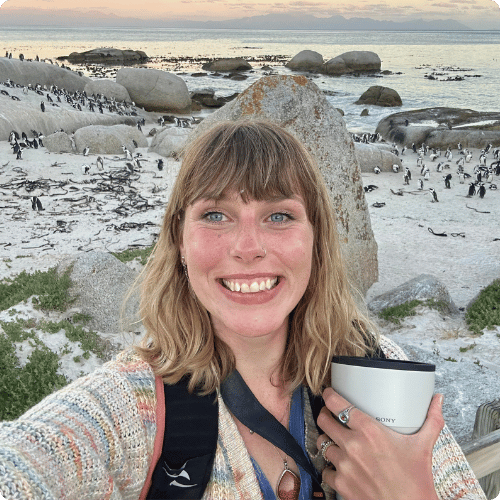
Mia Grundy is a nature photographer and keen birder based in Melbourne. With a background in Wildlife and Conservation Biology, she developed a deep appreciation for birds while studying and spending time outdoors. What began as a curiosity quickly grew into a passion for observing and photographing birds across Australia and overseas. Mia enjoys documenting species through photography and citizen science platforms such as eBird and iNaturalist. She is passionate about encouraging others to connect with nature and believes birding is something anyone can enjoy, regardless of their background or level of expertise.
-
Kirsty Costa [00:00:00]
This episode was recorded in Melbourne, Australia. Melbourne is known as Naarm by the Wurundjeri Woi-wurrung people, whose Country we have the privilege to be on. I pay my respects to Elders past and present, and to any First Nations person from around the world listening to this podcast.Welcome to Weekend Birder. I'm Kirsty Costa, and here together we notice birds.
I've been thinking a lot lately about social media, its challenges and its benefits, because it's through social media that I get to introduce you to Mia Grundy. Mia and I have been Instagram buddies for years now, so it's really nice to have her on the show to talk about the life of an everyday birdwatcher.
Mia has always loved being outside, and like many of us, birds came into her life gradually.
Mia Grundy [00:01:02]
Well, I've always been a lover of nature and being outdoors. I did my wildlife and conservation biology degree a couple of years ago. And then over time, I found myself drawn to birds in particular.So I used to go hiking and walking just to have some fresh air, but then birds gave me a deeper meaning to be outside. And yeah, I think in 2021, I bought my first field guide, the Simpson and Day one, and then it became a passion of ticking off checklists and learning which species were in each area.
I didn't know the difference between a Rainbow Lorikeet and an Eastern Rosella at the time, so we had a lot of work to do. And then over time, I've just fallen in love with all different species, and even going interstate or overseas to find different birds.
So it really becomes a mission now to be like, oh, where am I going to go? What birds are going to be there?
I find when I go walking with my friends now, we go away for a week and I just give them a heads up of telling them, you know, this might not be a 30 minute walk this time. It might be two hours. Because I might get fixated on taking a photo of one little species that looks like a brown bird, but it's actually really exciting.
Kirsty Costa [00:02:17]
Mia says that the way she birdwatches has changed over time.Mia Grundy [00:02:23]
I think I started off, every time I'd go birding, I would bring out the checklist, I'd bring out eBird. I'd even write a list of species that I wanted to see. And I do that. I do that still.But sometimes, you know, I'll be out on my walk at lunchtime at work and I'll notice birds without even recognising that I'm doing it. So it's not intentional birding. It's just when I hear a call or I look up in the sky, there'll be a bird there. And so I instinctively do it now.
And yeah, it's just the way that I experience the world. And I think we live parallel with wildlife. They're not separate to us. So I think it's a beautiful way to be present.
Kirsty Costa [00:03:06]
And somewhere along the way, birdwatching has become part of how Mia sees herself.Mia Grundy [00:03:11]
If people ask me if I was a birder, I would definitely say yes. My intro on Instagram now is "I like birds", so I think I make it a big part of my identity. Yeah.Kirsty Costa [00:03:24]
Time and time again on this podcast, Weekend Birder guests have reminded us about how birdwatching can steady us during uncertain times, like during COVID lockdowns.Mia Grundy [00:03:35]
I started my degree in 2021, so we were just sort of coming out of it at that time, but we still had some lockdowns. During the five kilometre, 25 kilometre radius and crazy times, I'd go birdwatching and just get out in nature. That would provide some structure to the day outside of Zoom and Google meetings.But as well, last year I lost my dad quite unexpectedly. I'm usually a very busy person. I love to do things, but I just couldn't. So I would be at home and just days would go by and by and by, and I'm thinking, oh, nothing is changing. My mental health wasn't getting much better.
So doing photography really became the staples of my days, and they helped me leave home during that time. So every few days I'd get my phone and get on eBird or iNaturalist, I use both, and just look up birds that I could find. And so having that small purpose to go out and record what I heard or saw gave some structure to days that felt really heavy.
And then as time went by, every three days turned into every two days, and then every day turned into every day. And every morning I saw that sort of ritual that it would be like a morning meditation. I think once I found myself getting outside in the morning, I could do the rest of the day. I think it's just that first step.
Mia Grundy [00:05:01]
Every morning felt very heavy. It's not just, I'm only going through grief. It's not just a mental thing. It's physical. Your brain and body, they're connected and they both feel heavy. And some days I would literally drag myself out. It wouldn't just be like stepping out of bed.And honestly, sometimes when I go for my morning walk, it would still be really hard and I wouldn't even get out of my pyjamas. But slowly I'd listen to a bird, even if it's just - I can't say any of them - but even if it's just the Crimson Rosella, which is super common down here, I'd be like, oh, that's beautiful. I've seen that today.
And it would take my mind away from losing my dad or being stressed about, you know, I was trying to find work at the time, whatever it might have been. I'm just juggling life things. And I'd stop thinking about that and focusing really on my actual surroundings. And so all of that weight that I was carrying lifted for a little bit.
And when I got home, I'd feel like I'd succeeded at something on a day, even if I did nothing for the rest of the day. I'd be like, well, I went outside, I saw a bird. Or sometimes I'd take my camera and take a photo of a bird, and that would be an even bigger thing. So, yeah.
Kirsty Costa [00:06:24]
If you are someone who has recently experienced loss, I just want to let you know that my heart is with you. I hope that you're able to slowly get outside and watch some birds, or watch some trees, in whatever way feels right for you. Big love to you.Mia has just mentioned how important her camera has been in helping her connect with the living world. Photography has become part of her practice and a way of better understanding birds.
Mia Grundy [00:06:55]
Well, I've always been taking photos of them, but I think when I shifted from just logging them on my phone and trying to speed around, find as many species as I could on a checklist, and maybe just focusing on one bird or one species for the day, it encouraged me to slow down and pay attention to their behaviour.So I wasn't just looking at the colours of the bird like identifying them. I was paying attention to their behaviour, how they're feeding, where they're sitting in the canopy or maybe on the ground, if they're interacting with other species of birds or their own species, and just responding to the environment around them.
And when you're capturing a photo, you slowly learn how to anticipate these moments. You're watching behaviours and then you kind of learn to understand how each bird flies and moves naturally, and they move differently at different times of the day. And it requires a lot of patience and all these things.
Photography as well, birds don't take directions, so it's very rude. And I guess sometimes I might think, oh, I want to capture the underparts of the wings of a bird today. And if I'm lucky, I'll capture a beautiful photo and I guess I did it. But sometimes that doesn't happen. And so it just requires so much patience.
I saw a Sacred Kingfisher locally to me, this would have been a couple of months ago, and I really wanted a photo of it, but unfortunately it flew away as soon as I had everything set up. So I went back there the next week and I got that photo. So it requires persistence, determination, and I don't really think there's a hobby quite like it.
Kirsty Costa [00:08:46]
Without planning it, it feels like every season of Weekend Birder has a random bird that keeps popping up, and it appears that kingfishers are the bird for this season.There are a few birds that have stayed with Mia along the way, but a moment with a group of Rainbow Bee-eaters really stands out to her.
Mia Grundy [00:09:06]
I've always been drawn to the colours, as many of us are. But I think they're so compact and cute, and the way they fly that's described, it's like a kite. You can get, I don't know exactly how many, but I've seen six on one branch before. And they're feeding with all the insects and the invertebrates. I just think it's so beautiful. And it's a really great species to capture.And I hadn't actually seen a Rainbow Bee-eater until January of this year. And so I'd been telling all my friends when they were like, oh, what's your favourite species? I told them it was that, but I'd never seen one.
So I'd actually heard them in 2021 when I went to Central Australia as a management tool, but I didn't see them. And so it's kind of been my quest.
In January, my grandpa, my partner and I, we went out to the Flinders Ranges in South Australia and we went to a little town called Hawker on the way. Straight away I looked out of the car and I didn't really believe it. I was like, I think that's a Rainbow Bee-eater. And I was like, oh no, it's flown away. I'm never going to see it again.
And then we hopped out of the car at the camping site, and I reckon we saw upwards of 20 to 30, and I was just in my element. I think we arrived at eight, nine a.m. that morning and I was just walking around. It's quite a small town, just walking around this small town during the middle of summer when it was like 40 degrees, just looking at the sky and the little wire fences and branches.
And yeah, I got some really good pictures. I'm excited to upload them soon. Honestly, I'd heard the sounds on recordings and whatnot, but to hear it in real life, it's not loud, but it's orchestral and it's beautiful. I love them.
Kirsty Costa [00:11:18]
That recording was gifted to us by Marc Anderson.I love Rainbow Bee-eaters too, and my favourite place to see them is on Dja Dja Wurrung Country near Bendigo in central Victoria. If you're curious about this colourful bird that's full of personality, head back to episode 45 to learn about them with Stephanie Chambers from the Sydney Bird Club.
One fun fact that stayed with me from that episode is that Rainbow Bee-eaters dig tunnels up to 90 centimetres into the ground to create their nests. Birds digging tunnels still blows my mind.
Like many of us who are community focused, Mia has spent quite a bit of time thinking about what birdwatching actually is and who it's for.
Mia Grundy [00:11:59]
I really don't think there are any rules. Of course, it's nice to log species properly and have our checklists all neat, but it's really about being immersed in nature.I think a lot of people that I've met along the way, whether it's at reserves and I've seen them capture a photo and start a conversation, or just out in the community, that call themselves birders, they're not academics, they're not researchers, but they have so much knowledge just from years of being outdoors and being connected to Country.
They've learned through observation and conversation as well. I think conversations like this are really important. But it's not about having all the answers. Whether you can identify three species or 300, it doesn't matter because there's so much time.
You can be an accountant, a teacher, a nurse. I said, you know, I do support work. It doesn't matter what you do in your day-to-day life. Nature doesn't judge who you are, and it doesn't discriminate based on age or life experience.
So I think it's just a time to slow down and pay attention. It doesn't matter how you do it. You can just do it.
Kirsty Costa [00:13:18]
I totally agree, and that's why I invite everyday birdwatchers like Mia onto this podcast. You don't have to be a scientist, or an author or a celebrity to share your love of birds and what you've learnt along the way. Everyone is welcome here and all experience is valued.By the way, Mia completely undersold her photography. It's beautiful. Not just birds and animals, but people too. You can find her on Instagram at Mia Photography, and I've also put a link to her website in the show notes.
Before we finish up, I just want to say thanks to everyone who replied to the latest Monthly Letter. I send this short and personal email once a month to share small stories, the latest news, and also a monthly giveaway. If you're a fan of the show, I think you'll really enjoy it.
This week, our lucky subscriber will win the latest Weekend Birder T-shirt, designed and printed here in Australia. It features a seabird that's very close to my heart.
When you buy a Weekend Birder T-shirt, you help me cover my costs and you keep the show ad-free. So thanks to everyone who has bought one.
In the next episode, we're heading into the forest to meet Australia's woodland birds.
Speak to you again soon.