153 Birding Your Own Way
About this episode
You don’t need the lingo to love birds. Comedian Kirsty Webeck chats about birdwatching on tour, car park sightings, accidental adventures and why everyone is allowed to enjoy looking at birds.
Birds featured: Superb Fairywren, Superb Lyrebird
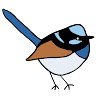
Episode illustration: Female Superb Fairywren

Kirsty Webeck is an award-winning Australian comedian known for her upbeat, relatable and inclusive comedy, with a gift for turning everyday experiences into hilarious stories. Since starting her comedy career in 2013, she has become a regular on stages across Australia and New Zealand, with television appearances including Question Everything, The Weekly with Charlie Pickering and Guy Montgomery’s Guy Mont Spelling Bee. Away from the stage, Kirsty loves birdwatching, snorkelling and exploring the natural world.
-
Kirsty Costa [00:00:01]
This episode was recorded on the Country of the Bunurong people. Their Country spans south-east Victoria, stretching from the Werribee River all the way down to Wilsons Promontory in the south-east. I pay my respects to Elders past and present, and honour their deep knowledge of place, seasons and local animals.This is Weekend Birder podcast, and I'm your bird-noticing buddy, Kirsty Costa. On this podcast, we discover the fascinating lives of everyday birds by chatting with the people who love them.
Season five is now humming along, and I hope you enjoyed the chat with my friend Lorna in the last episode. In this episode, it's my pleasure to introduce you to one of my new friends.
Kirsty Webeck is an award-winning Australian comedian who's become a regular on stages across Australia and New Zealand. And you might have seen her on television on shows like Question Everything, The Weekly with Charlie Pickering and Guy Montgomery's Guy Mont-Spelling Bee. Not only is Kirsty a talented comedian, she's also a birdwatcher.
Kirsty Webeck [00:01:14]
I think it was a natural progression for me from just animals in general. So I've always been a huge fan of animals. I've spent a lot of time outdoors. I'm a massive fan of snorkelling. When the weather permits in Melbourne, I am often found out in the bay with my snorkel. And of course, living in Melbourne as well, that's a very finite season.Birdwatching was a really natural progression from all of that. And obviously you can do it all year round, which is really cool. I've always been a huge walker, and there's a meme about when you hit your mid-30s, suddenly you appreciate birds. And I think the reason that we all love that meme is because it's true.
It's like, I was aware of birds. I had a lot of favourite birds. We're very lucky to have so many cool birds in Australia that you can just see when you're wandering around your suburb. My suburb is full of Rainbow Lorikeets and galahs and cockatoos and all the usual suspects. But in my mid-30s, I got super into it. And when I was touring for comedy, I'd never leave Melbourne without a pair of binoculars in my bag, and I'd always have a plan about somewhere that I was going to visit to try and find some kind of cool bird that I might not be able to see around home.
So I guess the short answer is I would have been in my mid-30s when it just occurred to me like, wow, they're cool and they're everywhere. We can just peek at them all the time.
Kirsty Costa [00:02:51]
What Kirsty loves about birds is that they're everywhere, and she's always looking out for them.Kirsty Webeck [00:02:51]
I remember at the end of summer last year, I just went to this spot not too far from my house with a bunch of my friends, and we were having a little picnic. Then suddenly I realised that there were all these little Superb Fairywren couples around us, and I'd never noticed them in that part of Melbourne before. They're one of my favourites as well. So it was so cool and so exciting.My friends aren't really that into birdwatching, those ones that I was with, but I was like, look, check those out. I had a little chat with them about them, like, oh, the pretty blue ones are the boys. And then they were all like, wow, aren't they cute? Just seeing them also sort of getting whipped up into a frenzy about them.
It's a place that they visit all the time and they'd noticed them around, but I guess that's part of the fun as well, that for most people that come into birdwatching, you spent a large portion of your life taking them for granted. They were just there. They were just hopping around. They were just trying to get your crumbs at the barbecue, whatever. But then when you develop an appreciation for them, you're like, wow, this is the best. We're surrounded by them.
Kirsty Costa [00:03:58]
When I started Weekend Birder four seasons ago, I chose the Superb Fairywren as the podcast logo. This bird has captured the hearts and curiosity of so many Australians that I've met, and on this show we've had a few really amazing fairywren experts tell us all these interesting things about this bird. We've learned about how the female teaches her chicks her family password while they're still in the egg. And we've also learnt how male fairywrens, the ones that are in breeding mode, shed their bright blue and black colours after that breeding season is finished, and then turn back to a plain grey-brown that looks more like the female. This is called their eclipse plumage.If you've never heard Kirsty do stand-up, I highly recommend you look her up. She's known for her upbeat, relatable and inclusive comedy, and she's got this gift of turning everyday experiences into really hilarious stories. I've seen her live a few times now, and every time I walk away with a really sore face because I've been smiling and laughing so much.
Kirsty is off and on tour with her comedy, and she admits that some of the places she visits are based on the birdwatching opportunities.
Kirsty Webeck [00:05:17]
Basically when I have a really full tour schedule, every now and then somebody will contact me and be like, oh, we live in this part of country Victoria or whatever, and we've got a little hall. Would you consider coming out and doing a show here?I'll have a look, and the first thing is, if I haven't heard of it, I'll get it up on Google Maps and I'll see if there's anywhere that can fit into the schedule. Then I'll immediately start looking around, just what's out there. If it's on the coast, my first instinct is always to be like, oh, I wonder if there's any good snorkelling around there. I could take my camera, my snorkel, and that'd be great.
And then secondly, it's always like, oh, even if it's the middle of winter, of course I'll be able to go for a walk around and have a look for birds. I've got some mates in comedy who are really into birdwatching as well. So they'll frequently visit parts of the country and they'll tell me, like they'll go, oh, I did a show up in Cairns recently, and I put my camera and my binoculars in and I got up really early and just went for a walk around the boardwalk, and I saw this, this and this. They'll tell me, next year when you're there, make sure that you spend an extra day or whatever.
So it does become part of the touring and the downtime. And I think that's really cool. There was a time when I first started touring that you'd get to a place and you'd probably just do a bit of work in the hotel or whatever, and then you'd go for soundcheck and you'd do your show. I guess I'm lucky as well that I'm in that stage of my career where sometimes I can arrive a little bit early in a place, or stay an extra day, and build those sorts of things in.
I was in New Zealand only a few weeks ago, and the way the venues worked their schedules around the country, I ended up doing a show and then a night off, a show and then a night off, basically for the whole time that I was there. So I did exactly that. I looked at the place that I was going to be in, and I made a call as to whether I was going to stay there for another day and visit mates, go up into a mountain sanctuary looking for birds, or if it was better to go to the other place early, and if there were better places to wander around and do what I wanted to do there. So that was a big factor.
And I actually did get to spend some time in an awesome mountain sanctuary just south of Hamilton. It was one of the coolest mornings of my life. I just had the best time walking through this rainforest and looking for birds. I had a little guided walk, and they talked to me about the kiwi population and how much it had grown because there were no predators in this sanctuary. It was just so cool. It was awesome. Those are the things that I remember.
Kirsty Costa [00:08:08]
I've recently been thinking about the weird places that birdwatching takes us, like rubbish dumps and sewage farms and cemeteries. Kirsty says she's been thinking about that too.Kirsty Webeck [00:08:17]
I think it's made me more adventurous as well, for sure, because you need another impetus to wade into somewhere that is maybe a bit isolated, or otherwise you might be like, oh, that's a bit foreboding. I'm on my own. But if there's the promise of this prize at the end that you might get to, it's like, yeah, I'm going to hike through this forest for 2.5 kilometres on my own and pass through this waterfall and eventually hit some wetlands and hope for the best on the other end.Sometimes afterwards, I catch myself just being like, oh, that's really cool that I went and did that without telling anyone where I was, which I'd never ordinarily do, right? But you get so excited and so swept up that you're just like, oh, I'm just going to pop over there and have a look for this bird that people have told me about.
And then before you know it, you're kilometres away from the car, you're in the middle of nowhere, you're on your way to do a show that night, and you're just like, yeah, no one knows where I am right now. But I am very excited to see what birds are at the end. So there's no holding me back.
It's made me explore just where I live more. A little while ago, in the neighbouring suburb to where I live in Melbourne, they had kind of pre-existing wetlands. They were kind of in the middle of a golf course, and they weren't good. The golf course was no longer, and then they invested all of this money into expanding the wetland. They're still being expanded now, but this place is two kilometres max from my house, and I never would have gone there ever. I live near the bay. There's so many places to go for walks. I never would have gone there. And now I go there all the time, just to have a peek at what's around. Just to see if I might spot another Nankeen Night Heron.
I always feel like I see the majority of cool stuff not where you're supposed to look, almost exclusively, but like, yeah, in the car park, for sure. Especially if it's a national park. It's already national park at the car park. It's surrounded in bushes and things. And sometimes I like to think of the animals and the birds and stuff kind of having a bit of a laugh about how everyone's like, oh, they paid their admission fee and they're going into the sanctuary or whatever, and we're all out here. Pretty funny. You feel that a bit when you see something cool in the car park and you're just like, yeah, they're having a laugh. They're like, no, we're hanging out out here. You're going to go in there and you'll see some beautiful plants and trees, but that's about it.
Kirsty Costa [00:11:08]
It's so true. "I saw it in the car park" should be the next Weekend Birder T-shirt, I reckon. We've heard from other guests who have also had the same experience, like Dr Kylie Soanes, who saw Purple-crowned Lorikeets in the KFC car park.Kirsty says that when the car park doesn't deliver, you'll find her heading out onto the track. Her latest adventure was in Dorrigo National Park, and if you've never heard of this place before, it's a national park about a one-hour drive from Coffs Harbour on the mid-north coast of New South Wales, on the Country of the Gumbaynggirr people. The national park forms part of the UNESCO World Heritage-listed Gondwana Rainforests of Australia, which protects ancient subtropical and warm temperate rainforest species that date back millions of years.
Along with her partner Elle, Kirsty went on a hike that provided a few surprises.
Kirsty Webeck [00:11:56]
We did a couple of hikes up there, and she's into it enough that we will both stop when we hear a bird call and we'll both just be looking up into the canopy. And it's kind of an unspoken game between us. It's like a race to see if you can spot it.We did one hike. Do you know how the hikes are always graded weirdly? And it either says it's going to take eight hours and you're done in half an hour, and you're like, did I miss something? And all the other way where they're like, oh, this is easy, and then you're fighting for your life and you're getting winched to safety.
Kirsty Costa [00:12:28]
Oh.Kirsty Webeck [00:12:30]
Yeah. And you're like, was this an Olympic rock climber that graded this hike? Because yeah, it's a disaster. I'm working on a stand-up bit about it at the moment because it's a real thing. Anyone who's ever walked anywhere out in nature is like, yeah.So because we were within the same park, we chose another walk of a similar length at the other end of the park, and we're like, let's do that as well, because this one was way easier than it was meant to be. They were surely graded by the same people. So we go and do the other one. It's a nightmare. It's an absolute nightmare.
We've already done a hike as well. So we're getting tired. Then we take a wrong turn. We hike into a gorge, then we have to hike back out of the gorge, and then we realise we're nowhere near being even halfway through this and we're losing it. I keep doing that thing where you step on a stick and the other end of the stick stabs you in the leg. I do that like ten times in a row, and I was ready to knock trees down. I was so angry. Then I tripped over a root and Elle was trying desperately not to laugh at me. The whole thing.
We're walking and we're both annoyed by this stage, and then a lyrebird ran across the path a metre in front of us, really slowly. Then it went up the side of the mountain that we were on so slowly. So we got to properly watch it within view, and neither of us had ever seen one outside of a sanctuary or whatever. We've obviously heard them a million times, but we'd never seen one.
We were so annoyed with the hike that after 30 seconds, I think Elle said, was that a lyrebird? And I was like, yeah, it was. But I'm so annoyed.
Then we kept walking, and then two hours later, after we'd gotten in the car and finally ended this godforsaken hike, we were like, pretty cool that we saw a lyrebird, hey.
And they were saying, look how slow it was on the path and stuff like that. Lyrebird knew that we were at the end of our tether. It was like, I'll give them a little peek just to turn them on.
Kirsty Costa [00:14:52]
That is a story I think many of us can relate to. The sign doesn't accurately tell you what adventure you're about to be on, or you misread it, or you end up on a walk you weren't planning. And then, as Kirsty so beautifully explained, the grumpiness and the fatigue can set in.Over winter, I took myself on a walk on a new part of Victoria that I hadn't experienced before. When the cold rain set in and the leeches covered my legs, I was losing my resilience really quickly. And then the rain cleared and a flock of ten Yellow-tailed Black-Cockatoos flew through the forest, and in that moment I found new energy and enough to get me back to the car. Thank goodness for birds.
Another thing I love about birdwatching is that everyone can choose their own unique way of doing it. Kirsty has a pair of binoculars, but she doesn't use the apps so much. She also doesn't use all that birdwatching language like "lifer", which means you've seen a bird for the first time in your life.
Kirsty Webeck [00:15:44]
Maybe it's because my whole job is about trying to explain things to people from my brain that they might not understand. And I've got to present it in a way that they're definitely going to understand without having access to all of the back knowledge that I have in my own mind.I was just thinking about it, and it's not just birdwatching, but a lot of other things that I'm into as well, like snorkelling and stuff. I think when I'm talking to other people about it, I just don't really use any of that language. But I understand it all, and I love that.
I think that's the cool thing about having a hobby and building a community around that hobby as well. All the lifer stuff, it's a secret code that people that are in that community all understand. It adds to the sense of belonging when you're in that. But it's really funny because a lifer, you can literally just say, I saw a lyrebird for the first time.
But I guess that's part of it, though, isn't it? It's a fun secret code that everyone gets to share, and I'm supportive of it. I don't use any of it. Also, I've been birdwatching for ages before I even heard of lifers.
I remember a while ago meeting somebody after a show and they were like, oh, you're a birdwatcher, aren't you? And I was like, yeah, yeah, yeah. I was down at this park earlier today with my binoculars. And then they asked me if there was a lifer that I wanted to see while I was in the area. And I was like, oh. And I was like, a lifer? And they were like, you know, something that you haven't seen before, like, are you going to see it for the first time?
But I could see in their eyes that they were like, you're not really a birdwatcher. I could just tell that they were like, yeah, you're an imposter. And I was like, no. I'm the accessible entry level of all of my hobbies.
I was on a podcast a little while ago talking about how I like being open about that kind of thing because I want people to know as well that you can really enjoy something without having an expert level of knowledge about it, or without knowing all the lingo, or seeing a bird and knowing it's special but, off the top of your head, not knowing exactly what it is, or getting it confused with a different bird.
I like being open about that with people, to go, just get out there and have a go. Don't worry about it. Don't worry about anyone else thinks. Don't worry if you say the wrong word around someone who's more of a bird expert than you are. Just go and enjoy looking at the birds because you're allowed to do that.
Kirsty Costa [00:18:34]
You sure are. Because you just named what this podcast is all about. Birdwatching is for everyone, and everyone is welcome. Sometimes we get sciency. Sometimes we get our facts wrong. But we're always enjoying ourselves and marvelling at the birds around us.Kirsty says that birdwatching has helped her see the birds that live around her with totally new eyes.
Kirsty Webeck [00:18:53]
I love spotting a slightly dishevelled Rainbow Lorikeet at my house and just being like, yeah, that's a juvenile. They're just trying to learn how to fly or whatever. And I actually love that part of it as well. I've got all these little parks around my place, and there are so many Rainbow Lorikeets around here. I love watching the little ones trying to learn how to fly.There's one park in particular near my house where I see it all the time, where I see them just over a few days, sort of skimming the grass like they can barely get off. And then watching them, every time I walk to the shop, getting to a point where they're able to properly fly up into the trees and stuff. So I love that kind of thing.
I love when I'm at the coast, I'm driving, and there's lamp posts and there's pelicans sitting on all the lamp posts. I love that. I did a road trip from Newcastle up to the Northern Rivers with my partner a few weeks back, and we saw a lot of that. They almost look like statues and they're all in different poses, but it looks like they're very specifically being put in those poses just because it's so satisfying on the eye. But they're just doing their thing.
There's a bunch of birds that I really love, and I just get excited every time I see them. I just love seeing oystercatcher couples wandering along the beach. I never get tired of seeing oystercatchers. I think they're really beautiful.
When we were in Dorrigo National Park, there were these little birds that we saw, and they were wildly digging in the dirt. My partner and I, we always talk about how much we love birds. These two were so busy. We'd never seen these birds, and they left no patch of dirt unturned. Watching them so focused on the job that they're doing and just thinking, in this moment, these birds are just like, this is a job that has to be done, and there's no one better for the role than me.
Watching them do that, they're all trying to turn out a little bug or something. But yeah, I love seeing that. We could sit there for an hour and watch these birds just rifle through the rainforest floor. I love seeing stuff like that as well. I think that is part of birds' characters that I love the most, just how they really seem to be on a mission. And to us, the mission is remarkably low stakes, but they take it so seriously and they're putting their all into it.
Kirsty Costa [00:21:32]
Many thanks to Kirsty Webeck for reminding us that there are many different benefits to birdwatching, and that we've all got our own way of being able to do it. Such an important thing to remember. And many thanks to Marc Anderson from Wild Ambience, who gifted us the Superb Fairywren recording.Many thanks to you, listener friend, for supporting the show and for caring for birds. If you love this show, please leave a five-star review and rating on your favourite podcast app, and that helps other people find us right here at Weekend Birder. You can also follow along at Weekend Birder on Instagram and Facebook.
So friends, if you're listening to this the week that this goes live, next week is Aussie Bird Count week. It is the largest citizen science program in Australia and I'm a very proud ambassador. Many thanks to our friends at BirdLife Australia for running it every year, and for everyone who's participating. It feels a bit like Bird Christmas, to be honest, and I've got a very special guest to celebrate Aussie Bird Count week.
Speak to you again soon.