About this episode
Imagine hatching underground and having to fend for yourself. Chris McCormack and Dr Joe Benshemesh reveal the remarkable life of the Malleefowl.
Birds featured: Nankeen Kestrel, Malleefowl
Episode illustration: Malleefowl
Resources
Meet the guests
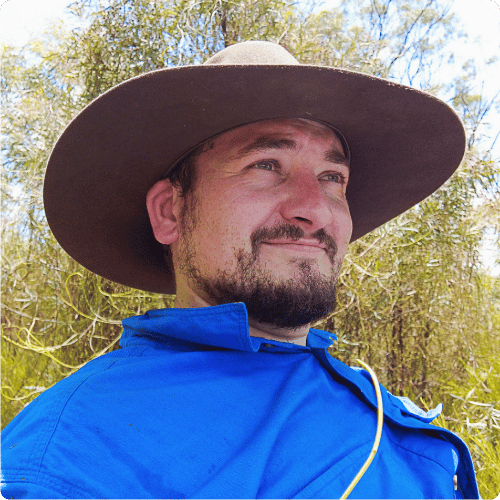
Chris McCormack is a conservationist and storyteller. With a background in conservation psychology and science communication, Chris explores how storytelling can strengthen people’s relationships with nature and inspire action for the environment. He has produced documentaries, podcasts and other media projects sharing the stories of Australia’s natural world and the people working to protect it. Chris spent many months travelling arid Australia to film the malleefowl and share their story.
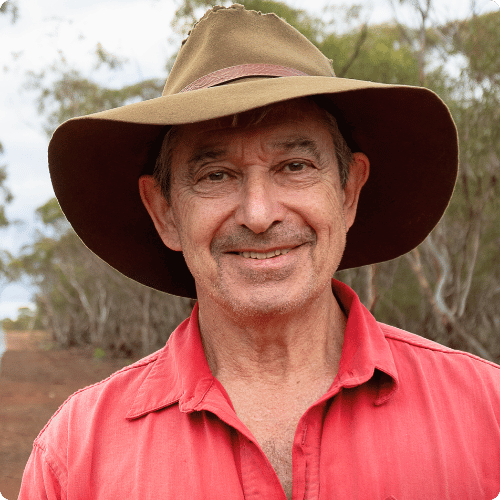
Dr Joe Benshemesh is Australia’s leading Malleefowl expert and has dedicated decades to understanding and conserving this remarkable species. A hands-on researcher and long-time conservation advocate, Joe has worked closely with communities, volunteers and land managers across Australia to improve knowledge of Malleefowl ecology and support efforts to protect the species into the future. Joe is a central character and narrator of the documentary.
-
Kirsty Costa [00:00:00]
This episode was recorded on Wurundjeri Country and Dja Dja Wurrung Country in Victoria. I pay my respects to elders, past and present, and acknowledge that Aboriginal peoples have cared for Malleefowl for many generations. This bird is part of important cultural knowledge, stories and traditions.
Kirsty Costa [00:00:33]
Welcome to Weekend Birder. I'm your bird loving host, Kirsty Costa. Have you ever heard of a bird that builds a giant mound of sand and leaves to incubate its eggs? And then when the chicks hatch, they have to dig their way out and look after themselves from day one. Well, my listener friend, that's the Malleefowl. I've got a personal connection to Malleefowl. I saw my first one recently at Hattah-Kulkyne National Park in northern Victoria with my mate Amanda Lamont, who was the guest in episode 119. I was so amazed by its uniqueness and also the story of its resilience. So when I heard about the making of a documentary called Malleefowl: The Most Unlikely of Birds, I reached out to offer my support and after watching the documentary, I quickly volunteered to become the film's ambassador. I've been co-hosting screenings and panel chats, and it's been such a joy to share this documentary with other bird lovers. I've also become friends with two of the amazing humans behind the film. This is Dr Joe Benshemesh and he's from the National Malleefowl Recovery Group.
Dr Joe Benshemesh [00:01:37]
My name is Joe Benshemesh. I've been working on Malleefowl for a very long time, since the mid 1980s, when I started a PhD looking at the ecology of the species, and I have had an interest in the conservation of Malleefowl ever since. I suppose I've always had a fascination with nature, but in terms of identifying birds, I remember there were some kestrels nesting at uh, at my school when I was a kid, and I was fascinated in them. I knew they were hawks, but I couldn't. I didn't know what type, so that got me interested. Really? Yes, it was Nankeen Kestrels. It was in Melbourne. I mostly remember them coming. Coming and going, you know, at the nest. The hovering was the clincher where, you know, I was able to distinguish them from, uh, Brown Falcons because, you know, they're so characteristic when they do that. Beautiful beautiful birds. But mostly I just, you know, saw them flitting past and recognised that they were, uh, awesome predators.
Kirsty Costa [00:02:42]
And this is Chris McCormack. Chris is from Remember the Wild, an organisation that helps Australians reconnect with the natural world.
Chris McCormack [00:02:50]
I'm Chris McCormack. I'm what am I? I'm, uh. I'm a few things, um, ecologist, uh, environmental storyteller, friend of Joe I think is a good. It's probably my role in this friend of Joe. I don't know that I have a specific memory like Joe does. I grew up in regional Victoria, north of Wangaratta, out sort of in a country area. And, uh, we were on a five acre block surrounded by the five acre blocks. My, my, my mother rode horses and yeah, I just used to roam around the paddocks and loved nature and I loved wildlife. And I remember I'd ride my little bike around the paddocks and watch all the, you know, the cockatoos and the Galahs, um, flying sort of over our house of, of, of a morning and at dusk to, to roost and just, I think I really loved the freedom. Um, but also just as funnily enough as Joe says, like just raptors
Chris McCormack [00:03:49]
were really captivating, you know, to just see, uh, whether it's a kite or whether it was an eagle fly over and, and just wonder where it's going and what it's doing. When the paddocks would get irrigated and all the wading birds would turn up, and suddenly you had this little Kakadu and you're
Chris McCormack [00:04:04]
effectively your backyard. And I think I just, you know, I always loved wildlife and birds is such a it's so lucky in Australia there's such a visible group of
Chris McCormack [00:04:13]
animals for us. So I think for me that that was it. Yeah. Just being exposed to it and wanting to learn more.
Kirsty Costa [00:04:20]
I love hearing how people find their way into working together. When Chris first met Joe, they weren't even talking about Malleefowl.
Chris McCormack [00:04:28]
I was doing a podcast called Look at Me with with the Guardian Australia, and that was about lesser known Australian wildlife. And 2018, maybe I turned up at a house in Alphington. I was there to talk to this expert about an animal that people really don't know anything about. And of course it was Joe. And of course the animal was the marsupial mole, because, as it turns out, Joe is also a bit of an expert in the marsupial mole. And of all the people that I could find to talk to. Joe was the guy. And Joe has done really fascinating research on on that. And that's the subject of another podcast. But after we we had this conversation in Joe's living room, which I think I spent most of the time with his dog on my lap. Beautiful, beautiful dog. Camp dog that Joe found out there in the arid, arid lands that he spent so much time in. And, um, on the way out, Joe said, you know, I actually spend most of my time working on something different, and it's really rare. And I said, yeah, cool. Can I go now? Because things kind of grew from there. And, um,
Chris McCormack [00:05:32]
I think what I really
Chris McCormack [00:05:35]
quickly became appreciative of was this whole world that I didn't know existed. This this huge community that was actively involved in monitoring a bird that I was really. I was fascinated with, like anyone who's heard anyone that likes birds and heard anything remotely about Malleefowl instantly go, God, I wish I could see that, but I remember driving around in a van in WA in my early 20s and we got out for a toilet break in the middle of nowhere in the mallee, and we'd seen those Malleefowl signs and I just said, guys, I'm just going to kind of run off into the bush real quick to see if I could find one. I didn't find one. Um, but, you know, so conversations grew from that. And Joe really wanted to celebrate this volunteer effort, which we'll talk more about and celebrate this bird. And I think, you know, when someone with an expert who has the connections across the country gives you access to that story. As someone who loves environmental storytelling, but perhaps more importantly, loves wildlife and loves birds, why wouldn't you kind of say yes? And it's been an enormous privilege. And over that time, I'll say, like, Joe has become quite a good friend and a mentor. So it's been a it's it's been a great journey so far.
Kirsty Costa [00:06:53]
After hanging out with them. I can attest to the special friendship that Joe and Chris have. If the Malleefowl is a new bird for you, or if it's a bird that you've actually known about for a while, you are sure to learn much more about it from Joe.
Dr Joe Benshemesh [00:07:06]
Yeah, well, this is a very bizarre bird. This is, you know, one of the most bizarre birds on the planet. It's a galliform. It's it's, you know, a, um, basically like a, like a chicken about the size of a chicken with a longer neck. Very beautiful. Very, very subtle colouring of greys and browns and white and black. It can disappear in the blink of an eye. And that's that's what the colouring is all about. Very, very beautiful, but, uh, astonishingly able to disappear. But it's most famous for its bizarre incubation method. It doesn't sit on its eggs and build an incubator, and it belongs to a small group of birds, the megapodes that build incubators. Or at least, you know, some of them just lay into warm sand. You know, either black sand beaches in the tropics, which are naturally quite warm under the surface or in, um, in areas with a lot of volcanic activity, uh, just in, in warm ground, as we have in Australia, we have a couple of other megapodes that, you know, the Brush-turkey and the Scrubfowl. They essentially just rake together a whole lot of leaves. This is in, in, you know, the wet tropics. And the leaves begin to rot and produce heat. And they find little hotspots and lay their eggs in there. But the Malleefowl goes a step further, and it inhabits the dry interior of Australia, where you just can't rake together a whole lot of leaves and expect anything to happen, rather than just they'll just dry out very quickly. So the bird builds a, um, an incubator that starts essentially as a hole in the ground, like it looks a bit like a crater. The old mounds, and it will, it will dig down until, you know, there's this, this quite a large hole going down, perhaps 30 or 40cm below the surface. And it will fill that with perhaps a cubic metre or so of leaf litter. And it'll wait until that leaf litter is completely drenched and then lock it, lock the moisture in with a layer of sand. And then the magic starts and the work really starts. This whole process, you know, takes typically months. And the, you know, the moist leaf litter begins to, to rot, producing heat. And that's what the birds use to start their incubation. But it's also the start of an awful lot of work. The first problem is that it produces too much heat. So the birds have to let out a lot of heat, and they do that in the very early morning before the sun gets up, you know, just to open up the mound. The mound, I should say, is typically 4 to 5m in diametre and a metre high when it's fully closed. So these are these are big structures. And opening them involves a lot of work. So you know the birds have to constantly maintain the temperature. And they will do that for up to six months. Over that period they typically will lay say 15 to 20 eggs, sometimes 30, sometimes even over 40 eggs. And each egg is roughly 10% of the weight of the female. So it is an enormous effort and quite, quite bizarre. In the bird world, there is no other bird that comes close to this in terms of, you know, engineering of an incubator. It leaves the other megapodes in the dust. And this is all because it inhabits a very dry environment. But having said that, it has been astonishingly successful, occupying something like 20% of Australia right into the heart of the deserts and within in the old days, within 30km of Melbourne down the south. So quite a bizarre bird, uh, wonderful bird. And yeah, always, always special to see, in fact.
Kirsty Costa [00:11:01]
I don't know about you, but I find it incredible that a bird can build something so enormous and then use the warmth inside it to incubate its eggs. In episode 89, Agathe told us about how Australian Brush-turkeys measure the temperature of their mounds in the rainforest through special sensors in their beak. Joe says that Malleefowl are constantly making little adjustments to help everything in their mound be just right. With a slightly different technique that also involves their beak,
Dr Joe Benshemesh [00:11:29]
and you can see it in sometimes, you know, taking billfuls of sand and the sand trickling from their bill. I don't know of anyone who's actually done the histology, but it's, you know, almost certain that they tell the temperature that way, much the same sort of way. I think that, you know, we might test their the temperature of baby's milk by, you know, on the elbow or whatever. They have something in mind. Obviously if it's too hot, that's the most dangerous. They need to reduce the temperature. And if it's too cool, they will use the sun to increase the temperature of the mound of the eggs. The thing is, you can actually sit and watch them too, because some Malleefowl become, um, very, very relaxed around human beings. They will allow you to sort of sit there as they work. They'll keep their eye on you typically, so, you know, keep a distance. But it's one of the reasons why there's such a popular bird in the regions, particularly with farmers, and that because you can develop a bit of a relationship, if you like, with your local birds, provided you're calm and, you know, don't rush around the place and and never cough, never cough or sneeze.
Kirsty Costa [00:11:29]
The Malleefowl isn't a particularly noisy bird, so you might be surprised by how quiet and subtle its call can be. This recording is by Marc Anderson from Wild Ambience. Let's have a listen.
Kirsty Costa [00:13:05]
One of the things that I love about the documentary is the opportunity to watch Malleefowl, just going about their daily lives. They're not easy birds to find, let alone film, and Chris spent a lot of time out in the bush trying to capture their behaviour. He got to know one particular male Malleefowl, very well.
Chris McCormack [00:13:25]
It was quite a process and it was a learning process as well. It really was a bit of an experiment, like what's going to work, what's going to capture the behaviour we need. And as Joe said, in much like the monitoring, we're fortunate that they have these at a certain time of year. There's these invisible threads that tie these birds to these locations. So you can actually go if you know where the mounds are. You can go and you go, right. Well, I know the bird's going to be here in this location at some point. At least I've got the space part of the equation of space and time sorted. The problem, of course, then becomes when I'm not really an early riser. Kirsty. Um, so the birds are, particularly the male when he needs to get up and he needs to open that mound. So you're getting up at 5 a.m. or thereabouts, maybe a bit earlier. You're heading out to these mounds to sit in initially. Hides that I'd set up around private properties. Basically, hope that he turns up and really hope they turn up and they do their thing. And sometimes you're lucky and sometimes it's not. It's not your day. But as as Joe said, there are some birds that are more confiding than others. And I happened upon a bird that was confiding after I'd gone and set up a bunch of hides on a bunch of mounds within distances, informed by Joe what he thought would be appropriate, what he thought would disturb the birds in any way. Then I just happened across this bird that just did not care about me in the credits, I think you've seen courtesy of a nickname, That Bird Goldy, because it was. He was my golden Malleefowl. You know, the golden goose kept the gift that keeps on giving. His female partner was far more discerning. She had much better taste. She wanted nothing to do with me at all. Um, but at least, at least he was fairly easy to film, and
Chris McCormack [00:15:18]
I could quite literally set the camera up on the mound a few metres from him while he did his thing. And that's he. He provided so much of the beautiful footage. It's just the most marvelous feeling to be ignored by an animal. It's a wonderful thing to have an interaction with an animal where they're engaging with you, sure, but to be ignored as if you're just a part of their world and not a particularly important part, is whether that's a magpie in your backyard or the fairywrens. Or Malleefowl its man. It's just a really. I find it to be a really profound feeling in a weird way. And I think the birds make the film obviously in terms of their subject, their behaviour, their beauty, but quite literally in terms of of that bird's own agency and his decision or non-decision to, to not really be fussed by me in the camera in terms of some of those other behaviors that you're talking about, these, these other animals like the um, the swamp wallaby or the emus interacting with the man, those were provided by remote cameras. So with regards to the swamp wallaby that was on a private property, Michael and Louise who who own and operate explore the mallee is a great, um, bird eco tour company. Probably not plugging them correctly, but anyway, you look them up, um, and they, they have a, they have a pair and they have amazing footage and that that really helps support the film. And also Graham, who's on is a part of the National Malleefowl Recovery Group, has done this fantastic work with the remote camera as well a live camera which is now live on the NMRG's website as well, if people want to check that out. And that provided some of this footage of like the emus and the emu chicks walking up to the mound and going, what's going on here? You know, which I find fascinating, it's fascinating to me that this, this mound is such an interesting and absurd object that it transcends it transcends species in just how bizarre it appears to be. It triggers curiosity in various taxa. I think that's a really, really strange thing.
Kirsty Costa [00:17:23]
I totally agree. I love the way the audience laughed when local animals like kangaroos and emus visited the mallee. Foul mouthed. Out of curiosity, I've put a link to the live Malleefowl webcam in the show notes if you're curious too. We've heard about the incredible amount of work that goes into building around and keeping those eggs at just the right temperature, but what happens when those eggs finally hatch? I personally think this might be one of the most surprising parts of the Malleefowl story.
Dr Joe Benshemesh [00:17:50]
Yeah, well, this is the thing that you've got a big incubator and you've got, uh, these enormous eggs. You know, three times the size of a chicken egg for a bird roughly the same size. And they're down, you know, up to a metre below the surface now, and they hatch. Watch what happens. Well, the poor little buggers have to find their own way out. So that's their that's their first challenge. And in effect, you know, they all they need to do is, is, is move and wriggle and sand, you know, sort of comes in underneath them and they slowly sort of float to the surface. But it takes hours. And then when they do come to the surface, they're on their own. They've just hatched. They've been in darkness and struggle, and they come to the surface. And it's, I guess a typical mallee day, the, the, the mid to high 30s. And they're entirely alone. And in fact, you know Chris is included in the film. You know quite a few shots of where the, the adults are digging down to check the temperature or lay an egg, another egg, and they encounter a chick on the way and they totally ignore it. It's like they've even been known to kick a chick out. They're extremely respectful and careful with the eggs, and you can definitely see this in their behavior. But when it comes to chicks, not just, you know, the chicks are on their own and you wouldn't think this would work at all. They have to find food and shelter, and they're this is the first view they had of of the universe. Oddly enough, they can that they can run and they can fly almost immediately. But they can't walk in a straight line. It's like they're drunk or something. They, they they simply don't have the coordination when they first come to the surface. So, you know, you can plonk them down and they just sort of fall over and you think, oh, the poor things, you know, they're so incapable. And then all of a sudden they're they're gone. They've either run off because they can run very, very fast, or perhaps they've even flown. But even if they've run, when they stop, they just fall over again. And of course, you know, in, in, in time after a few hours, they've, they've got their coordination and they're very capable little, little chicks. But they have to find food. And anybody who knows the mallee or, or even, you know, interior to the mallee, the, the, you know, the desert landscapes, there's just not a lot of food around. So that's their first problem. And of course everything wants to eat. The foxes and cats introduce foxes and cats but also raptors and just about everything. But can the probability of the chick, you know, they've been you would think they've been lasting. The day is pretty small. But uh, certainly, you know, probably. Well, it's been measured, I suppose, a couple of times with day old chicks, you know, 80% typically dead within the first ten days, but some get through. And this is the, the, the extraordinary thing because the birds are actually, uh, it's a system that seems to work extremely well. So quite bizarre. But also, you know, absolutely fascinating. And you can sum it up by saying any adult male, female, you see, is like a super athlete. They've been tested from day one. Um, and they have they've survived for a couple of years to be an adult. And they are, you know, 1 in 100, each one of them.
Kirsty Costa [00:21:21]
Imagine being a tiny mallee chick and having to dig your way through all that sand and leaf litter, only to discover that you're completely on your own. It's the same for the Australian Brush-turkey. A chick's evolutionary adaptations and all those instincts kick in to survive, and it has to work out things for itself. And Joe says that's why the Malleefowl lays lots of eggs.
Dr Joe Benshemesh [00:21:43]
To accept this system, where it's more like a fish or an insect, where you lay lots and lots and lots of eggs. Um, with the expectation that 1 in 100, 1 in 1000, 1 in 100,000 will actually make it to, um, adulthood. We we think of every, every baby clearly as very, very precious. It's not like that for all animals. Not even all, you know, all birds. The pumps, pumps them out. It's it would be fair to say that the, you know, the your typical Malleefowl lives for 2 or 3 weeks.
Kirsty Costa [00:22:19]
Joe has been studying the Malleefowl for decades. He's seen how much of its habitat has changed, and he's also seen firsthand what is currently threatening its survival.
Dr Joe Benshemesh [00:22:28]
The number one for just about any species is habitat, habitat loss. And once it's gone, it's pretty much gone for good. There are two very important effects here. One is simply the loss of habitat, the loss of what the animal needs in order to survive. And the secondary effect is the fragmentation that that causes, where you have a continuous range that is now sort of cut up into a whole lot of islands. And that is very dangerous because it's divide and conquer, isn't it? I mean, that's how you that's how you destroy something, is to divide it up into bits and then destroy each bit. So number one, without any, any question is habitat. You know, the big question for the last, you know, 30 or 40 years really has been okay. How Malleefowl doing in areas that have not been cleared, we know that the population has been massively reduced because of the clearing, but how are they going in the national parks and in other areas? And that's a very difficult thing to answer. We know if we look at individual Malleefowl that are predators, foxes, cats can be, you know, a lot of power in their lives, in the jaws of foxes and cats. That's true of every stage in their lives. From eggs, because foxes, you know, get into the eggs all the way through to adults. So once they once they become chicks, you know, cats get them as well. There are other predators, of course. I mean, for the young male fowl or the raptors, they love eating out. So predators are a big concern. But our biggest concern has been okay, well, what about the population? We know that the chicks must have high predation, otherwise we would be knee high and within just a few years, because they lay so many eggs and so many chicks emerge. And that's been a big effort by the citizen scientists. It is to, you know, track that and understand that. And then looking further ahead. You know, the big ones, I suppose a climate change, all of these threats are exacerbated by the fragmentation. So you have the small patch, you know, it's easy for fire to burn it out, or for foxes to become professional fowl eaters and wipe out a local population, all sorts of things. So there are lots of different threats and understanding the population. What we've done is really try and look at the adults and understand the the trends in the breeding numbers.
Kirsty Costa [00:25:14]
It turns out that a lot of people care about the fowl, and a lot of people are working together to ensure that it survives. I guess that's one of the reasons that I described the Malleefowl documentary as a healing balm in modern times, because I think the crisp beautifully captures the community effort, from traditional owners to scientists to volunteers, farmers and landholders.
Chris McCormack [00:25:35]
You often feel like a voyeur or a tourist as a documentary filmmaker. You dip into people's lives and they share the things that they are most passionate about, that they spent years and years like Joe. Joe is an example decades of his life working on. And I'm not very good at the dipping in, so I end up getting very, very involved. But to to take that step back, I suppose, Kirsty, and to take that filmmaking perspective first, from a logistical point of view, the time it took to make the film is in part reflective of of the breadth of the monitoring programme that spans from Victoria and New South Wales through South Australia, all the way over to, you know, Western Australia, not far from Perth and Albany and as you mentioned, into the arid interior in, in, in places that very few people visit, very few people go. And where remote communities and particularly First Nations communities are absolutely essential to caring for country, for monitoring mallee, for the wonderful thing for the film, but also for Malleefowl, more broadly, is that Joe has spent a lot of time travelling around Australia inland, arid Australia, forming these relationships, showing those people there. There are people from remote communities in the film face here or there. The Joe is known for over 30 years, you know that I, I couldn't even name them there just in the background, you know, but that those are that's the importance of relationships. So from a, from a storytelling perspective that is essential. The relationships and the breadth and depth and the timespan of those relationships that show has that other, other key figures have. All this conservation effort comes together are revolving around those relationships around that, that connectivity between people and place. It would have been very hard not to centre the farmers in this film because their role is really important. It's essential. The story is, to me, really interesting and exciting and tangible. It's about getting Malleefowl back to a place where they disappeared, but they're also really colourful characters, like they just are who they are. And I think as a storyteller, you kind of want to put those people on on camera, right? You want to go. These people are worth seeing. And so one of the, one of the main characters is a bloke called Dave Heath who farms out of Griffith. He's got remaining mallee habitat on his farm and he really cherishes that. Really cherishes that he. You cannot get Dave to stop speaking about the wildflower. He just loves the flowers. He loves Pink Cockatoos. He has them nesting in nest boxes out at his window. They eat his barley and he just loves watching them eat his crop. You know, it's a beautiful thing. And Malleefowl he's thoroughly interested in and obsessed with, and so is his neighbour, Rodney. Rodney's loves birds. He's had all sorts of birds, including Frankie, the Eclectus Parrot who's in the film and a good friend of Joe, as people who watch the film will see. So Rodney has this interest in raising birds, breeding birds, and Dave has this mallee habitat left. And so it's this it's it's quite
Chris McCormack [00:29:00]
a unique it's a unique situation for multiple reasons. But one of them for me was just two farmers that happened to live next to each other that just really love birds. Maybe that's not as rare as we think sometimes, but these guys really, really love birds and they really love the bush. And the fascinating thing about Dave Heath's property
Chris McCormack [00:29:20]
is that it's where Harry Frith did his original research on Malleefowl after Harry Frith in the 50s, doing this research. Generations of scientists have come back to this property to do work on mallee habitat, including Joe. But not not. Not just Joe in the National Malleefowl Recovery Group. And so it's sort of become this sanctuary for science on mallee. It wasn't a choice. It was an it was an inevitability to present these people because they just are who they are. And they I think they they speak volumes to what landowners can do for conservation. The other thing I think just generally on a personal basis, is I keep ending up working with farmers. I keep ending up telling stories about farmers and working in conservation alongside farmers. And I can only conclude it hasn't been an active choice. I can only conclude it's because actually there are a lot of farmers, a lot of landowners who do care, and it's where we can get things done. And these guys, their families are excellent, excellent representatives of that.
Kirsty Costa [00:30:26]
That's where my hope lies in the care being shown by people and the resilience of birds themselves. I shared my thinking about this a few episodes ago, and I don't think that we should underestimate the strength of other animals besides humans. Joe says that's where his hope lies to.
Dr Joe Benshemesh [00:30:43]
Malleefowl. I think you know, they are, um, as I often say, they're very easily underestimated. They are very, very tough birds. And there are species that we can do a lot to, to help them, particularly farmers. I already mentioned the, uh, the problem of fragmentation. And that's something we are working very actively to try and, you know, find ways to, to, to actually not only, you know, um, mitigate the threat, but also have something positive come out of the cut up landscape. I think we can do that. So I'm actually quite hopeful. But having already mentioned fragmentation, what are these fragments surrounded by? The they're surrounded by farmland. So the farmers are absolutely integral to this. And we've talked a little bit about, you know, David Heath's property. And I think it's a great example. You know, part of it is managed by national parks, a nature reserve. And it'd be lucky, I think, for Rangers to get out there once a year for an hour. And that's not because they don't care, it's just the way the system works. There are lots of reserves. There's not much money in conservation these days. There are very few rangers really for the for the work that needs to be done. David Heath and his family are farming. You know, all the areas around. They're there every day. They've got eyes on the ground all the time. And that is typical right across, you know, the wheat belt where we have these small remnants. So they are clearly I mean, if you can get them alongside. And what's more, they're their land managers, whether it be reducing predators or or benefiting a species such as Malleefowl. So it's a no brainer. Of course you'd want to get them on site and they are onside because they, you know, there's so many times that I've encountered farmers, even in the early days, you know, um, where they would start a conversation and say, oh, I'm no bloody conservationist. But like now, he felt sort of thing. Well, mate, if you're a good farmer, you're a good conservationist. It's not. You know, the two aren't mutually exclusive. So I think there is a lot of care. And that's what we want to do is, is tap into that caring and flush a few people out, or at least let them know that, you know, we can work together to get some good outcomes. So in that regard, I'm quite hopeful. I think that Chris’s film is a is an excellent way to to show that, you know, you don't need to be a greenie to, uh, um, to care about the local environment or a local species. And there's stuff you can do. I think, you know, with, you know, climate change and the warming, um, much of the range of Malleefowl is, is under a well, a dark cloud very much throughout the centre of Australia. Um, we're already seeing temperatures which are absolutely frightening, sort of 50 degrees and more. And it seems like it's getting worse every year. So I don't know what will happen to inland Australia, but I think along the edges and particularly, you know, in the Wheatbelt, we have a very good chance of um, conserving Malleefowl, uh, if we work together.
Kirsty Costa [00:34:00]
One of the things that I love about birdwatching is that there are so many ways to get involved. Whether that's sharing your observations, helping with research, or joining a local conservation group. And if you've been listening to this episode thinking that you'd love to do something for the Malleefowl, there's actually a wonderful opportunity to get involved with monitoring these birds.
Dr Joe Benshemesh [00:34:19]
The easiest way is probably to go to the National Malleefowl Recovery Group website, and then from there, find your local state group. There are groups in every state just about and there will be uh oh they call them training days or, you know, information days every year to get involved. The work they do is magnificent and of immense importance. Uh, they're not an easy bird to to monitor in the sense that you can't just rely on bird lists and and, you know, what you're seeing by bird is you really have to make an effort. Fortunately, their large mounds are, uh, you know, very useful in that regard. And so basically, we monitor the mounds through that, we get a very good idea of what the trends are in different areas. We can see where we're, you know, entering some into dangerous territory where populations are slipping or where they're not, you know, where they're doing quite well. It's fundamentally important as a, um, you know, a foundation for any other work. So yes, I would certainly urge people to get involved and see how they can. They can help and they will meet lots of like-minded people.
Chris McCormack [00:35:42]
You're joining a community that has been running for a few decades now, and so you're adding to a data, an enormous database that allows the National Malleefowl Recovery Group to be able to make decisions and to actually act. You cannot do that without the monitoring. But although that all sounds massive and huge in scale, it's a weekend a year. That's the work. It's a weekend of birding a year. That's that is. Which is
Chris McCormack [00:36:10]
pretty fun. It's in the mallee. It's an amazing place and you get to see some amazing people. So, um, you don't need to rock up once a month. You don't need to rock up twice a year. It's one weekend a year. And contributing to something that is really has profound and deep impact. The other thing I just wanted to say is thank you so much for all your support. You came out of the blue really to help this film campaign. You saw the film and decided it was worth maybe, you know, talking about it a little bit. And we appreciate that massively because it really is all in service of the mallee at the end of the day. So thank you so much and we're looking forward to having you, um, in Sydney and Canberra and wherever else we end up. I'd also like to thank Joe for giving me the opportunity to tell this story, because it's been an amazing journey. And as Joe keeps reminding me, we're only getting started.
Chris McCormack [00:37:14]
So, um, yes. And thanks to all your listeners as well.
Kirsty Costa [00:37:18]
You're welcome. Chris. So a weekend a year gifted to the Malleefowl sounds like a very fitting thing for a Weekend Birder listener to do. The show notes for every podcast episode are found on the Weekend Birder website. There's a link in the app. If you click on more for this episode. On the website, you'll find links for volunteering, more information about the bird, and upcoming film screenings in places like Melbourne, Sydney, Canberra and beyond. I'd really love to see you there, and there's a good chance you'll meet Chris and Joe as well. Before we finish up, I just wanted to say thank you to everyone for your support of the podcast. I've been so blown away by how many people are leaving a rating and review on their podcast app, or supporting me on social media, or sending me lovely emails, and also all those people who have bought a Weekend Birder T-shirt for themselves and their loved ones, which basically helps me fund this whole thing. It's such an honour to be part of this growing community of bird lovers. I'm deeply grateful for you, and I'm really excited to share the next episode with you as we discover more about the fascinating lives of everyday birds. Speak to you again soon.