About this episode
Can you hear what birds are telling you? Ecologist Andrew Turbill explores bird calls, their meanings and how to listen more closely.
Birds featured: Golden Whistler, Lewin’s Honeyeater, Lewin’s Rail, Pied Currawong, Rose Robin, Satin Bowerbird
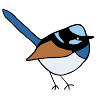
Episode illustration: Rose Robin
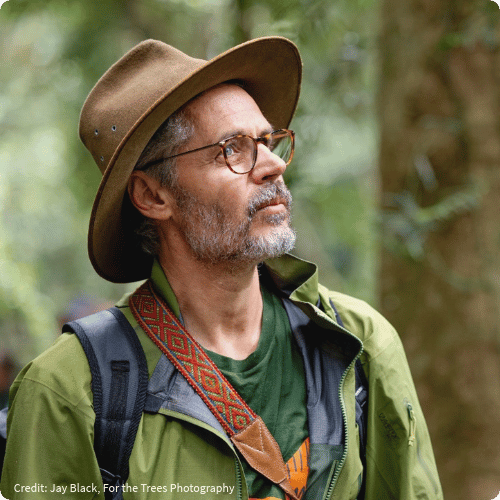
Andrew Turbill is a highly experienced forest ecologist and environmental educator with more than 25 years’ experience working across a diversity of roles in private consultancy and state government. His professional work includes avian ecology, fauna surveys, environmental and climate science education, nature connection and interpretive copywriting. Andrew’s approach to reconnecting people to the natural world relies on a mindfulness-based practice of ‘deep listening’ to bird language. Blending the science and observation practices of bird ecology, bird language and immersive personal experiences, Andrew’s programs seek to awaken and support an innate capacity for joyful engagement with wild nature through expanding our sensory awareness of, and personal relationship, to birds. Through his business, Andrew hosts multi-day bird language retreats, online bird language courses, guided walks, workshops, mentoring and presentations.
-
Andrew Turbill [00:00:00]
I'm on Gumbaynggirr Country up on the New South Wales north coast. It extends from just up around the escarpment, which is quite close to the coast, right down to the coastal plains and where I'm in on the Bellinger River. But importantly, it also extends about 15 to 18 kilometres out to sea. So all that country that's now covered in in ocean out there. Um, it's important for us to remember that 20,000 years ago, that was all, um, that was all forest. Uh, most of that water was, um, was tied up in ice glaciers. And so a country really is, uh, all those old campsites, those old, well made campsites out there now, humpback whales migrating off of them. And that always is something to take my breath away when I'm out there staring at the coast. So that's my that's my way of reflecting on the, you know, the cultural sort of layers of, of cultural history in the landscape.
Kirsty Costa [00:00:47]
Thanks, Andrew. I am on Bunurong Boon Wurrung Country in south east Melbourne. We pay our respects to elders, past and present, across Australia and to any Aboriginal and Torres Strait Islander peoples listening to this podcast. Welcome to another episode of Weekend Birder. I'm your birdwatching buddy, Kirsty Costa. I'm a science communicator, storyteller, and a lover of wildlife. Since I started this podcast, Andrew Turbill's name has been brought up regularly. Many thanks to listeners Andrew G. David E, c, Harry B, Holly S, Lewis K, Pat K and Tricia H for suggesting Andrew as a guest. Andrew Turbill is also known as Andrew the Bird Guy, and is well known for his knowledge of forest and bird ecology. Andrew's superpower is reconnecting people to the living world, and he's here to help us become better listeners to the language of birds. Here is how Andrew's love of birds first started.
Andrew Turbill [00:01:58]
Well, I had thought about this for a bit, and people asked me this. You know, whenever I sort of go to my retreats and stuff, how did you get into it? And my earliest memories of really getting into birds, like the first bird I really enjoyed watching, I think. I can't remember all there was maybe six or something like that. Was the Satin Bowerbird, male Satin Bowerbird. They had these glorious, um, bowers that they build, which everyone keeps calling nests and drives me mad. But these beautiful bowers of the male bird, and there was one in my dad's backyard, and I remember sort of like hours and hours and hours sneaking down into the forest with a little tape recorder. And sneaking up in the lantana and lying amongst the leeches and ticks and mosquitoes and sort of recording it's, you know, it's weird because that little call, that mechanical sort of, um, R2-D2 sort of noises it makes and just being like, transfixed by this bird. But then later on getting taken, um, to a Gould League, uh, naturalist sort of field camp for a weekend. And I don't think they run them anymore, but it was just, I guess, where all the nerdy kids would go, just going there and realizing that there were probably, you know, there were adults who in this stuff like this wasn't just a little a fancy of a six-year-old, like they were adults. And and it was there's a science of it. And people, kind of the adults, gave you a lot of recognition. If you came back and said, oh, I just saw, you know, a logrunner's nest or whatever they like, they were really excited. Where did you find it? You know, it sort of felt like a pretty important knowledge to have. And then getting into I used to accompany an elderly ornithologist. He'd go to bird banding and in the forest, and they set these big long nets, cross tracks. And my job was to be a runner to go out and, you know, untangle these birds from the mist nets and put them in little calico bags and carry them back to the banders who would put their hands on them and everything. So like being quite young and having like, you know, a Regent Bowerbird or something, or a Noisy Pitta in your hands, walking away and biting you as you're trying to get it out of the webbing of the net and put in a bag. I don't know, like if that doesn't, like, weld you onto a life of living birds, then I think there's something drastically wrong with your brain. So that kind of just was what sealed my fate, I think.
Kirsty Costa [00:04:19]
Shout out to the Satin Bowerbird, which is getting a few mentions in season five of Weekend Birder. Revisit episode 155 with Aura Parker. If you want to find out more about this truly amazing bird and shout out to the Gould League, which was formed in 1901, in Australia. Originally set up to prevent bird egg collecting and to educate for the protection of birds, the Gould League has made a significant impact on generations of Australians and their environmental attitude. It still exists today and I'll put a link to its website in the show notes. I remember the Gould League posters of birds and shells that adorned the walls of holiday houses in the 1970s and 80s. Andrew says he remembers them too.
Andrew Turbill [00:04:58]
One little sort of curiosity about that is that. And my dad gave me a pair of binoculars and a bird book, getting my brother, you know, a torch. And he went off to another Gould League club for mammals. Um, now he's an associate professor of zoology, specialising in mammals at Western Sydney University. And I'm Andrew the Bird Guy. I mean, you got to be careful what you do with your kids when they're young. You can send them off on these long trajectories.
Kirsty Costa [00:05:26]
Andrew's younger years have led him to a career in ecology, and his specialty has become listening to bird communication. He often uses the word bird language, and I'm curious to know how he describes what this means.
Andrew Turbill [00:05:38]
There's a whole science of bird vocalisation, bird communication systems, you know, very complicated science that ornithologists get into. And and they can they will argue back and forth about whether birds really have a language and everything. But I'm a science communicator. I mean, I'm a storyteller, science story, natural science storyteller with a bird ecology background. Um, so for me, the bird language part is very much a, a teaching tool. It's a way for non expert people who just love birds. But don't don't be experts in birds. They're just amateurs and not even like fantastic at birds. I love working with people who are just new to it. They're my favourite people to work with. It's a way of understanding that birds do more than just go squawk and chirp. Chirp, right? I think for the majority of people that we people think that birds have a very simplistic way of communicating about the world around them by just making a singular noise and just chirp, chirping, and they don't give much more thought to it than that. But that's like a cartoonish sort of level of understanding around birds. I mean, we're talking about a very intelligent, um, particularly I'm talking about songbirds here, which is a thing I'm most interested in. And so with songbirds particularly, but this also applies to this, to the, to their sister group, the parrots. Um, they have this in they they're very intelligent. I mean, their intelligence is some of those songbirds and parrots is is akin to, um, you know, the primates, some of the and and like so their problem solving skills, their communication complexity skills, um, their ability to do planning, tool making, tool manipulation. It's we're talking about a very complex animal. Um, and so. One of the ways I get people to connect with with birds, um, and to understand the complexity of it. One of the doorways in, if you like, into that world of birds is through listening to their calls and other other communication means that their postures and their feathering, the way they move, they can shape their feathers on their body, paying attention to that deeply, paying attention to that, and then looking at that within a system of like, what is that telling us about the birds environment? Like, who are they talking to? What could it be saying about that environment around? Is it a social thing? Um, is it related to a courtship behaviour then? Probably, yeah, probably a courtship and, uh, to do with breeding. Um, but if they attack each other, probably do with aggression. If it's a call that's made. And when you go out, have a look at it. You see there's a python on the ground. You can be pretty sure that all probably means something to do with Python alarm call. So it's a ground predator call. You know, they're always looking up in the air, and you look up and see Charlie coming over. That's an aerial. So I've kind of categorized the calls in this way where I've got about 8 or 9 different categories, and these are broad categories, so I'm sure I'll break them down over time. Just being able to have people go, okay, it's not just making a call, but I can identify so little ones honey does it's machine gun call and you go Lewin's Honeyeater. And if you're into twitching or, you know, you just kick it off in your eBird, you move on. That's all there is to it. I'm getting people really interested in that and curious about what is that? What is that call mean? Is that a territorial call? Is it a is it a call that relates to its partner or to other birds? It knows. Well, is that a courtship call? And so you have to know that. You have to spend a lot of time with that bird. What Jon Young, one of my mentors in the US, would call dirt. Time you spend dirt. Time paying attention to that lawns, hunting for a long time, and then deciphering, you know, through the context, through the situation or around that call when it's behaviour relative to other birds and and within the seasons, because it changed over time. You get to have some understanding of what that call means. And so it's it's a way to go very deep with your relationship with birds, not just, oh, that's this bird tick. Done. Move on.
Kirsty Costa [00:09:42]
That was the call of the Lewin's Honeyeater recorded by Marc Anderson. I don't hear this bird very often in my neighbourhood, so I'm hoping that someone out there might be more familiar and potentially even know what it was trying to communicate. Andrew says that since he's been teaching people about how to listen to birds, it's made him more aware of how humans might be going about their lives and interacting with the world.
Andrew Turbill [00:10:02]
When I first started doing my bird retreat, my bird language retreats and my workshops and my online learning series, that was it kind of came out of time that I finally had some time to put this stuff together during the COVID lockdown. When I first started delivering those those retreats, I thought I was coming in to really teach people about how to identify a bird based on its call, and then load up a lot of ecology around that. So people had a, I guess, a sense of the bird within its ecosystem. And because I'm very much a sort of not I'm not affiliated with the twitching side of things, which is what I think where we tend to there's some very knowledgeable bird lovers among the twitches. I'd be wrong, and they do some fantastic conservation work for birds. But I don't like this. This tendency of it's kind of like a capitalist tendency of transactional nature into another commodity. You know, something like I said, like a, you know, a very simple bird, like an Eastern Spinebill, you just sort of it's tick it off and moving on to something a bit more sexy. But I wanted to. I wanted to give some context to that, some ecological context there. But what I found when, after a few retreats, what I very quickly found was that what was missing, um, was that people couldn't. They didn't know how to listen. I just completely assumed everyone could listen like I can listen. Um, but I've been listening to birds since I was six, and so my brain has been wired around, um, a value system that says every time a, you know, every time a thornbill farts at 100m away, I want to hear it. It doesn't matter which direction. And then it doesn't matter how high the bird is or how low it is, or how far away it is in any one direction, I want to be aware of it. So my brain's constantly scanning for small, um, bird calls and bird movements in my environment all the time, which is why I cannot possibly deal with being in a busy cafe or a pub anymore. Or a preschool. I'm completely useless. I'm overwhelmed because I can't turn off my peripheral hearing anymore. I can't just focus on one person talking to me, I can, I'm just always listening to the periphery. But what I know is similar retreats because people don't listen to that. They their brains are very good at like listening to one person talking, um, or once, one sort of thing that they're concentrating on and then subduing all the rest of the sensory information coming in, I realise that the first thing I needed to do was get people to actually listen properly. And so that's when I spend the first day really is doing is is while I'm presenting material people out in the, you know, in our camps, I'm constantly saying, don't forget to listen to the Wonga Pigeon in the background over there. And can you hear the new horn here in the background? He's doing a, you know, alarm call and a python way down the creek down there. And so just getting people to listen to me talking, but also constantly throwing that sensory net, why is they camp? That's the first step of a language really is getting the bird language is reprogramming the sensory triaging system that our brains have to to deciding what to do with sensory input. And for most people, when they arrive, um, I'll be talking and they'll be looking straight at me, and that's lovely. I know they're paying attention, but by the Saturday, two days later, um, they're getting what I call Fantail Neck in a little Grey Fantails. Are they next? They're worth looking around for the next mid g. That's the way I want people's heads to be moving on the Saturday afternoon of my retreats, where they can't just concentrate on me. Now they're being distracted by all the things happening in the background.
Kirsty Costa [00:13:30]
I can really relate to what Andrew's saying since becoming a bird noticer, I'm finding myself tuning into multiple layers of sound when I'm in any environment, and my theory is that it's made me more sensitive to noise.
Andrew Turbill [00:13:43]
I thought it was just me. I thought maybe I had a hearing issue. I've actually had a good hearing, but I thought maybe I had some sort of sensory issue. Maybe I was recently doing some ecology, um, survey, some bird survey work where I had to be young people, some 30-year-old, really top notch, uh, ecologist, bird ecologists. And, um, we were out at the pub that night in between two days of surveying, and there was one table, you know, quite noisy. And I just sort of said, does anyone feel like we just can't work here? Can we move a bit? And they were like, oh my God, I'm so glad you said that. I can't hear anything. Um, and I realised it's not just me. It comes with the territory. If you're into if you do pay attention to birds all the time, your brain has developed a sensory triage system that says, oh, bird sounds. Yeah. Andrew said that they're important. I've got to feed them through to his frontal lobe, um, and incorporate them into his consciousness. Um, whereas the first time I really understood how this worked, I really got the impression that this is how it worked. I was with a group of students that I was teaching on a ten day bird language program, and we're out in Dorrigo National Park, actually. And, um, a Rose Robin was calling and I made a dee dee dee dee dee dee. Dee dee dee dee dee dee. And I was like, oh, it's the rose Robin, can you hear it? And these six people were like, nah. And it was calling a good volume. And I said, well, next time it calls, I'm going to likely give you a little, just a little, little punch on the arm. Not not just a little nudge. It'll just like trying to, you know, there it is. You know. And it went, did I go? Uh, this friend of mine, Claire, a little nudge on the arm, and she said, oh, I hear it now. And then afterwards, they could all hear it, even though it hadn't changed its volume position or calling rate. I was thinking, where was it going before that? Where? Where did it go when it went into your into your ears and was turning into electronic, you know, signal and went into your brain. It went to your spam, you know, your brain just went, that's not important stuff. I'll send that to spam. And after I gave a little, little nudge, it connected and went, oh, you want to hear that? Okay. And so it sends it upstairs into the executive brain. And I was like, ah, so what we're actually doing most of the time is we're filtering out birdsong. We just don't hear it. So teaching people to hear it is the first step. And I've seen that work in just 1 to 2 days. I've seen people's brains reprogram. And then I know because I follow up, you know, years later, people say, I still can't. I still can't stop it. And so someone wrote to me after a treat one day and said, I woke up in the morning and the first thing I always said was like, oh my God, what is that bird? And had to track it down. It turns out it was just the fridge running. I'd never heard it before.
Kirsty Costa [00:16:27]
Well, this is kind of blowing my mind right now. I noticed so many sounds in my house that my husband never hears. I also notice sounds that my friends don't hear, and it's not because I have amazing hearing. In fact, I'm actually slightly deaf in my right ear. I think it's because I've developed my skill of listening as a birdwatcher. Deep listening to country is something that Aboriginal and Torres Strait Islander peoples have been doing for tens of thousands of years, and I personally like to thank Auntie Torres, who first taught me how to sit and do deep listening to birds when I was in my early 20s. Andrew says that he learned about the importance of deep listening as part of his ecology training, and now he helps other people do the same.
Andrew Turbill [00:17:05]
I have a bunch of exercises I get to do where it's just about reprogramming that brain that that sort of triaging system in the brain. Then when people start to be able to hear it, the next thing that typically happens is they're overwhelmed. You know, it's like, oh my God, there's so much bird song out there. How do I make sense of all this? Because it's it's kind of they're exposed to this sort of cacophony of calls. And most of the people I get I work with don't know their species very well from calls. And so they're like, I'm just being overwhelmed now. And that can be, you know, it can be frustrating. And people want to reach for their Merlin app and, and I just like it's okay. You just need to approach this one species at a time. It's it's a bit like approaching a fire front. You don't take the fire on at the very front. You move to an anchor point at the back. And we feel safe. And you just flank it. You just do one thing at a time and flank it. So, you know, the anchor point might be. Look, I know what a Lewin's Honeyeater sounds like, so we'll teach. I'll teach them a couple of the common ones, and they kind of get. They feel comfortable knowing they got a couple common ones. And then we start increasing that. But I don't I don't just say, oh, that's a so-and-so, that's a so-and-so. I get them to go out into the field, listen to birds, and try and come up with just listen to one bird in particular, really get good at describing that. And, you know, you can have different. You can have body movements on your hand like, I know the Golden Whistler, for instance. There's got that. Dee dee dee dee. Dee dee dee dee doo. It is one of its territorial calls. And someone came back from a sit spot, which I'll talk about in a moment and said, this bird was going to chew it and she just put her fingers. You can imagine my hand up in with my fingers outspread. And each of the each of the finger tops. Dee dee dee dee dee. When you get to the thumb, you do a little a little, uh, jump off the thumb. Dee dee dee. Chew it. And it was a brilliant way to remember that call. And everyone in that retreat remembered the Golden Whistler from that moment onwards. So we have different ways. Remembering calls. It might be, you know, a Scarlet Honeyeater people describe as like, oh, it's crystalline and glassy and it's it's ethereal. And so words like that come together sort of. It's important to use language. And Robert Macfarlane is another one of my heroes in this regard. It's important to come back to language and not just use I. It was a chirping noise. So we we really try and describe the sound. And when you do that and you put words like crystalline and liquid and ethereal, people can hear those things in sounds. They hear the differences in the sound. And then instead of what sounds like a cacophony, is now a series of very different voices. And it makes it easier than to approach one voice at a time and start to learn those voices, even if it takes you a day or two. I mean, one bird, the Lewin's Rail, took me 30 years to identify one voice, you know? And after two hours in the body, lying in the lantana in a leech infested gully, and I had one call right next to me. That's a relationship I developed with that Lewin's Rail. Um, for the rest of my life, I'll never forget that call that bird, because I had this relationship that bonds me to it. Merlin could have told me probably in two seconds. But what's the point in that, right? It's that you know the bird, but you have no relationship to it. So I try and get people to develop relationship to bird by going out and experiencing the calls and learning them the hard way by spending time with them. And then once that relationship is formed, there's confidence to go on with the next one and the next one. And people get to know their birds. And these are birds that we now I've spent time with, and I get to know them. I get to know their personalities and you get to love them. They're not just a tick in a ticking box situation.
Kirsty Costa [00:20:48]
I must confess that Andrew is totally calling me out on this one. Sometimes I open my Merlin Bird ID app on my phone, hold it out to the forest, and am amazed by what birds he can hear and identify. And while this is really exciting, I'm not forming relationships. I'm using the app to learn what they sound like, but I'm not always lingering long enough to really listen to birds. So that's a good pick up by Andrew and something I'm going to keep myself accountable for in the coming months. One of the other techniques that Andrew uses in his courses is the power of a sit spot.
Andrew Turbill [00:21:18]
Well, if you go out with a local birding group on the weekend, they'll mostly just walk slowly, but they'll walk and then they'll stop for a bit. Then I'll walk and they do a lot of walking and then sort of identifying something and moving on, because it's mainly about the identification for the list. And whereas like in sit spot, you go to one place and you stay there in this one place for it depends how long you've got a retreat to an hour long. But I'll often do 3 to 4 hours if I get half a chance. If I'm not doing a sit spot, I'll do what I call loitering with intent, which is a series of sort of like sit spots or standing spots with very small, slow movements in between. I might cover 150m across 3 or 4 hours with a lot of sort of just punctuated by a lot of sort of standing in one place or sitting in one place for about an hour each time. But when you do that, unlike when you're walking, you create. When you're walking through a forest, even if you're quiet, you generally create disturbance. I mean, just by your very movement, you're creating disturbance. Um, and you're scaring off particularly birds that are very, um, shy, like logrunners and lyrebirds and Noisy Pittas and things. This is my my north coast rainforest, sort of feathered friends. But when you're at his spot, you stay in that one place for such a long time. It's very similar to what a cuckoo does. You know, one of the parasitic breeding cuckoos do. Or or a bird of prey like a goshawk or something, where it'll just fly and create a disturbance around mobs for a while. But then you just ride it out and you stay there, and you stay there and stay there until everyone has to go back, because they all got jobs to do, right. All the other birds have got to go back on jobs. They've got chores to do, they've got children to feed, they've got nests to make or whatever they're doing. They can't sit around mobbing you all day and taking notice of you all day. They go back to doing what they normally do. And so in that spot, um, you get to see the birds behaving in more or less a what we call a baseline state, the sort of state they'd be in if you weren't there. So it's a bit of a it's a bit of a ticket to go behind the scenes, you know, behind the stage and see what goes on when you're not normally there. Um, and the longer you stay, the more the more natural that behaviour becomes and birds will become. Will will come very close to you. Because just like you and I, we all have like, personal space, like I got personal space. And like, people get too close to me unless they're, you know, my child, my partner or my friends. But most of the time we, we have a certain sense of like when someone's approaching you, they get, you know, maybe 3 or 4m away, you think, hello? What are this person? What do they want? Um, you know, if they're coming in quick, you might think, oh, gee, am I in trouble? And birds, butterflies, they all have personal space. And so when you're moving around, we tend to just, like, infringe upon that personal space. And so the birds or the butterflies wherever they move away. But when you're in a sit spot, they move into your personal space and they're much more sort of, um, willing to let you come in close to their personal space within this sit spot. So it's not unusual to have birds come in within a metre of you, that you'd normally not get within 3 or 4m of when you're in your sit spot. Um, and so they can be quite profound. And I've had people in retreats like be really profoundly moved by an experience in their spot and doesn't happen to be like, oh, I had a lyrebird come in and it made it with another live. But then the goshawk flew in and took its head off. And it's not like going to be a day without a special. It's just that you had this very authentic, one on one relationship with this wild animal, like a wild, this wild bird, you know, that didn't have to come near you. It doesn't owe you anything. You're not feeding it. It's not your pet. And it comes in and spends time with you. Um, this is beautiful. When a little Yellow Robin, for instance, the Yellow Robin comes in and just eyes you and goes, oh, yeah, you're pretty cool if you just don't move. Of course I know. You know I know who you are. I know what you are. But if you don't move, I'm going to sort of just perch here and look for some worms that are okay with you. And it's quite a beautiful little moment to share with a wild bird. And that's why I think it's quite this. It's going to be very profound.
Kirsty Costa [00:25:12]
That's really interesting to think about. I often find a place to sit when I'm walking, but I don't stay there for longer than 20 minutes. And now that I think about it, some of the best bird experiences I've had have been on bush hut verandas in forests where the birds have come and gone. So this checks out for me.
Andrew Turbill [00:25:29]
When you're walking, your brain is having to scan the environment and and and try and, you know, see what's there. But because you're actually moving, the environment is changing. And so your brain is overwhelmed with detail and has to update all the time. So the scan is very granular. Um, it's a bit like when I first got internet and the speed of the internet dial up internet was very vastly different. The internet you and I are using now, um, and the phone speed on 5G, we, you know, we'd be using. Um, and so when you say do you the environment is not shifting in all the trees, and the foliage might have a little bit of breeze behind it, but it's generally not shifting. So your brain can afford to do fine. Fine. Scan. Uh, really fine scan resolution of your environment. And it's not unusual to be seen there for an hour and then suddenly realise there's a Tawny Frogmouth right above you in the branch. Been there all the whole time, but you just hadn't seen it, because up until then it had been rendered out as just a branch. But now your brain got down to such a fine scale of resolution, it went, oh, it's not a branch. It's a Tawny Frogmouth sitting on a nest. And this has happened to me several times. So the sit spots are a core routine because it lets people go very deep. It quieten down their mind. It's kind of a mindfulness meditation practice in a way, and it enables people to then have the animal, the other birds come to them and have these very precious, profound sharing moments. So it's very authentic like that.
Kirsty Costa [00:26:58]
Andrew says that the more you learn about ecology, the more joy there is to find. And it's also hard because you become more aware of the healing that needs to be done for the living world.
Andrew Turbill [00:27:09]
The more you go down this path, the more you're also going to become aware of all those hurts and it can become painful. And so for me, spending time in nature, even just even just seeing my steps, watching the birdbath one afternoon on a hot day, watching the birds just parade through in a conga line of of happy birds. It I get a lot of personal soothing out of birds. It calms me. Um, it it brings me. I wouldn't say it brings me hope because I'm, I might. The science that I work in, I do a lot of climate change science as well. So I'm, I'm mired in, in that science, but still it revitalizes me. Um, and it energizes me, I guess. And it's something to always remember that, you know, you might have a family at home, might have a little Eastern Yellow Robin jump in the birdbath, or a whip bird jumping around the birdbath or whatever it is. And remember that that that little guy hat, you know, and it's ancestry has just spent the last 20 to 40 million years in Australia. Um, and has drifted with Australia since we broke away from Antarctica. It's just an astonishing longevity. A lineage, an avian lineage. Um, of course, it stretches back to the time of dinosaurs. I mean, birds are just theropod dinosaurs. We call them birds because it helps us sleep better at night. But, um, we still live on a dinosaur dominated planet. In terms of the vertebrate world, that watching the birds, listening to birds spend time with birds, I find is good for me. And I see it. I see it in the people I bring to my retreats. There's this like, this is like, um, both the hummingbirds for a couple of days instead of people because they all come in. They don't know each other. Generally, they come in from all around Australia and but by a couple of days later, they're all just vibing. Everyone's got bird books in their hands. They can hear them making weird noises to each other, and they don't describe calls. And then something will call outside. Everyone will run outside for that. It's this. This sort of engagement with birds takes us away from our other thoughts, takes us away from our normal lives. And it can feel very not just joyous, but profoundly, um, I think revitalising. And as the world moves, you know, increasingly towards the ecosystems that run the world are becoming increasingly tattered, in tatters. I think we need we need to have we need to strengthen these relationships. For mates with birds. For other people it might be with other things, but the non-human world. Um, because I think through that revitalisation, it gives us the energy and the positivity and indeed, like the motivation to to continue doing what we need to do around conservation and the politics of conservation and sustainability. That's a major motivator for me about why I do this for birds, because in the day I want this to be about conservation. That's very different. Again, to a lot of the twitching world, which is not always about conservation, can be very competitive, but can bring people a lot of joy if what we do doesn't in some way, um, feed back into making the lives of these birds around us better. Then we've got a question why are we doing it? It just seems to me to be a form of avian voyeurism. I think having a conservation focus. And that can be as simple as. Just like keeping the birdbath filled up with clean water. I mean, that in some ways is improving the lives of your local birds and your local backyard. And I think, you know, that's I think there's a real potential for the average person, no matter who you vote for, um, no matter where you live in the middle of the suburbs, rural areas, wherever it might be, birds are available. They're accessible. And, um, those relationships are right there for us to engage with. Um, you just need some, some little bit of teaching tools to, to to get a bit of a handle on how to, how to start their relationship, but their lifelong relationships. And I think they can bring you a life of increased joy. And, um, and it's a two way dialogue between you and nature. Think in the last ten years, um, our fixation on screens, um, has meant that. I mean, I'm not just sort of. This is not some sort of conjecture. We do know this from the from the evidence of cite the size of the evidence. Now that we are not as good as paying attention and holding concentration as we used to be when I was growing up. Um, because of our, um, engagement with screens and social media particularly. So when you go to this spot, um, initially, if people go an hour, oh my God, what am I going to do for an hour? But I kid you not, it's just like, guaranteed that the vast majority of people come back from the first hour and say, was that just an hour like I could do? I could go two hours, then it can be quite emotional. I've heard people crying, you know, at the end of this bar and I'm like, they come back crying. I'm like, oh my God, did they sit on that and asked, what's going on? They say, I've never given myself permission just to sit and be quiet and listen for an hour in the bush in their whole life. These are like middle aged people. So we're in this sort of productivity cycle all the time where if you said, you know, I'm going to go sit for an hour in the bush and do nothing, it's like, why? You know, like, what's the point in that? That just seems like bludgeoning, um, you know, and this is capitalist lens to it. Or it's like, not productive time, but you have to see it as it is productive time. It's just it's more productive, I think. But certainly as productive as going to Pilates or going to the gym or doing yoga or going to meditation or any of those other self-help things that we tend to do, because we do have the science that shows that this stuff is not just a profound way to interact with nature as a nature connection, but it also nature is connecting with us at a mental and physical wellbeing level and really good for us. Reducing our stress levels, increasing our ability to concentrate not just in that moment but for days afterwards. Um, even increasing our ability to, to heal from wounds and sickness. Um, this is where this is what the science is showing us now. This stuff is good for us. So there's a nexus here between the interesting birds, the nature connection part, and the human health and wellbeing healing from modern society part.
Kirsty Costa [00:33:20]
I think there's lots of us who can relate to this, and I think I could listen to Andrew all day. He's got such an interesting perspective on bird noticing and birdwatching, and on our relationship with the living world. Many thanks for coming on the show, Andrew, and to all the Weekend Birder listeners who requested him. His website is Andrew the Bird Guy and he's also on Instagram and Facebook. His links are in the show notes and you can find me at Weekend Birder, which is where the show notes live, and also on Instagram and Facebook. At Weekend Birder I hang out there regularly, so feel free to pop in and say hello. In the next episode, we're going to meet someone who is putting their body on the line for a very special parrot. Speak to you again soon.